Online Reporter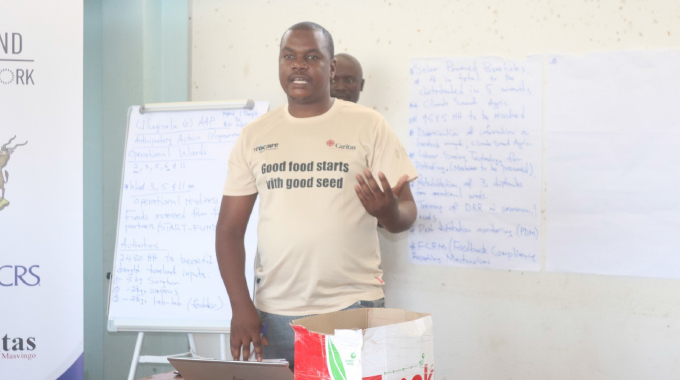
Tapson Ndou [email protected]
CARITAS Masvingo, in partnership with Catholic Relief Services (CRS) Zimbabwe, has launched a major anticipatory action programme in Beitbridge District that stakeholders say could become a significant step towards strengthening communities ahead of anticipated climate shocks, including drought associated with the El Niño phenomenon.
The Ulugisela II Anticipatory Action Project will run from September to November 2026 and is designed to move communities beyond simply responding to disasters after they occur by putting measures in place before the full impact of climate-related shocks is felt.
The initiative comes at a critical time for Beitbridge, a district that remains highly vulnerable to drought and erratic rainfall, with prolonged dry spells posing serious threats to household food security, livestock production and livelihoods.

At the heart of the intervention is an agricultural support package targeting 2 480 vulnerable households, allowing families to prepare for difficult climatic conditions rather than waiting for crop failure and food shortages to occur.
Each targeted household will receive an input voucher valued at US$30, covering 5 kilogrammes of sorghum, 2 kilogrammes of cowpeas and 2 kilogrammes of Lab-lab fodder seed.
The selection of drought-tolerant crops is particularly significant for Beitbridge, where unreliable rainfall can make conventional crop production increasingly difficult.
Speaking during the stakeholders’ inception meeting this week, Caritas Monitoring and Evaluation (MEAL) Officer Mr Esby Chirimugiri said the initiative was aimed at ensuring that implementing partners and district stakeholders have a common understanding of the project’s targets, responsibilities, monitoring systems and implementation arrangements.
“This inception is about aligning everyone so that we implement one vision and one set of targets,” said Mr Chirimugiri.
“The project is being funded by the START Network through START Funds and complements the Government of Zimbabwe’s efforts to prepare communities for predicted climate-related shocks.
“It will be implemented in Wards 2, 3, 5, 6 and 11, with operational readiness activities particularly focused in Wards 3, 5 and 11.”
Mr Chirimugiri said the programme will also promote climate-smart agriculture, livestock management and climate resilience, while encouraging communities to adopt labour-saving technologies such as potholing.
Beyond the direct agricultural assistance, the project is expected to strengthen community knowledge, allowing households to make informed decisions before and during climate-related emergencies.
In addition, a further 9 585 households are targeted to benefit from information dissemination and other resilience-building interventions.
“The initiative is also taking a broader approach to resilience by investing in community infrastructure. Four solar-powered boreholes are planned across the five operational wards, while three dip tanks will be rehabilitated,” said Mr Chirimugiri.
“In addition, the interventions are expected to contribute towards improving access to water and supporting livestock, which remain an important livelihood asset for many rural households in Beitbridge.
“The combination of agricultural inputs, water infrastructure, livestock support and climate information means the project goes beyond a conventional relief intervention. We are not just responding to a crisis.
“We are building systems that allow communities to withstand shocks and continue producing even under stress.”
It is understood that the intervention also reflects the Government’s continued efforts, together with development partners, to protect vulnerable communities from hunger and the effects of drought.
Caritas Beitbridge Field Officer Mr Alfa Mbedzi said the initiative represents an important investment in communities, particularly vulnerable households that are often the first to feel the impact of drought.
“This project is not simply about providing assistance after communities have been affected, but about strengthening their ability to prepare early and reduce the severity of future shocks,” said Mr Mbedzi.
“The approach will help households make better decisions around farming, livestock management, water use and preparedness, thereby reducing dependence on emergency assistance when disasters strike.
“The ultimate objective is to leave communities stronger and better equipped to confront future climate shocks.
“The project will also place emphasis on accountability and community participation. Community members will receive training in Disaster Risk Reduction, while post-distribution monitoring will be conducted to assess whether assistance is reaching the intended beneficiaries and producing the desired results.”