admin
admin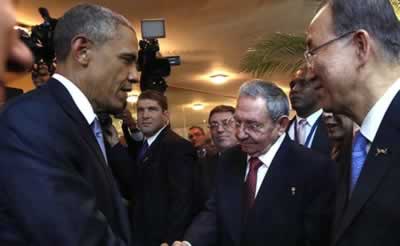
 The presidents of the US and Cuba have met in Panama City, marking a potential turning point in US relations with Cuba and the region.
Barack Obama said after his meeting on Saturday with Raul Castro that the discussions had been “candid and fruitful”, and that a strong majority of citizens in both Cuba and the US would back warmer relations.
“I think our ability to engage, to open up commerce and travel and people to people exchanges is ultimately going to be good for Cuban people,” Obama said at the Summit of the Americas in Panama City.
“My message to people is that the Cold War is over.”
Obama also said while relations would improve, that did not mean that there were not divisions between the two countries on sensitive issues such as human rights.
Castro had earlier told Obama that he was ready to discuss these issues, saying: “Everything can be on the table”.
But Castro also cautioned that the two countries have “agreed to disagree” on some concerns.
“We’re willing to discuss everything but we’ve to be patient,” he said earlier.
During a roundtable summit with other leaders of the American hemisphere earlier, Castro had praised Obama as “an honest man”.
Castro said “every US president before him is to blame” for making Cuba suffer under the US blockade.
A normalisation of relations has seemed unthinkable to both Cubans and Americans for generations.
Al Jazeera’s Latin America Editor Lucia Newman, reporting from Panama City, said Obama’s comments did not mean that there were not divisions between the two countries.
She said Obama had not gone as far as announcing Cuba’s removal from a US list of state sponsors of terrorism, as was widely expected.
Such a move would remove a major impediment in establishing diplomatic ties between Havana and Washington, she said.
Our correspondent quoted a seasoned political analyst with close contacts in both Washington and Havana as saying: “There must be something that the United States still wants that it isn’t getting, very likely related to access by US diplomats in Cuba to dissidents and other members once embassies are opened.”
She said that Obama still had to deal with the US government embargo against Cuba and another thorny issue was Guantanamo Bay, the controversial US military prison which Cuba regarded as occupied territory. — AFP


 Online Reporter