

 admin
admin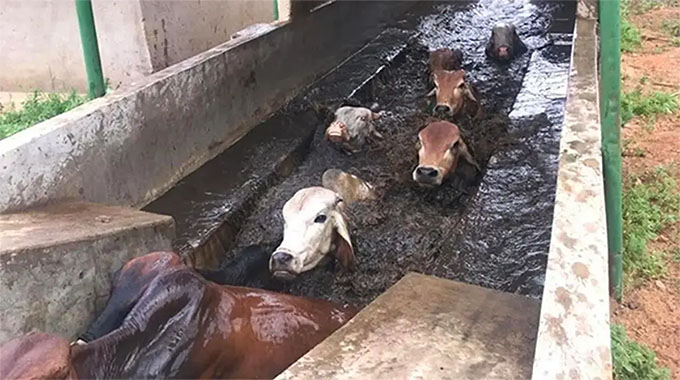
Precious Manomano
Herald Reporter
Any farmer who does not take their cattle for dipping will be arrested as Government seeks to contain tick borne diseases and so will be enforcing the Cattle Cleansing Regulations of 1993, which makes dipping of cattle mandatory, providing for prosecution of non-complaint farmers.
Recently, Government declared war on tick-borne diseases after the country lost 500 000 cattle to diseases.
Programmes such as the dip tank resuscitation programme, the Presidential blitz tick grease programme and the local manufacturing of vaccines were implemented to combat diseases.
The programme enhanced the national effort against ticks and tick-borne diseases, which culminated in a 47 percent reduction in cattle mortality attributable to January disease in 2021 from the 2020 figures, and a further 39 percent decline in overall cattle mortalities last year compared to the previous year.
Government also reviewed the Animal Health Act and its associated regulations to more effectively enforce animal movement controls for an enhanced disease control programme.
Implementation of the revised Animal Health Act and its regulations will effectively go further than just preserving the national herd but allow for its continued expansion.
Speaking at the livestock field day held at Solitude Farm in Mhondoro Ngezi, Agricultural and Rural Development Advisory Services (ARDAS) chief director Professor Obert Jiri said although Government has taken great strides in elimination of tick borne diseases, farmers must dip their cattle and failure to do so will attract arrests.
”These people should get arrested in order to complete this war. The war against January disease will not end until we start to have people arrested for not dipping cattle. We must enforce it because we lost almost 500 000 cattle because of January disease which needs to be controlled by dipping. We need discipline from farmers so that we eliminate January disease. Cattle rustling should also end. If cattle are sold in a proper channel that way we also eliminate all tick borne diseases, ”he said.
Prof Jiri said there is a need to control health issues on livestock so the beef industry would grow. Value addition was also critical for farmers who are in dairy farming.
Efforts to resuscitate the livestock sector and then see it grow to new levels continue to gather traction with the Government implementing several measures aimed at boosting production to satisfy national demand for both human consumption and industrial use.
The livestock sector contributes significantly to the inclusive growth and development of the national economy.
Under the livestock recovery and growth plan the Government was concerned with the level of performance of the livestock sector and it promulgated a blueprint to address all areas that were limiting growth.
Observed challenges were associated with animal health, sanitary and feed safety issues, availability of adequate nutrition in the way of pastures, fodder and water, and improvements in the genetic make up of the herd.
These challenges are responsible for the low off-take, low fertility, high mortality and morbidity, low carcass weight, poor quality and inability to effectively compete on the export market.
The main objectives are to improve or address challenges in the key areas of animal health, animal genetics, animal nutrition and other related parameters.
The host farmer, Mrs Theodora Murombedzi, who is into livestock production, urged other women to work hard in farming. Women empowerment was a critical component that reduced poverty.
Mrs Murombedzi is into beef, dairy, goat, and poultry; she also grows maize for her livestock and maize and beans for family consumption.
”Women should not hesitate to take up livestock production, It’s an amazing project. We started a cattle project in 2006 but today we have a herd of 93 beef cattle, 31 dairy cattle, 130 goats and 800 indigenous chickens. We started with three dairy cattle. If you have livestock, you are assured of eating clean food.
“We are doing well in dairy production and we have a huge local market. We sell eggs and we are also into hatchery. The demand on goat production is very high and sometimes we fail to meet demand. The only problems we face here is water because our area did not receive enough rainfall so our livestock do not get enough pastures especially in summer so we end up supplementing. We mix hay and salt to give to our livestock,”she said.
Speaking on the same event Mhondoro Ngezi ward 10 Councillor Mr Bezel Kazembe said people in his area are taking farming as a business adding that and there is no hunger in his area.
He urged residents to vote for President Mnangagwa in the forthcoming harmonised elections adding that people should consider the good works that are done by the Second Republic to promote development of the nation.
”Let’s be grateful for the developments that are done by the second Republic in lifting people’s lives so let’s vote for Zanu PF in the next elections because it is the only party that has people on heart.
“Here more farmers are doing very well in farming. What we need is the help from the Government to find markets for us and access the loans from banks easily so that we continue improving on farming,” he said.
Mrs Ruth Tuvare of Rutara village indicated that it is critical for farmers to continue working hand in hand with authorities to ensure that livestock is protected from tick borne diseases.
”This is a critical issue which must not be ignored because we lost thousands of cattle due to tick borne diseases. The majority of us were left with nothing hence we appreciate the Government efforts to provide us with dipping chemicals and tick grease to eradicate tick borne diseases,” she said.
Climate change has brought its own challenges to the livestock sector. There has been an increase in animal disease outbreaks, frequent droughts and floods.
These natural phenomena have continued to threaten the national herd. In the past 10 years, successive droughts have resulted in poor nutrition, especially for grazing animals, and this has led to reduced fertility, resulting in low calving rates.



 Online Reporter
 Bongani Ndlovu