daniel chigunwe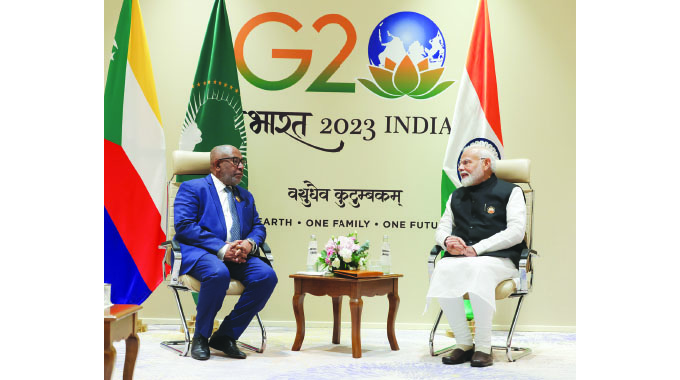
Gibson Nyikadzino
Correspondent
The admission of the African Union (AU) as the new permanent member of the G20 (soon to be G21) group of countries presents an opportunity to express with more thoughtful insights on the importance of intergovernmental unions and how Africa can exploit this opportunity to play a role in balancing key global affairs.
This admission comes at a time the world economy is recovering from Covid-19, when the world is divided over Russia’s special military operation in Ukraine and when some African countries are facing the threat of hunger due to climate change.
Africa is not spared from facing these events.
By analysing such events, key questions need to be both asked and answered.
Is the international political system on the cusp of a new balancing order?
Is the admission of Africa to the G20 not a soft balancing act to check the power of the international system’s strongest states?
How will Africa’s interests be advanced and secured in the G20?
The G20 is now one of the most represented alliances, with 101 countries and possibly after the Non-Aligned Movement (NAM) with 120 member states.
The G20 is believed to be critical in creating an atmosphere favourable to equitable global growth and development as its members cater for 85 percent of the world’s economy, 75 percent of world trade and 66 percent of the world’s population.
In this context, Africa’s weight of 55 countries is having a permanent seat at a time it intends to contribute to the global economy when some of its member states have not ratified the Africa Continental Free Trade Area (AfCFTA) agreement.
However, there is progress being made as 47 of the 54 signatories (87 percent) have deposited their instruments of AfCFTA ratification.
The world is going through turbulent times and promotion of trade at an intra-continental level is key for Africa, despite getting opportunities to be in the G20.
Sadly, as of 2022, Africa’s intra-continental trade stood at only 14 percent while trade with the European Union (EU) for example, was 36 percent.
Summarily, Africa needs an increased inward reflection on its trading elements.
There are some changes that are being presented to the G20 as a result of Africa’s membership.
The major change is that by including Africa, the G20 now has more global broad-based representation and legitimacy.
Since its formation in 1999 after the 1997-1998 global financial crisis, the G20 never sought to be an “inclusive” alliance, but with the incorporation of Africa, the interests of nearly 1,4 billion people are expected to be advanced and represented.
It should be stated that before the AU’s admission, the only African country that was in the ensemble is South Africa.
This G20 platform is also expected to give Africa a voice around global economic governance.
For the AU, it however needs to put forward certain Africa Common Positions or Consensus Positions on key issues like the just transition, climate justice, energy and global trade.
This is so because Africa on many occasions is found on the technological periphery hence finds it difficult to play catch up on the global era when competing with other nations.
It is easy to see how Africa can use new technologies to do the usual things better.
It is, however, more difficult to get from where it is today to meaningful destinations if its interests are only seen on the table but without practical implementation.
This calls for shifts in strategy for Africa to accompany the euphoria of being part of the G20 family.
To advance its interests, it is therefore up to Africa to come up with mechanisms and modalities on how it will physically participate and engage with the rest of the member countries.
It now has to be determined whether the AU chair, AU Commission chair or technical working groups will represent the continent.
As this membership is a moment of joy, it also presents complex scenario on how Africa should navigate the current environment.
Africa will either remodel its representation like what the other G20 member has done it, that is the EU.
For the EU, as super-national entity, unlike the AU, it can make decisions on behalf of its 27 member states whereas the AU can only make declarations on behalf of member states but cannot make decisions on behalf of member states.
From the AU, what is however encouraging is the position the bloc took at the just ended Africa Climate Summit in Nairobi, Kenya.
At the summit one of the key resolutions made by African countries is that there is need for a new global tax to fund climate justice. This, however, is not a common position, but it will produce elements key to establish what has to be done.
It is appropriate for Africa to now push for its interests to ensure that its voice is heard.
The hope is that the admission of Africa as the latest member of the G20 is to make interdependence among players firmer and be on a more constructive footing because with political, social and economic dependence or interdependence lies the hope for mutual respect.
It should also be noted that the inclusion of Africa is an expression to balance power, in this context, economic power considering that Africa is anticipated to be the site of development in a post-industrialist world because of its natural resources, manpower development and a high demography of an active population than other regions of the world.
Africa’s presence should therefore be interpreted, also, as power-balancing mechanism that is laying the foundations for more significant shifts of what can be expected tomorrow.
Africa can take this opportunity to bargain future agreements in various blocs that it joins through the coordination of positions and policies to obtain additional benefits for the continent and erode the dominant positions of other players to ensure equality among nations.


 Online Reporter