Dr Masimba Mavaza
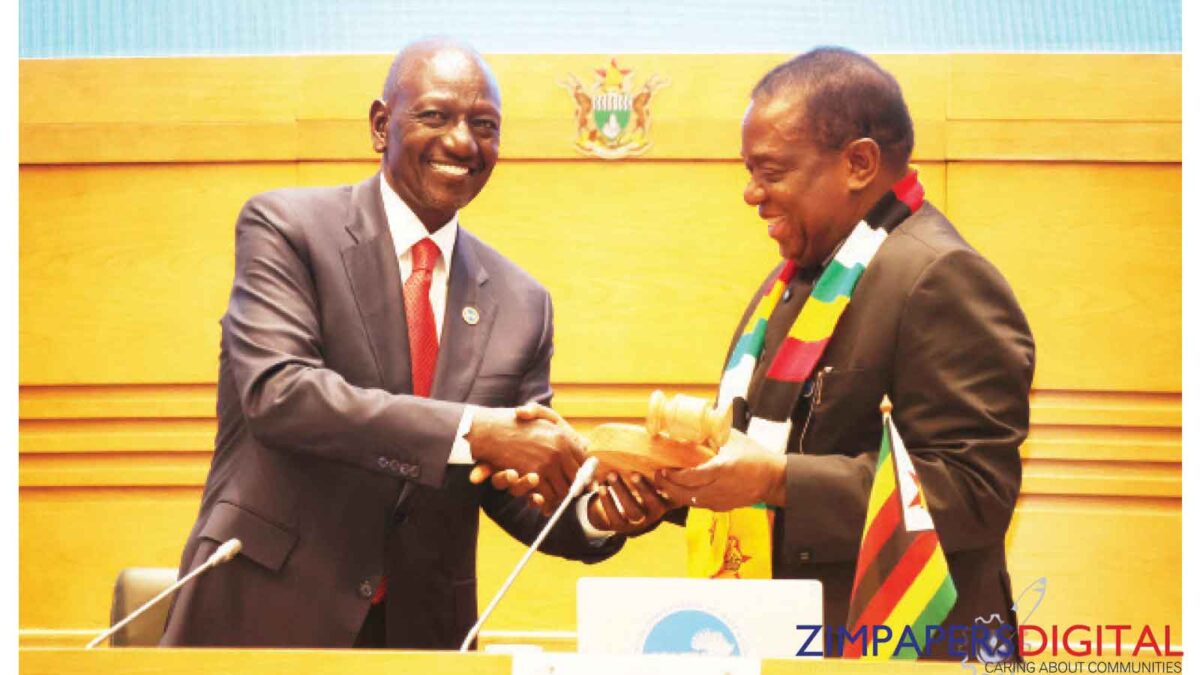
History was made, written not in ink, but with a gavel.
In the majestic New Parliament Building at Mt Hampden, Harare, under the watchful gaze of 21 sovereign flags, President William Ruto of Kenya handed over the instruments of power of the Common Market for Eastern and Southern Africa (COMESA) to His Excellency President Mnangagwa of Zimbabwe.
Zimbabwe assumes the chairmanship for 2026-2027, with Zambian President Hakainde Hichilema as Vice-Chair and Kenya as Rapporteur.
It is a crowning moment for Zimbabwe, but it is also a moment to understand the cathedral whose pulpit Zimbabwe now occupies.
The Genesis: From Ashes Of Fragmentation To A Common Dream
COMESA did not fall from the heavens. It was forged in the fire of Pan-African necessity.
Its umbilical cord is the Preferential Trade Area for Eastern and Southern Africa (PTA), established in 1981 in Lusaka, when Africa realised that political independence without economic independence was a hollow drum.
The PTA was a preferential dream, timid and limited. Africa needed a common market. Thus, on December 5, 1994, in Kampala, Uganda, the Treaty establishing COMESA was ratified, and the Preferential Trade Area metamorphosed into the Common Market for Eastern and Southern Africa.
What began with a handful of states is today a colossus of 21 Member States, stretching from the Mediterranean shores of Egypt and Tunisia to the Indian Ocean islands of Comoros and Seychelles, from the Horn of Africa to the Zambezi heartland — a market of over 640 million people and a combined GDP of over US$1 trillion. It is Africa’s largest Regional Economic Community by membership.
Its journey is one of incremental but resolute integration: the Free Trade Area in 2000, which grew intra-COMESA exports from a mere US$2 billion then to over US$14 billion in 2025; the customs union launch in 2009; and today, the march towards a full common market.
It is an institution that says to the world: “We are not 21 small markets begging for aid. We are One Market, One Future.”
How Is The Chairman Chosen? The Poetry Of Consensus
The chairmanship of COMESA is not won by campaign, by lobbying or by the highest bid. It is bestowed by brotherhood.
The supreme organ of COMESA is the Authority, comprising Heads of State and Government. It is the Authority that is responsible for the general policy and direction of the Common Market.
The process is as elegant as it is African:
1. Rotation and Hosting: By established practice and by Article 10 of the COMESA Treaty, the chairmanship is rotational and is intrinsically linked to the hosting of the Summit. The Head of State who hosts the Summit of the Authority automatically assumes the chairmanship for the ensuing year. It is not an election in the Western adversarial sense; it is a consensus endorsement by peers.
2. The Bureau System: To ensure continuity and troika wisdom, the Authority elects a Bureau of three: Chairperson, Vice-Chairperson and Rapporteur. This Bureau provides leadership between Summits. When President Ruto handed over to President Mnangagwa last Thursday, Zambia became Vice-Chair and Kenya remained as Rapporteur to preserve institutional memory.
3. Consensus, Not Contest: The decision is taken by consensus. There is no ballot box. The Authority, in its closed session, agrees that the host shall lead. It is a profound expression of African diplomacy —kubvumirana, the collective nod.
Thus, becoming Chairman is not merely about power. It is about accepting the duty to be the chief shepherd, the chief advocate, and the chief servant of 640 million Africans for 12 months.
Today: President Mnangawa’s Mandate — One Market, One Future
The handover was, therefore, not an accident. Zimbabwe applied to host the 25th Summit, and in hosting, earned the right to lead.
President Ruto, in his farewell address, captured the moment: “Mr Chairperson, you have my support, my counsel, and my full commitment.”
President Mnangagwa takes the gavel under a theme that is both poetic and programmatic: “One Market, One Future: Advancing Inclusive Industrialisation, Investment and Regional Integration in COMESA.”
His vision is razor-sharp:
That our common market must enable enterprises to produce at scale and facilitate cross-border movement of factors of production;
That we must stop exporting raw minerals and start processing and adding value at home;
That integration is only a success when it benefits the ordinary citizen.
He also launched, alongside the handover, the COMESA Medium-Term Strategic Plan 2026-2030, a blueprint aiming to raise intra-COMESA trade to 15% by 2030, to digitalise commerce and to industrialise inclusively.
For Zimbabwe, a nation that has walked through the valley of sanctions and isolation, chairing COMESA is not just an honour. It is vindication.
It is recognition that Zimbabwe is not a pariah, but a pillar. That from the ruins of Mbare Musika to the corridors of Westminster, from SADC to COMESA, Zimbabwe is back at the high table, not as a guest, but as Chairman.
Let history record: On October 22, 2026, in Harare, COMESA did not just change Chairmen. It changed gear.