admin
admin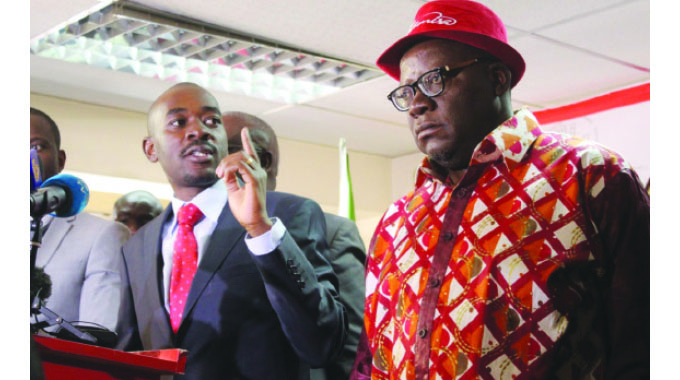
Innocent Mujeri-Correspondent
The world of Zimbabwean politics has been left in a state of perplexity. It has often been observed that those who do not learn from history are doomed to repeat it.
Perhaps nowhere is this more evident than in the case of Nelson Chamisa, who, it is alleged, may be leading the country’s opposition movement towards an alarming debacle.
A stark comparison arises when one looks back at the era of Morgan Tsvangirai, who, despite his faults, displayed fortitude and political savvy that seems to be missing in the present landscape.
Today, it is said, Tsvangirai would be turning in his grave, witnessing the unravelling of a movement he devoted his life to.
One of the elements of Chamisa’s leadership is his relegation of seasoned opposition members such as Tendai Biti and Welshman Ncube to the peripheries, in what appears to be a strategic move to consolidate his power.
This tactic, however, seems to have led to a paradoxical result. Instead of solidifying his leadership, Chamisa appears to be slowly dismantling the very core of the opposition movement.
In his bid to centralise power, Chamisa has surrounded himself with individuals possessing significantly less political experience.
While fresh blood in politics can often inject novel ideas and perspectives, an excessive lack of experience in the close circle of a party leader can lead to an inability to make well-informed, strategic decisions.
The lack of veteran opposition members in Chamisa’s inner circle raises the question of whether he is more interested in maintaining control over the party than in fostering a formidable opposition to the ruling Government.
Furthermore, this move sends a disheartening message to the Zimbabwean people – that the opposition movement may be more interested in its internal power dynamics than in advancing the rights and interests of the citizens.
This seems to create an image of a fragmented and self-serving party, undermining public confidence in the ability of the opposition to provide an effective counterpoint to the current Government.
History is littered with instances where leaders who surround themselves with sycophants and yes-men have seen their reigns end in disaster.
Without the checks and balances that experienced political figures provide, leaders can become myopic and dangerously autocratic.
Chamisa’s recent behaviour, characterised by this ill-advised centralisation of power and lack of inclusivity, points ominously towards his party’s defeat in the forthcoming elections.
An opposition party, by definition, should be inclusive, dynamic and capable of appealing to a broad range of voters.
Instead, under Chamisa, the opposition appears to be narrowing, becoming more exclusive, and as a result, less representative of the Zimbabwean populace.
The citizens of Zimbabwe yearn for an opposition that can challenge the status quo and effectively counterbalance Government.
Instead, they are witnessing a once promising movement slowly imploding, not due to external forces, but rather because of its own internal strife and power dynamics.
Indeed, the world will remember Chamisa, not as the vibrant, charismatic leader he could have been, but rather as the man who accelerated the decline of the opposition movement in Zimbabwe.
His legacy will not be one of triumph against a dominant Government, but rather of missed opportunities and misguided strategies.
This will undoubtedly be a bitter pill to swallow for those who once had high hopes for Chamisa’s leadership.
It is an unfortunate situation that the opposition in Zimbabwe finds itself in.
One cannot help, but lament the opportunity squandered, the potential wasted. Nelson Chamisa could have been the beacon of hope for those yearning for change.
Instead, his actions and decisions have cast a pall over the opposition movement, and quite possibly, paved the way for their defeat in the forthcoming elections.
People deserve better than an opposition leader who seems more interested in his own power than in the wellbeing of his constituents.
They deserve a political party that is robust, inclusive and driven by the needs of the people, not the egos of its leaders.
Unless Chamisa changes course, he will be remembered as the man who lost sight of this vision and in doing so, weakened the opposition to a point where it may struggle to recover.
The Zimbabwean people deserve more than this.
They deserve a political party that is a true reflection of their needs, their hopes, and their aspirations.
They deserve leaders who are willing to set aside personal ambition in the interest of the greater good.
Until this happens, Zimbabwe’s political landscape will remain unbalanced, and its future uncertain.
The opposition movement needs to learn from the past, restructure, and rebuild, before it is too late.
The world is watching, and history will be the judge. It is now up to the leaders of the opposition to decide what legacy they wish to leave behind.


 Online Reporter