Online Reporter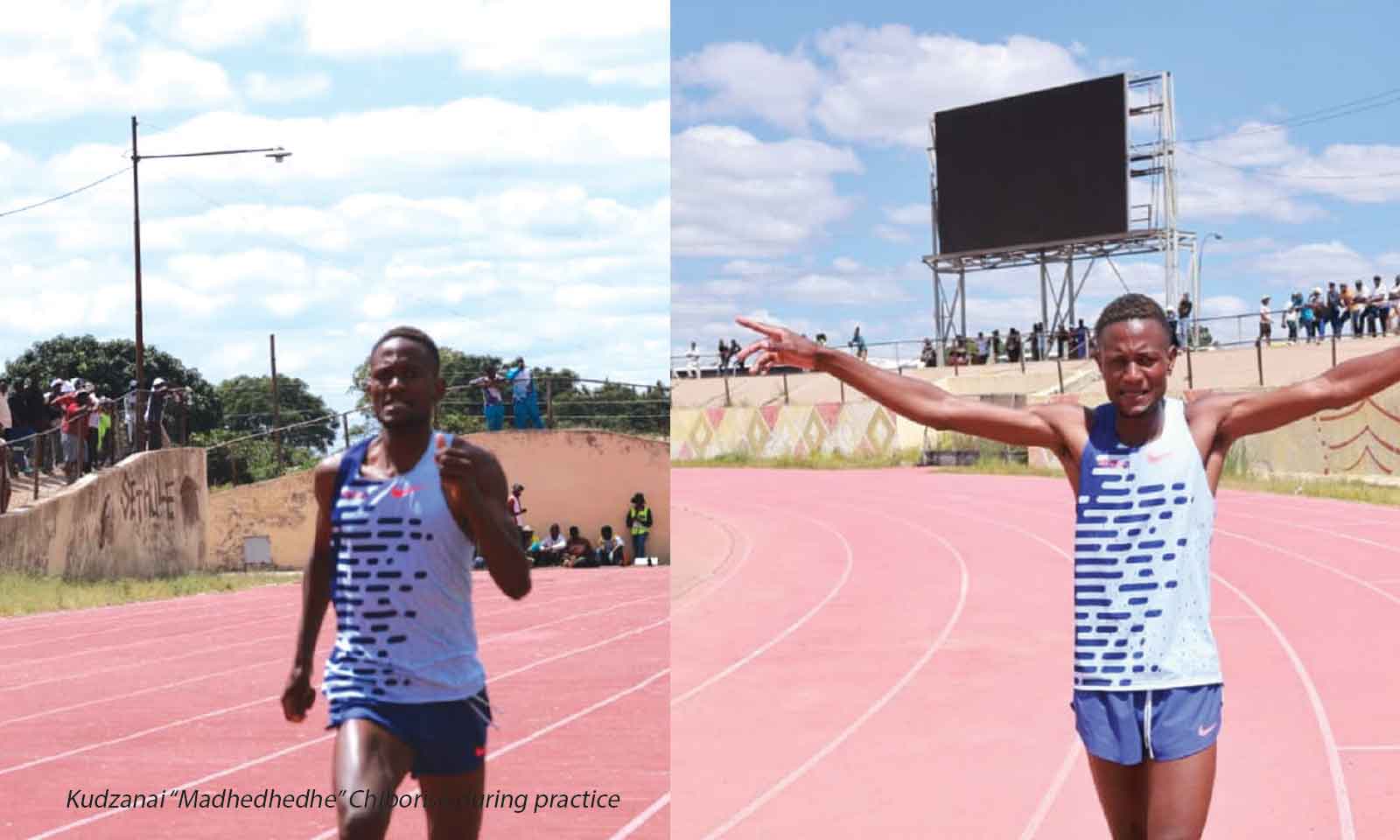
Only Moyo
Features Correspondent
GOLD is supposed to be patient. It sits buried in the earth, waiting for years of pressure, heat and human persistence before it finally reveals itself. But on the track, Kudzanai “Madhedhedhe” Chiborise has rewritten that story.
For him, gold is not about waiting; it is about speed, about chasing the wind until it yields.
At the oval, where spikes scrape against tartan and lungs burn in rhythm, Madhedhedhe is known for something almost unsettling: he runs too fast.
Fast enough to turn races into solo performances.
Fast enough to glance back mid-race and urge whoever is trailing him to push harder.
“Come on, pace up!” he shouts, not out of arrogance, but out of a strange loneliness that comes with leading too far ahead. In those moments, it is not competitors he races, but the wind itself.
A tourism and hospitality student at Harare Polytechnic, Madhedhedhe’s life oscillates between lecture rooms and training lanes.
Yet his true classroom is the track, where every stride is a lesson in endurance and precision.
Specialising in the 800m and 1 500m, he has quietly built a reputation as Zimbabwe’s fastest man over those distances, currently holding the national lead in both events.
His ambition is disarmingly simple.
“My aim is to set a new PB (personal best) to beat my previous time,” he says, with the calm certainty of someone who measures success not in others, but in seconds shaved off his own record.
His rising profile has not gone unnoticed.
He is billed to appear at regional competitions such as the Confederation of Universities and Colleges Sports Association (CUCSA) games in Botswana, and he has earned an invitation to a prestigious athletics meet in Cape Town.
These are the stages where talent meets opportunity.
For athletes like Madhedhedhe, opportunity often feels just out of reach.
Behind his speed lies a disciplined ecosystem.
He trains alongside Botswana Olympian Tshepiso Masilela and is now under the guidance of South African middle-distance legend Caster Semenya, a multiple Olympic medalist.
Under such mentorship, training is no longer just about running; it is science.
When he trains outside Zimbabwe, he describes an environment of strict camp discipline, where high-tech systems monitor performance, recovery and adherence to the training regimen.
It is a glimpse into what athletics could look like at home.
And yet, back in Zimbabwe, the contrast is stark.
“I hold too many medals now, I can’t even count them,” he says with a laugh, before his tone sharpens.
“But now I need to earn decently from my talent.”
Among his accolades are 17 Tertiary Education Sport Association of Zimbabwe medals, with hopes of adding more.
The medals shine, but they do not pay bills.
Like many athletes in the country, he finds himself caught between excellence and economic reality.
His dedication, however, is unquestionable.
Discipline is not a slogan; for him, it is a lifestyle.
“The hardest thing about being an athlete is diet,” he explains. Sadza, Zimbabwe’s staple, is now a once-a-week indulgence. He has become hyper-aware of what he consumes, avoiding foods that might compromise his performance or health.
These are the quiet sacrifices behind the spectacle of speed, the unseen battles that shape champions.
At one point, the allure of greener pastures tempted him. Offers and possibilities stretched from Turkey to the United States, part of a broader trend where African athletes change citizenship in pursuit of sponsorship, exposure, and financial security. Madhedhedhe considered it. But in the end, he chose to stay.
“If the season lapses, I would rather be local and hold the fort at home,” he reflects. It is both a patriotic stance.
Zimbabwe, notably, has yet to claim an Olympic gold medal in athletics.
For a nation rich in raw talent, this absence speaks volumes about gaps in infrastructure, funding and long-term development.
Madhedhedhe is acutely aware of this. “More should be done to market athletics locally,” he insists.
“Facilities and support, they affect everything.”
Still, he runs.
He runs not just for medals, but for meaning.
In communities where opportunities are scarce and drug abuse is an ever-present threat, athletics offers an alternative path: a discipline, a purpose, and a way forward.
For Madhedhedhe, every race is a statement that when talent is nurtured, it can outrun circumstance.
And so, while gold may traditionally belong to those who wait, Kudzanai Chiborise is proving it can belong to those who chase it, faster than anyone else dares, fast enough to leave the world behind, and fearless enough to race the wind alone.