Elliot Ziwira
At the Bookstore
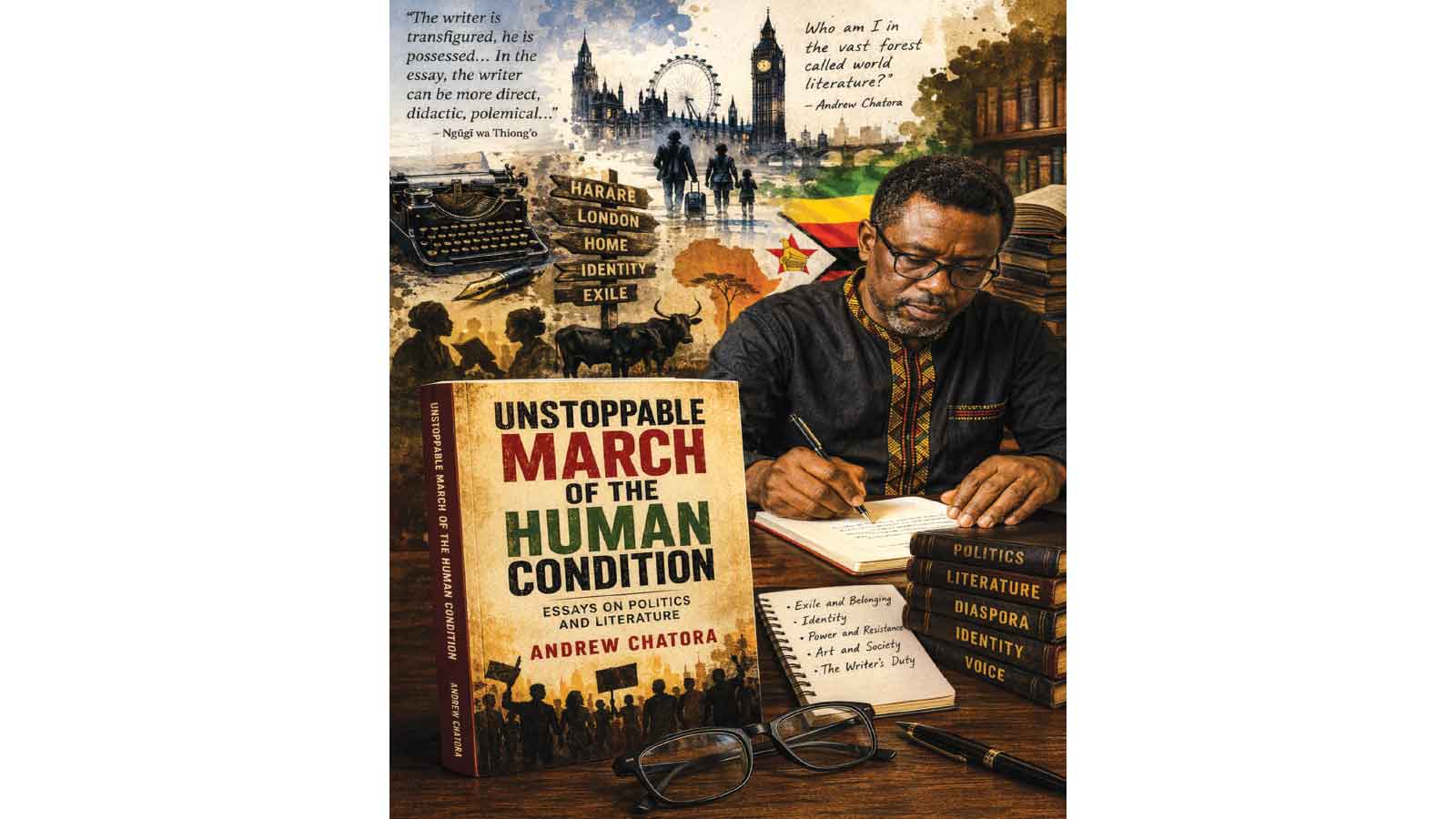
IN his latest work, Unstoppable March of the Human Condition: Essays on Politics and Literature (2026), Andrew Chatora, author of the novels Diaspora Dreams (2021), Where the Heart Is (2021) and Harare Voices and Beyond (2023), departs from his familiar terrain of fiction to present a compelling collection of non-fiction essays.
The volume brings together essays from Chatora’s parallel career as a thinker, literary and arts critic.
It also includes reviews of selected Zimbabwean writers as homage to their contributions, alongside reflections on television shows that illuminate the Black experience.
Has Chatora abandoned fiction?
One is reminded of Ngũgĩ wa Thiong’o, who, in the preface to one of his essay collections, writes: “In a novel, the writer is totally immersed in a world of imagination… At his most intense and creative, the writer is transfigured, he is possessed… In the essay, the writer can be more direct, didactic, polemical, or can merely state his beliefs and faith… to define his beliefs, attitudes and outlook in the more argumentative form of the essay.”
Chenjerai Hove echoes the same sentiment in Shebeen Tales (1994): “The essays gave me time for a further dialogue with myself.
“As a writer (of fiction), sometimes there is a temptation to engage in dialogue with the characters I create. That is at the expense of dialogue with myself… the essays were at the centre, refreshing my mind, drawing my vision from the distant (fiction) to the nearby, the immediate, which I found has more to teach us.”
Like these literary giants, Chatora uses non-fiction to reclaim his narrative, document fast-changing realities and engage directly with urgent socio-political questions.
An exponent of the African diaspora tradition, his candid, relentlessly engaging, and vulnerable novels are a polarising affair among social critics and literary enthusiasts.
His fiction on the Zimbabwean diaspora places him within a rich literary tradition. Ever since Dambudzo Marechera’s The House of Hunger (1978), there has been a sustained stream of narratives about leaving home in search of survival and fulfilment.
In Diaspora Dreams (2021), Kundai Mafirakureva follows his beautiful pregnant wife, Kay, a teacher, to England. Unlike the hardened narrator in Brian Chikwava’s Harare North (2009), Kundai arrives in the diaspora driven by love and responsibility.
Yet from the moment he lands at Heathrow Airport, a whirlwind engulfs the couple as familiar tensions emerge over money, family obligations and the burdens of home. As is often the case in diasporan fiction, African filial ties are placed on trial as social and legal systems collide.
Diaspora Dreams, as Memory Chirere notes, “is dazzlingly real as it shines its light into the intricacies and emotional souls of the immigrant community in Britain”.
One of the essays revisits this interplay between home and exile while examining the contributions of exiled African writers such as Chenjerai Hove, Ngũgĩ wa Thiong’o and Sony Labou Tansi, alongside musicians Dorothy Masuka, Hugh Masekela and Thomas Mapfumo.
In the end, Chatora confronts the enduring question: after all the struggles, how does the artist define home? Home, and what constitutes it, remains an enduring theme in African literature.
Deeply personal and politically charged, the essays chronicle Chatora’s life as a Zimbabwean writer and English teacher in Britain. They explore structural oppression, internalised racism, trauma and resilience, while pointing towards healing through literature, art and personal agency.
In one essay, Chatora revisits the storm stirred by Diaspora Dreams, asking himself: who am I in the vast forest called world literature?
As an heir to the traditions of Chinua Achebe, James Baldwin, Charles Mungoshi, Stanlake Samkange and Yvonne Vera, he wrestles with ambition, belonging and authenticity.
Chatora realises that ambition opens a writer to a line of fire. He ponders if the African writer in exile should write for home, or for Western approval.
Living in post-Brexit Britain only sharpens this dilemma, as he reflects on life as a Black writer navigating an increasingly xenophobic society.
His nostalgic recollections of the Department of English at the University of Zimbabwe provide one of the collection’s emotional high points.
During the 1990s, the department, under eminent scholars such as Rino Zhuwarara, Musaemura Zimunya, Thompson Tsodzo, Kimani Gecau and Tawana Khupe, nurtured generations of distinguished literary and media practitioners, among them Robert Muponde, Alice Kwaramba, Albert Nyathi, Ignatius Mabasa, Memory Chirere, Bevelyn Dube, Susan Makore, Dudziro Nhengu, Naome Ziyambe, Ruby Magosvongwe, Winston Mano, Nhamo Mhiripiri, and many others.
In yet another essay, Chatora reflects on the legacy of African writers before him, who confronted colonialism, post-independence disillusionment, economic decline and human rights abuses, often at great personal cost, including exile.
He asks whether the writer should remain an independent moral voice or align with the so-called “democratic forces”. But is either position sufficient?
Rather than prescribing answers, Chatora invites readers into a dialogue. Drawing on the call-and-response tradition of African oral culture, he interrogates what African writers have achieved and what remains to be done.
The collection is enriched by guest contributions from the celebrated Zimbabwean poet, essayist and critic Onai Mushava, whose observations complement Chatora’s reflections.
Throughout the volume, the central concern remains the place of the contemporary African writer.
Chatora pays tribute to literary influences, including Charles Mungoshi, Ngũgĩ wa Thiong’o, James Baldwin, Chenjerai Hove, Yvonne Vera and Ayi Kwei Armah, while exploring literature, history, politics, language, identity and exile with equal ease.
Written in an engaging anecdotal style, Unstoppable March of the Human Condition makes a significant contribution to Zimbabwean and African literary discourse. It is not constrained by rigid definitions of the essay. Instead, it offers readers unfettered access to Chatora’s literary journey, intellectual convictions and personal reflections.
It recalls Chinua Achebe’s observation in Hopes and Impediments (1989): “Experience is what we are able and are prepared to do with what happens to us.”
- For an immersive reading experience, visit the DigiHub Retail Shop at Herald House, corner George Silundika Avenue and Sam Nujoma Street in Harare.