Online Reporter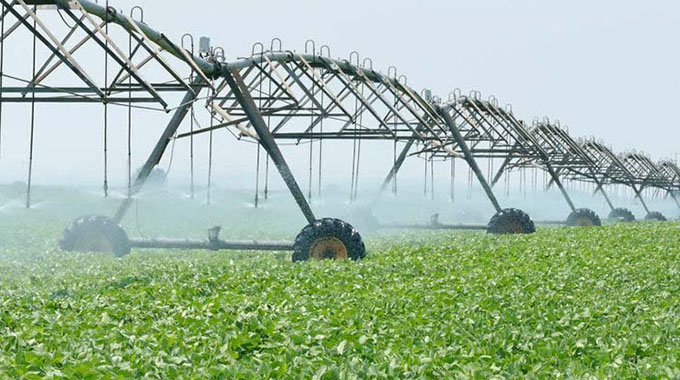
Lovemore Kadzura
Post Reporter
THE revival of the Chiduku Irrigation Scheme (formerly Romsely) into a modern, highly mechanised operation is rapidly transforming smallholder farmers into emerging commercial producers.
With reliable access to irrigation water and electricity, production and incomes are rising in this once sun-baked, drought-stricken area.
After decades of low yields caused by dilapidated infrastructure and erratic rainfall, the scheme is now partly operational thanks to rehabilitation efforts spearheaded by the Government in partnership with development agencies, who injected US$4,5 million into the project.
Water now flows to the fields through a canal drawing from the perennial Mucheke River, enabling farmers to shift from subsistence farming to market-driven commercial agriculture.
In Bloc A, farmers are growing maize, wheat, and potatoes under a joint venture with private partner Mundamurefu.
The Agricultural and Rural Development Agency (ARDA), which manages the scheme, is finalising plans to engage plot holders in other blocs to kickstart production. This initiative is set to revolutionise rural agriculture and empower communities.
The tripartite partnership—farmers, ARDA, and Mundamurefu—offers multiple benefits. ARDA brings expertise in irrigation management and sustainability, while Mundamurefu contributes commercial know-how, investment, and access to lucrative markets.
Farmers gain modern farming techniques, premium inputs, mechanisation, and opportunities to tap into export markets.
This synergy is already boosting yields, improving crop quality, and enhancing farmers’ bargaining power, translating into higher incomes and a brighter future for rural households.
Furthermore, the joint venture model allows farmers to share risks and benefits, fostering a sense of ownership and cooperation. As a result, farmers are empowered to transition from subsistence farming to commercial production, improving their livelihoods and contributing to the local economy. The collaboration also facilitates access to credit facilities, extension services, and training, enabling farmers to upgrade their skills and stay competitive.
Overall, the ARDA-Mundamurefu partnership is a game-changer for the Chiduku Irrigation Scheme, unlocking opportunities for farmers to thrive in a challenging agricultural landscape.
Chief Chiduku said the revival of the scheme is one of the biggest investments ever made in his area, and has brought about a massive change to the economic fortunes of his subjects.
He hailed President Emmerson Mnangagwa and the Second Republic for remembering the scheme, which was last functional in the 1980s, and bringing it back to life in a massive way.
“First, I would like to express my heartfelt appreciation to the Government for renaming the scheme to the appropriate name, Chiduku Irrigation Scheme. Romsely is a colonial name which does not resonate with the people here. I would like to applaud President Emmerson Mnangagwa for listening to our plea to revive this scheme, to which he responded positively. The scheme has been revitalised to levels that we had not anticipated. We never thought there would be the installation of 24 centre pivots at the scheme, and it is something that we will not take for granted.
“In my area, crops did not perform well this current season due to erratic rainfall, but in the irrigation scheme, it is a different story. The beneficiaries have had their lives changed significantly, as they have managed to produce enough to eradicate hunger through irrigation. There is a whole new lease of life here, brought about by the revival of this irrigation scheme. People who used to rely on handouts from Government and development partners are now in partnership with private companies.
“They are getting their percentage share in the form of produce, which they store for personal consumption and sell the surplus. There is also an arrangement that some plot holders are also employees of the joint venture, which becomes a double benefit for them. Everyone is happy here,” said Chief Chiduku.
Chief Chiduku added that the irrigation scheme has also enabled his subjects to diversify their crops, reducing their reliance on a single crop, created employment opportunities, both directly and indirectly, boosting the local economy.
The farmers are also gaining valuable experience and skills, which they can use to improve their own plots, leading to increased food security and income.
Chiduku Irrigation Scheme Management Committee member, Mr Whisper Makani, said the impact of the scheme is already evident, with increased production allowing households to generate surplus income, which has improved their lifestyle.
“The rehabilitation of Chiduku Irrigation Scheme is a game-changer for us. We are no longer producing just for our own consumption, but for the market. We have entered into a joint venture with a private player to partake in farming in Block A, where we have completed land clearing. We receive 10 percent dividends in the form of produce. The partner helped us with land and canal clearing, which was our contribution to the scheme’s redevelopment work. This season, we have eight hectares of potatoes and 52 hectares of maize. We are now busy preparing for the winter season, where we intend to plant wheat, beans, potatoes, and other crops. This block has 94 farmers.
“From where we started to where we are now, we can confidently say that this scheme is registering instant success. By the time all the blocks will be functional, there will be a sea of green crops and a hive of activity. We are in natural region three, which is synonymous with unreliable rainfall and successive years of droughts, and this is being addressed by the revived scheme,” he said.
ARDA chief executive officer, Mr Tinotenda Mhiko, said they aim to plant 12 000 hectares in Manicaland through various schemes, and are finalising plans to start large-scale wheat production at Chiduku Irrigation Scheme.
“We are targeting to establish 11 571ha of winter wheat in Manicaland—which is an 18 percent contribution to our national target of 65 000ha. The wheat will be established across four sets of farmers — ARDA estates, ARDA-managed irrigation scheme business units under the V30 Accelerator Model, ARDA joint ventures with A1 and A2 farmers, and ARDA clustered smallholder farmers. We will also work with the recently refurbished Chiduku Irrigation Scheme Business Unit to establish a significant hectarage,” said Mr Mhiko.
The revival of Chiduku Irrigation Scheme is being viewed as a model for rural development, demonstrating how targeted investment in irrigation can transform livelihoods and drive the transition from subsistence to commercial agriculture.