admin
admin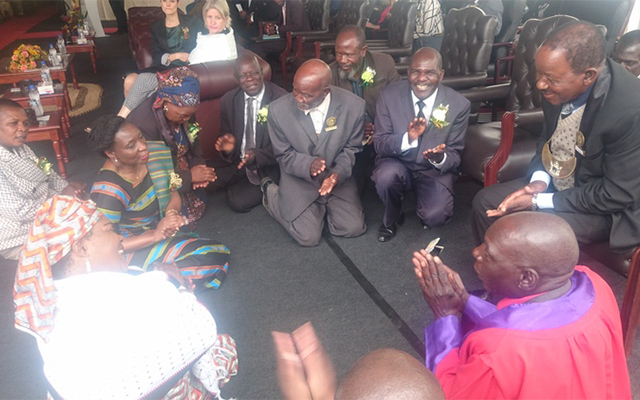
Samuel Kadungure : Senior Reporter
THERE was drama at the official opening of the Murambinda Magistrates’ Court on Monday as traditional leaders from Buhera refused to consecrate its unveiling, accusing the Judiciary Services Commission of violating their norms and values by constructing the structure without consulting them.
Chief Nyashanu was angry and penalised JSC three beasts and a goat for by-passing him and constructing the structure without the requisite traditional rituals, a feat he said chagrined his ancestors.
The JSC acceded to Chief Nyashanu demands and paid $1 000, which is equivalent to the penalty imposed on it.
JSC secretary, Justice Rita Makarau, Minister of State for Provincial Affairs, Cde Mandi Chimene, National Prosecuting Authority board member, Mr Misheck Mugadza, Buhera Central legislator, Cde Oliver Mandipaka, Chief Magistrate, Mr Mishrod Givamombe and acting JSC deputy secretary, Mr Munamato Mutevedzi were involved in resolving the impasse.
Chief Nyashanu said the construction of the courthouse, in-between Buhera Rural District Council and ZRP Murambinda, in Headman Murambinda’s area, left him feeling insulted as he was made a stranger in his land.
Chief Nyashanu said their tradition dictates that all developments should be dedicated to their ancestors, through the symbolic inserting of a peg (hoko) on the proposed site.
Chief Nyashanu insisted that though the development was welcomed, it should not have commenced at the expense of the requisite traditional protocols.
“They were supposed to inform the traditional leader, who is the custodian of the land on which they wanted to build first to allow for the performance of necessary traditional rituals. You cannot embark on such massive development ignoring the traditional requirements that comes with the dedication of the development to the ancestors. Our ancestors were insulted by such wilful violation of our standing tradition, and I penalised them three beasts and a goat. They opted to pay cash after we agreed on the price of $300 per beast,” said Chief Nyashanu.
JSC secretary, Justice Rita Makarau, called for respect of traditions and called for the review of the law to allow the use of indigenous languages.
She said the dress code of judges and the general court environment was intimidating.
“Some people end up losing cases, not due to lack of merit, but because the court environment is so intimidating. There are certain things that should be corrected like allowing the use of indigenous languages. When I am dressed in my court regalia, you could hardly recognise me, I become so scaring and that issue of the dressing code also needs to be looked at because at times the attire alone instils fear in people,” said Justice Makarau.
Murambinda Magistrates’ Court is one of the 22 new courts constructed across the country with funding under the $15 million JSC-Danida partnership.
An exciting component of all the new courts constructed with the Danish support is the inclusion of a legal aid office from which legal aid providers will render assistance to the indigent through the Legal Aid Help Desks.
The help desk initiative has been motivated by the need to address the unfairness and injustices that may occur when a party to proceedings in a court does not have legal assistance, be it in the form of papers drafted by a lawyer, legal advice or even legal representation.
The Legal Resources Foundation will work together with Justice for Children, WLSA, ZLHR and ZWLA on the help desks following the signing of the Memorandum of Understanding with JSC on Monday.
Justice Makarau said JSC was striving to build a stronger justice delivery system and provide quality justice and the public should take advantage of the help desks to understand the court process.
“Make use of the desks to be informed. The abuse of children should stop.
“Give children an opportunity to pursue education. Teachers are regarded as fountain of knowledge in communities; they should know how the court works so that they can inform communities.
“The JSC and the education sector should join hands ministry of so that school children can compete in quiz competitions,” said Justice Makarau.
Mrs Deborah Baron of LRF said where one party was represented and the other was not creates an uneven playing field.
“The self-actor has to overcome those hurdles without the assistance of the court.
“Often the self-actor is unable to go over the hurdles and gives up on a claim or does not succeed in their case, not because their case is without merit, but simply because they have not adhered to procedure.
“The court as the umpire watches helplessly because its hands are tied and it cannot proffer legal advice or assistance to the self-actor.
“The assistance is aimed at making access to justice a reality for the marginalised and vulnerable who cannot afford lawyers in private practice and yet
the courts expect them to file papers which meet the standards as laid out in the rules of court and in various pieces of legislation.
“The assistance that will be rendered to self-actors will mainly be completing court papers, legal advice, referrals and then, where necessary, legal representation.
“These services will be provided by qualified legal practitioners and law students with the assistance of paralegals.
“The help desks will provide services at the courts without court users having to walk or incur transport costs to get to legal aid providers’ offices,” she said.
Cde Chimene said the court was established at a time the rate of crime had escalated in Buhera.
“Some of the crimes are gruesome and sophisticated. Buhera has frightening rape and murder incidences.
“This should go a long way curbing rampant cases of child abuse. The court is proximity to the people, thereby according victims an opportunity to testify in a friendly environment, without travelling hassles and when their memory is still fresh,” said Cde Chimene.
Members of National Assembly from Buhera District, lawyers, senior civil servants, officials from the Danish Embassy, civic organisations and the general public attended the function.


 Online Reporter