Mthokozisi Ncube, [email protected]
CHIEF Justice Elizabeth Gwaunza yesterday toured key Judicial Service Commission (JSC) infrastructure projects in Bulawayo and Matabeleland South as the commission steps up efforts to improve access to justice through the expansion of court facilities and modernisation of judicial infrastructure.
The visit comes ahead of the National Magistrates’ Conference, which begins today in Bulawayo. The annual gathering will bring together magistrates from across the country for training and discussions on matters affecting the administration of justice.
JSC secretary Dr Walter Chikwana said the Chief Justice’s visit formed part of a broader nationwide assessment of projects being undertaken by the commission following her assumption of office.
“The Chief Justice is here and we have various activities taking place in the southern region of the country. Starting tomorrow (today) and Saturday we have the National Magistrates’ Conference where all magistrates in Zimbabwe will gather for annual training conducted by judges from the High Court and the Supreme Court on various issues of law. The magistrates will also hold meetings to discuss matters of common interest relating to their work,” he said.
Dr Chikwana said the commission had taken advantage of the Chief Justice’s presence in the region to review progress on several major infrastructure projects aimed at strengthening the justice delivery system.
“We’ve been to Gwanda where we are building a multi-purpose court complex that will house the High Court, the Magistrates’ Court and the Sheriff’s office. Here at the Bulawayo High Court we’re undertaking office expansion and creating a gym for judges as part of their wellness programme,” he said.
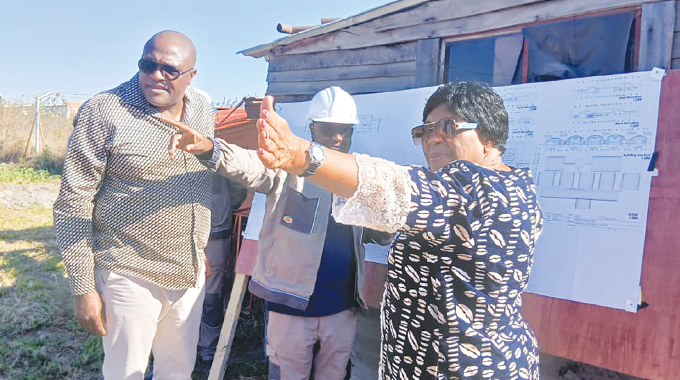
The delegation also toured the Cowdray Park Magistrates’ Court construction site in Bulawayo, which is expected to bring judicial services closer to one of the city’s fastest-growing suburbs.
Dr Chikwana said the developments were part of a national drive to enhance access to justice and were not confined to the southern region.
“This is based on our trajectory of enhancing access to justice throughout the country. It’s not restricted to the southern region. Across Zimbabwe we’ve various programmes aimed at improving access to justice for people living in different provinces,” said Dr Chikwana.
Speaking during the tour, Chief Justice Gwaunza said the commission was also working to expand the Sheriff’s office in
Bulawayo in recognition of the critical role it plays in the administration of justice.
“The Sheriff’s office acquired bigger premises and we are working on making the offices larger so that all the requirements of the Sheriff and staff are met. It’s still work in progress but it’s something we are looking forward to completing.”
She said the effective enforcement of court orders and judgments remained an essential component of the justice system.
“If you go to court and obtain judgment in your favour but the judgment is not enforced, then justice has not been fully achieved. The Sheriff’s office is very important in that process,” she said.
Chief Justice Gwaunza also expressed satisfaction with the developments taking place at the Bulawayo High Court, describing the project as a significant investment in the country’s judicial infrastructure.
“It’s a big institution and we are proud of it. We’re proud of the architecture, the new ideas and innovative construction methods being incorporated into this building,” she said.
A key focus of the visit was the construction of the Cowdray Park Magistrates’ Court, which is expected to ease the burden on residents who currently travel long distances to access court services.
Chief Justice Gwaunza said the construction of courts closer to communities was central to the commission’s mandate.
“The purpose of the Judicial Service Commission is to make the law more accessible to the public. Building courts closer to where people live helps us achieve that objective,” said Chief Justice Gwaunza.
She noted that many people still face challenges in accessing judicial services because of distance, a situation the commission is working to address through continued infrastructure development.
“We want people with legal issues, whether civil or criminal, to access the courts easily. That is our main goal,” said Chief Justice Gwaunza.
The Chief Justice also highlighted the strategic importance of the new Gwanda Court Complex, saying it would strengthen judicial services in Matabeleland South while reducing pressure on courts in Bulawayo.
“When the Gwanda court becomes operational, there will be no need to bring many serious cases to Bulawayo because the complex will accommodate both magistrates and High Court judges,” she said.
Once completed, the multi-purpose complex will house the High Court, Magistrates’ Court and Sheriff’s office under one roof, significantly improving the administration of justice in the province.
The projects form part of the JSC’s broader effort to strengthen judicial infrastructure, decentralise court services and ensure that more Zimbabweans can access justice efficiently and without travelling long distances.