

 Online Reporter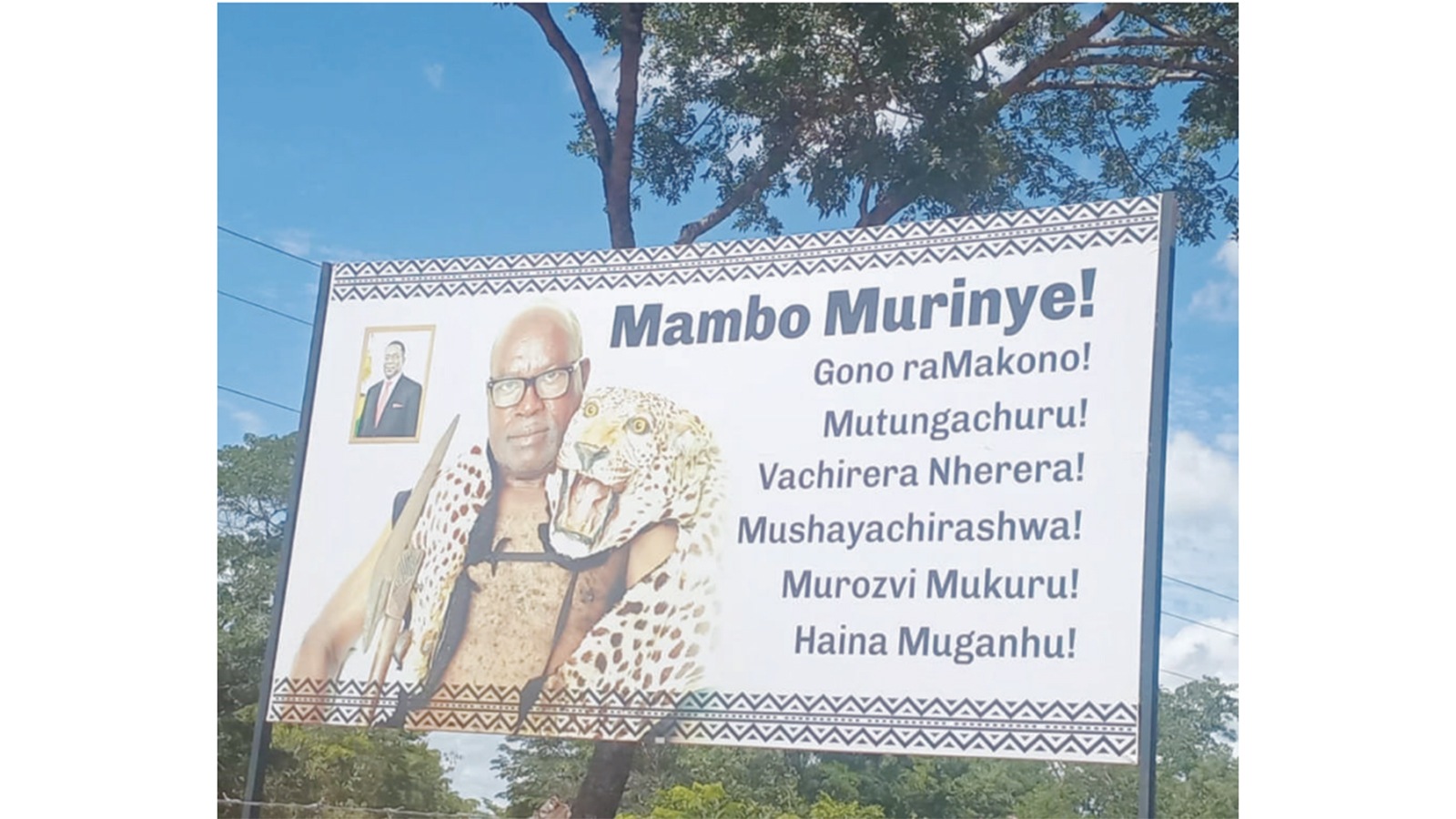
George Maponga
Masvingo Bureau
ONE morning, some 14 years ago, the country woke up to lurid news that, in an unprecedented move, a traditional chief and his main officiant in Masvingo had summoned Zimbabwe’s biggest cellular services operator, Econet Wireless, to a traditional court demanding 2 000 white cattle as payment for desecrating graves of long gone ancestors.
Econet was accused of defiling graves of Duma clan chiefs while erecting a base station on Sviba Hill near the Great Zimbabwe National Monument.
What further stunned the nation was that the two complainants were demanding 2 000 white cattle from Econet for the alleged crime of desecrating graves on Sviba Hill.
Econet pushed back on the charges and refused to accede to the demands.
The company wrapped itself with a legal veil, seeking protection from two prominent Masvingo traditional leaders who sought to use the weft and warp of tradition to punish the mobile phone network operator for allegedly violating graves on Sviba Hill, a stone throw from the historic Great Zimbabwe National Monument.
Leading the charge against Econet in the graves’ desecration was Chief Murinye, born Mr Ephias Munodawafa, and his co-plaintiff was fellow Duma clan traditional leader Chief Mugabe, Mr Matubede Mudavanhu.
The then Chief Shumba —Mr Mugaviri Chikava — who was also a Duma clan chief had been chosen as a neutral arbiter to preside over the case against Econet at his Chamakondo Traditional Court near Muchakata Business Centre in Masvingo Central district.
The case took the nation by storm owing to the scale of damages sought by Chiefs Murinye and Mugabe, notwithstanding that Econet Wireless never agreed to pay compensation for the alleged damages as the firm argued, among other reasons, that white cattle were not indigenous to Zimbabwe hence it was impossible to get 2 000 white cattle demanded by the two chiefs.
Econet has not delivered the 2 000 white cattle up to this day, however, its base station was erected.
It still stands today atop Sviba Hill in apparent defiance of the two Duma clan chiefs who fiercely opposed its erection in the vicinity of the precincts housing sacred remains of their ancestors.
A few years later after the Econet case had fizzled, Chief Murinye’s name was to crop up again after his subjects accused him of banning them from gathering wild loquats (mazhanje) for sale. Villagers took aim at their chief for blocking them from making money from what they deemed to be a God-given resource.
Wild loquats are found in abundance in Murinye communal lands, a vast area of plains, rivers and interlocking hills, that borders Chikwanda and Zimuto communal lands to the north, Mugabe and Shumba to the West, Nyakunhuwa to the east and Nyajena to the south.
Not long after the tension over wild loquats had subsided, Chief Murinye’s name was again back in the limelight.
This time he was at loggerheads with Zimbabwe’s sole sugar miller Tongaat Huletts Zimbabwe, a company that owns the country’s two sugar mills in Triangle and Chiredzi and also owns cane fields straddling over 20 000hectares across the Lowveld.
Chief Murinye demanded that Tongaat plough something back to the Murinye community arguing that Lake Mutirikwi, which contributes the bulk of the water used for irrigating cane fields in the Lowveld, was domiciled in his area of jurisdiction.
Lake Mutirikwi is located along the border of Murinye and Chikwanda communal lands and Chief Murinye was adamant that Tongaat should give something back to his community for profiting from water from Zimbabwe’s largest inland dam that was commissioned in 1960.
In June 2023, a video of Chief Murinye went viral after he was recorded while being attacked by a mob of villagers in Boroma area under his jurisdiction who had been angered by his attempt to block burial of a dead relative at an area which the chief said was sacred.
The chief sustained body bruises and a swollen eye as a result of the attack that was roundly condemned by the Zimbabwe chiefs’ council.
The chief ’s four assailants were arrested and arraigned before the courts and subsequently jailed after being convicted of assault.
Fast forward to Chief Murinye’s latest move to use his vehicle to block a road leading to Riverton Academy Murinye on 11 January 2026.
His blockade of the road stopped parents and scores of students from proceeding to the newly opened high school that is owned by prominent businessman and educationist, Mr Philemon Mutangiri, who was born and raised in Machingura village in Murinye where the school is located on his parents’ homestead.
After blocking the road, the chief traded barbs with Mr Mutangiri as he vowed to continue the blockade on alleged grounds that he was not consulted on the school’s construction.
He also said the new school should not open as it was not properly registered.
The impasse was only eventually broken after the intervention of the Minister of State for Masvingo Provincial Affairs and Devolution Ezra Chadzamira, allowing the school to open.
While Riverton Academy Murinye has been allowed to open against Chief Murinye’s wishes, he has vowed to continue fighting to the bitter end.
Chief Murinye seems to be a man followed by controversy or rather it is the controversy that follows him?
In the aftermath of all these controversies that have placed his name in infamy, he remains an unapologetic man and vowed to continue fighting for what he believes is right even at the cost of aspersions being cast on him by the public.
“I will continue to stand up for what I believe to be right, I will continue to fight for justice, I am guided by principles, and I have no apologies. People can say what they want about me, but I am a principled man, and I stand for principle.”
The traditional leader argued that he was being unfairly framed as a controversial character by the public yet everything he did was guided by logic and the need for greater societal good.
“I can’t say all the controversy that follows me is because of my being a lawyer, I stand up for what is right and just, I am royalty and royal blood runs in me, so it is normal to do what I do.
My qualification as a lawyer did not implant anything in me but it just enhanced what was already in me, I have royal blood and I fight for principle, I fight for my people.’’ Chief Murinye has no regrets over his actions, saying he was simply being misunderstood.
“My decision to ban the gathering of wild loquats in Murinye for sale was justified.
I am a chief, and I am in charge of the land and everything on it, including wild animals like baboons, monkeys and other small creatures that are part of the natural ecosystem.
“If I allow people in my area to gather all the wild fruits for sale in towns and cities, how will the monkeys and baboons survive?
“I should make sure there is harmony between my people and nature, I don’t want hungry baboons to invade homes looking for food because people have gathered all the wild fruits for sale in towns and cities so that they make money.’’
On his decision to stop the burial of a deceased villager on sacred land in Boroma that resulted in his assault by an angry mob, Chief Murinye charged that he was duty-bound to respect theculture and tradition of his area.
“I could not be seen to be sanctioning the burial of a dead person in a sacred place (Ndambakurimwa) where it is illegal to conduct burials according to our culture and tradition.
“In fact, those people who wanted to bury their relatives on that sacred ground are squatters; they are illegal settlers that is why I stopped them and what will happen to the graves when they are finally evicted from that area.
What will certainly happen? “According to my culture and tradition, it is not permissible to bury someone in a sacred place (Ndambakurimwa), and as long as I am chief, I will never countenance that,’’ charged Chief Murinye.
He also feels that he was justified to demand that Tongaat give back to the Murinye community for the money the company has been making for decades using water from Lake Mutirikwi.
My forefathers used to stay in what today makes the Mutirikwi basin before construction of this dam (Lake Mutirikwi).
My forefathers were displaced to pave way for this dam in 1958 and in actual fact my predecessor (the late Chief Mudarikwa Murinye) was flown in a plane by the colonial government who were showing him the vast land the Murinye clan people had been displaced from to pave way for Mutirikwi Dam so what is wrong if I ask Tongaat to also help my people who lost their ancestral land to a dam project and especially now that most of my people are now staying in mountainous areas that are barely arable?” asked Chief Murinye.
The chief says he still wants Econet Wireless to compensate him for desecrating the sacred Sviba Hill where his great great ancestors are interred.
“I still want Econet Wireless to pay compensation for their base station on Sviba Hill whose construction defiled a sacred Duma shrine.
As I am speaking to you right now, the skull of my great ancestor (Chief) Vurayayi (Murinye), the fourth Chief Murinye, was exposed because of the base station and I want Econet to pay compensation for that, I will not hold back on my demand for compensation.’’
Chief Murinye also disclosed that he was prepared to help the nation by revealing the graves of Kings Chirisamhuru and Mutapa that are hidden around the Great Zimbabwe monument area.
The two,Mutapa and Chirisamhuru, were prominent Rozvi chiefs who ruled at the peak of the Great Zimbabwe Empire around the 11th and 15th century whose capital was the modern-day Great Zimbabwe monument.
According to him, he feels there is also nothing wrong with him asking Mr Mutangiri to assist him after the prominent educationist built a state-of-the-art school in his area of jurisdiction.
“It is unfortunate that he (Mr Mutangiri) is running around soiling my name and image over something that we can easily discuss.
I remain open to him coming to me so that we discuss our differences and close ranks.’’ “He (Mr Mutangiri) built his school on land that is under my control.
He will make lots of money judging on the fees that he is charging per child, what is wrong with attending to my request for my children to attend school for free especially considering how much he will generate from the school for many decades to come,’’ he said.
No matter how one looks at it, Chief Murinye seems to be followed by controversy wherever he goes, whatever he does and whenever it happens.
Chief Murinye(58) will also always be remembered for making history when in 2017 he became the first traditional leader to obtain a Bachelor of Laws degree with the University of Zimbabwe.
In January 2018, he officially registered with the Law Society of Zimbabwe as a legal practitioner and took an oath before the now sacked High Court judge Justice Edith Mushore in January 2018.



