Online Reporter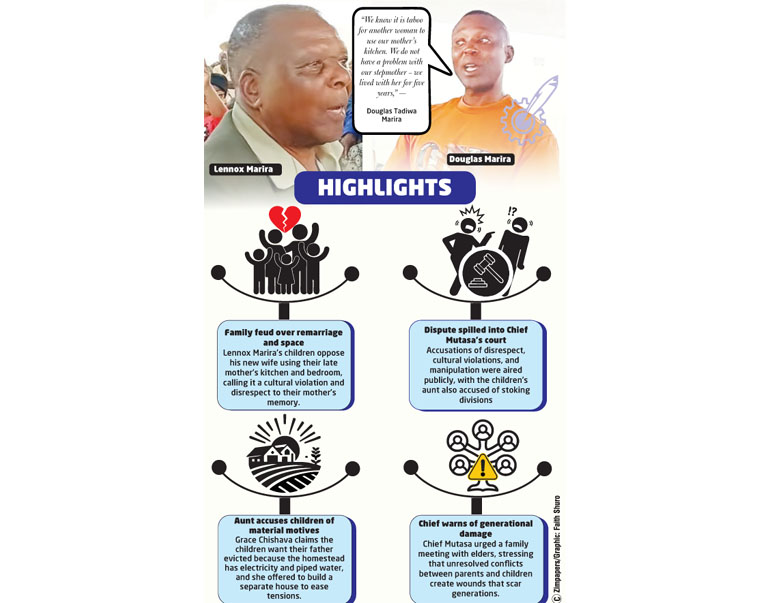
Tendai Gukutikwa
Weekender Reporter
A FAMILY in Mutasa has been left deeply divided after children from a late woman’s family allegedly turned against their father for remarrying and moving his new wife into their mother’s homestead.
The bitter feud recently spilled into Chief Mutasa’s community court recently, where accusations of disrespect, cultural violations, and manipulation were aired in public.
At the centre of the dispute is Lennox Marira, who remarried five years after the death of his first wife.
His decision to have his new wife occupy part of the homestead once used by the late woman has sparked fierce resistance from some of his children.
One son, Douglas Tadiwa Marira, told the court that tensions escalated when their father insisted the new wife use their late mother’s kitchen and bedroom — a move the children view as a violation of tradition and a dishonour to their mother’s memory.
Douglas Marira told the court: “The problem is that our father married a second wife after our mother’s death, and now he wants her to stay at our mother’s homestead, using her kitchen and bedroom.”
He stressed that the family was not rejecting their stepmother, but objected to what they saw as a violation of cultural beliefs tied to their late mother’s home.
“We know it is taboo for another woman to use our mother’s kitchen. We do not have a problem with our stepmother — we lived with her for five years,” Douglas added, claiming the situation had been worsened by their paternal aunt, whom he accused of stoking divisions within the family.
“The problem is our father’s sister, our aunt, who has become a source of conflict between our stepmother and us. It feels as if she is making us fight,” he said.
Family members present at the hearing confirmed that the dispute has escalated into open hostility, with accusations that the children now want their father evicted from the homestead altogether.
But the aunt, Grace Chishava, dismissed the allegations against her.
Instead, she accused the children of disrespecting both their father and stepmother.
“When my brother’s first wife died, we asked her family to provide him with another wife, but they refused. He later found someone else, married her, and now has two children with her. His children from the late wife do not want her at their homestead,” Chishava told the court.
Chishava told the court she had offered to build a separate house for her brother and his new wife within the same yard to ease tensions, but claimed the proposal was rejected.
“I am not a donor, as they assume. I only want to build this house for my brother and his wife because his children have been abusive towards him,” she said, adding that she felt indebted to her brother for shaping her future and could not stand by while he was humiliated by his own children.
“I love my brother, and I will not let them disrespect him. It was because of him that I became a teacher. He paid my fees at the teachers’ college when we were still young. I owe him the good life I have lived, so I cannot stand by and watch them abuse him,” declared Chishava.
She also expressed concern for the safety of the Marira family’s heirlooms and traditional artefacts.
“Our late father’s knobkerries and family heirlooms will be left exposed if they chase him away. That is why I want the new house built — so that our heritage remains safe,” she explained.
Chishava described the children’s behaviour as violent and disrespectful, accusing them of unfairly turning against their stepmother.
“These children are violent and very disrespectful towards her. They want to boot her out, yet it is not for them to dismiss her, but for her husband, their father,” she said.
She further alleged that the children were motivated by material interests tied to the homestead.
“They want to chase my brother Lennox away because the homestead has electricity and piped water,” she claimed.
Chief Mutasa voiced concern over the rising number of inheritance and remarriage disputes tearing families apart after the death of a spouse, particularly where cultural traditions and property rights collide.
He urged the Marira family to put aside anger and seek common ground before the conflict causes permanent divisions.
The chief emphasised the importance of convening a proper family meeting involving elders from both sides to chart a lasting solution.
“There is need for a family meeting so that they can help solve the problems within the family,” Chief Mutasa said, warning that unresolved conflicts between children and parents often leave wounds that scar generations.
He further cautioned the children against allowing resentment to destroy family unity.
“As the children, you need to find solutions while your father is still alive, because once he dies, there will be problems,” he said, urging dialogue, mutual respect, and cultural sensitivity as the path forward.