admin
admin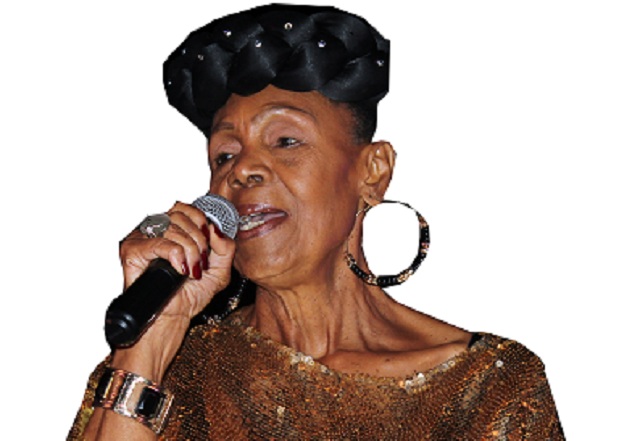
Bruce Ndlovu
It is rare for one to get an audience with a legend on the African music and film scene and on one of those days when one does get the opportunity it is even harder to convince them to open up about their views on the past and the present.
Last week, legendary South African actress and jazz musician Abigail Kubeka (ABOVE) was in town and unlike a guarded old soul that one would expect to find in a usual run of the mill star jazz legend, she is a bundle of calm energy and a fountain of readily available wisdom.
For the uninitiated, Kubeka is a stalwart of the Sophiatown jazz era, a golden music epoch that gave birth to such legends as Hugh Masekela, Caiphus Semenya, Miriam Makeba and Dorothy Masuka.
On the screen she made appearances in the 1995 movie Cry The Beloved Country and more recently soapies Rhythm City and Generations.
I met Kubeka at the Joshua Mqabuko Nkomo International Airport and upon taking a seat in the car that was to transport her to her residence in Zimbabwe for the next couple of days, she immediately launches into her unknown history with the country. She proceeds to narrate a colourful tale of some of the countrya��s colonial era bars and nightspots.
a�?A lot of people dona��t know this but this is not my first time in Zimbabwe because I came here ages ago. Back when Harare was still called Salisbury, I worked at a place called Golden Mine and later on at Elephant Hills Hotel.
a�?We did a tour of Rhodesia and one of our favourite joints to perform at was Mapitikoti Bar which was managed by a guy called Job Kadenge. We called it Mapitikoti because as early as 6pm you would find women milling around the place,a�? she said.
Gazing outside the window at the City of Kingsa�� bustling but well manicured streets Kubeka takes a detour from the past and plants herself in the present, as she points out the difference between Bulawayo and a�?dirtya�? Johannesburg.
While someone in Bulawayo might take the citya��s cleanliness for granted, she says the people in the city have it good.
a�?I still live in Soweto and it is relatively clean there. But as you move into the Jozi CBD it gets gradually dirtier.
There is not a lot of dirt here and only a few beggars sleeping on the streets and it is really marvellous to see,a�? she observes.
On encountering the towering statue of Joshua Nkomo, she suddenly turns political as she believes that Mandelaa��s own statue in Sandton in South Africa is evidence of misplaced priorities.
a�?Why couldna��t they keep his (Mandela) statue in Soweto where his house is? They had to take it away from the people who mattered to him and take it all the way to the rich people in Sandton. White people want everything good,a�? she says.
While she was a bombshell back in her day Kubeka is no longer a young thing that television audiences can lust over.
This is, however, a problem for her and other ageing actors who find themselves restricted in their choice of roles.
a�?Roles are getting fewer as the years go by. I dona��t have the luxury to choose television roles because the choices are already thin. I wish there was more diversity in the roles older actresses get but as it is I am always cast as someonea��s mother,a�? she says.
Kubeka adds that although older actresses are largely ignored, their knowledge is worth its weight in gold. While younger actresses might have formal training, it rarely equates to actual stage and screen experience.
a�?They go to school to learn how to act but things are different when you get on that stage. For me my acting and music act are like a hand and glove because one complemented the other and I learnt equally from both disciplines,a�? she says.
Although Kubeka has her gripes about the entertainment scene she is not a bitter has-been who is only angry because her best days are behind her.
Still as streetwise as she was in her younger days, Kubeka refers to her colleague Masuka as a�? ntwanasa�? as she points out that she is not averse to young people tweaking her classic jazz tunes for their own new compositions.
a�?I would love them to take our old music and put their own twist to it. Music is a calling and you cana��t look down on anyone practising their craft whether one is a jazz musician or house musician. At the end of the day as long as they credit me, it is more money in everyonea��s pocket,a�? she said.



 Online Reporter