admin
admin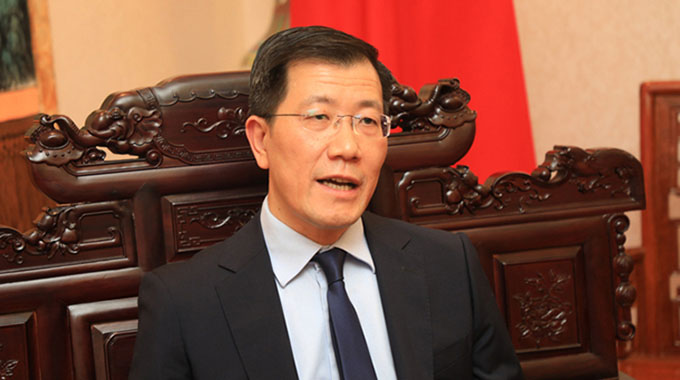
Fungi Kwaramba Political Editor
Zimbabwe’s all weather friend China has supported this country more than any other in the fight against Covid-19. Our Political Editor Fungi Kwaramba (FK) spoke with His Excellency Chinese Ambassador to Zimbabwe Guo Shaochun (GS) who shared his views about the two countries’ relationship. The interview below is a continuation from yesterday.
****
FK: It seems as though there is sustained pressure to attack the image of China. There was a recent report by the US which claimed that China was involved in human trafficking here in Zimbabwe?
GS: It is very sad that just as human beings need solidarity more than ever before, some choose to launch a smear campaign against China. This myopic, irresponsible move hurts China, hurts those engaged in it, and creates more ructions in a world already rocked hard by a global pandemic. What it endangers is the well-being of each and every one of us.
It is completely dishonest to accuse China of human trafficking in Zimbabwe or anywhere else for that matter. This is a false claim, designed only to taint China’s image and sabotage the good relations between China and Zimbabwe. Such an ill-advised attempt to sow discord between China and Zimbabwe is doomed to fail. In fact, the human rights record of the US itself is under critical international scrutiny. I think it would better serve the interests of the American people that their government focus more on fighting Covid-19 and truly protect the human rights of its citizens of all colours, races, ethnicities, and genders.
FK: What is your impression about the Second Republic, under President Mnangagwa in fighting corruption?
GS: Corruption is a stumbling block to economic development. The Zimbabwean government, under President Mnangagwa’s leadership, has shown a clear commitment to political and economic reforms. I have noticed that President Mnangagwa has repeatedly stressed uprooting corruption is a key mission of the Second Republic.
Corruption is not a condition unique to Zimbabwe; it is a universal, stubborn threat to governments around the world. No country can declare itself completely immune to corruption. We must all stand in vigilance. China is also fighting corruption with full strength. Our efforts have been very successful. We are ready to exchange experience and good practices with Zimbabwe.
FK: Our re-engagement initiative, how has the Second Republic improved on the ease of doing business and how has this encouraged investors from China?
GS: We are glad to see that Zimbabwe is making steady progress on improving the business environment. In the past three years, the ease of doing business ranking of Zimbabwe went up from 159 to 140. Though this year the global FDI is projected to fall by 40 percent, the continuing efforts made by Zimbabwean government will definitely attract more foreign investors including Chinese companies in the long term. Our Embassy will facilitate and promote those investments to strengthen our economic cooperation for mutual benefits.
I would like to mention an issue here, that is, some have been falsely accusing China of plundering resources from Zimbabwe. Let me make it clear that we are not interested in doing so. This is never our intention, and we have never done anything close to it. If you check all the cooperation agreements signed between the two governments, you will see none of them is about mining or is based on Zimbabwe’s resources as collateral or in exchange. In the mining of precious metals, such as gold, diamond and platinum, you will not find a single state-owned enterprise from China.
It is a fact that some Chinese private enterprises have invested in Zimbabwean mining sector. Such investments have helped Zimbabwe solve the problem of funding and technology shortages in mining development. Naturally, the investors should get a reasonable return. This is their legitimate rights and interests, not plunder. In the meantime the Embassy has always required them to operate legally and pay attention to environmental protection although we have no jurisdiction over their local business. Our consistent position is that Zimbabwe’s resources belong to the people of Zimbabwe. We propose to introduce compliance supervisors to mining enterprises, both domestic and foreign, to monitor whether their business activities are legal, whether they meet environmental protection standards, and whether their mineral products are traded in the way prescribed by Zimbabwean law. This move hopefully will not only ensure that the mineral income contributes to the development and people’s well-being of Zimbabwe, but also promote business transparency and the long-term and sustainable development of the enterprises.
FK: On the international stage, tell us about the Hong Kong issue, how is it being solved?
GS: At the instigation of external forces, turbulence erupted in Hong Kong following the proposed legislative amendments in 2019. Hostile elements in and outside Hong Kong posed a grave threat to China’s national security. Under Article 23 of Hong Kong’s Basic Law, China’s Central Government authorises the Hong Kong SAR to enact laws on safeguarding national security. But the pernicious obstruction and interference by anti-China separatists in Hong Kong and external forces have made this impossible. Some provisions of Hong Kong’s existing laws that could have been applied to maintain national security have long been in a state of hibernation.
Upholding national security is the responsibility of all governments. Article 23 does not change the fact that the central government holds the primary and ultimate responsibility for national security in all sub-national administrative regions. In view of Hong Kong’s grave situation and its inability to enact laws on safeguarding national security by itself, China’s National People’s Congress, the highest organ of state power of the country, unanimously passed the national security law for Hong Kong in June.
The law includes 66 articles and specifically outlaws four types of criminal activity: secession, subversion, terrorism and collusion with foreign or external forces. Shouldn’t these four crimes be prohibited? Frankly speaking, China has the strictest definition of crimes against national security, and we have never abused the concept of national security. The national security law for Hong Kong will protect the lawful rights and freedoms of the law-abiding citizens, serve the fundamental interests and well-being of the people of Hong Kong, and support the more in-depth implementation of “one country, two systems” in Hong Kong.
The rights and freedoms enjoyed by the residents in Hong Kong have been well protected and broadened since Hong Kong’s return to its motherland. During the 156-year British colonial rule, there was no democracy or freedom to talk about in Hong Kong. Residents were not allowed to elect any of the former 28 Hong Kong governors or take to the street to demonstrate. The UK even applied the Treason Act to Hong Kong. During these 156 years, which Western country has called for democracy and freedom for Hong Kong residents?
Some Western governments denigrate the law not because they are genuinely concerned about the human rights of Hong Kong residents or the law affects the rights and freedoms in Hong Kong in any way. They are only agitated because the law curtails the “freedom” for them to incite disturbances in Hong Kong and sabotage China’s national security. The poor performance of some western politicians surrounding the Hong Kong issue is a clear mirror revealing their own hypocrisy, double standards or astonishing ignorance. Non-interference in other country’s internal affairs is a basic principle of international law and a basic norm governing modern international relations. China will not allow any one to undermine peace, security, and prosperity in Hong Kong and the whole of the country.
FK: As a member of the Security Council, how has China pushed for the removal of illegal sanctions on Zimbabwe?
GS: We fully understand and support the determination and efforts of the government and people of Zimbabwe to pursue national independence and safeguard national sovereignty. China is strongly against sanctions or threats of sanctions used as a political tool to interfere in other countries’ internal affairs. In 2008, we vetoed the proposed resolution to impose sanctions on Zimbabwe at the UN Security Council. This is China’s first and only exercise of the veto power for an African country at the Security Council.
On October 25, 2019, the SADC’s Anti-Sanctions Day, China reiterated its position that the long-term unilateral sanctions imposed on Zimbabwe by some countries and organisations are not based on international law and devoid of legitimacy and legality. Sanctions and coercion does not solve any problem; it only pushed Zimbabwe’s economy into a slump and made life difficult for the ordinary people.
The call by Zimbabwe and many African countries for the sanctions on Zimbabwe to be lifted is just and reasonable. We urge relevant countries and organisations to remove sanctions on Zimbabwe as soon as possible.
Fully aware of the hardships Zimbabwe endures as a result of the sanctions, China has also been working tirelessly to help Zimbabwe grow its economy. Chinese companies, such as Tianze Tobacco, Sinosteel, and Jiangsu International are playing a significant role in various critical sectors of the Zimbabwean economy.
China also consistently provides assistance for those struck by Cyclone Idai. We stand ready to work with Zimbabwe to tackle the economic challenges brought about by the sanctions.
FK: You also suffer from tariff wars from the US and recently telcoms company Huawei efforts to set up the 5 G were stopped in the UK because of suspicions, can you shed light on this.
GS: China and the US have reached a mutually beneficial trade deal based on equality and mutual respect. This is good news for the whole world as well as our two countries. We surely want to see it faithfully implemented. China acts on its commitments. We will implement the deal because we put our name on it. That said, some in the US have been spreading hearsay and acting like a bully. This is toxic to bilateral trust and cooperation. China will not tolerate bullying and biased practices. We are determined to safeguard our sovereignty, security and development interests.
Chinese telecoms giant Huawei has been a reliable and trustworthy service provider for more than three billion people in over 170 countries and regions. No country, organisation, company or individual has come up with concrete evidence to show Huawei’s products pose security threats.
For about 20 years, Huawei has enjoyed good cooperation with the UK authorities. It created tens of thousands of jobs, strengthened Britain’s telecom infrastructure, and made life much more convenient for ordinary Britons.
The UK’s decision to ban Huawei is deeply regrettable. It sends out a very negative message. The UK government’s ability to independently formulate domestic policies is questioned by the entire Chinese business community. The British government should heed the rational call at home and make choices that best serve the long-term, fundamental interests of the country.
Huawei is present in 170 countries. Even with the UK closing its door, there are still 169 doors open. Neither the suppression of the US nor the ban of the UK will stop Huawei. The Chinese telecoms leader will rise up to the challenge and grow even stronger.
FK: The number of Zimbabweans in China?
Please inquire about the authoritative number with the Zimbabwe Department of Immigration.


 Online Reporter