

 admin
admin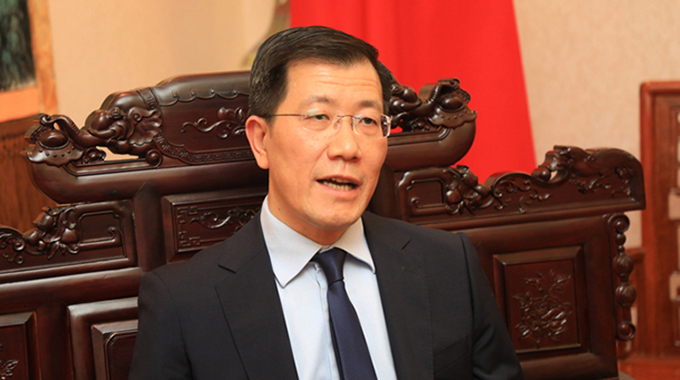
Elliot Ziwira Senior Writer
Amid concerted efforts to impede progress through slanderous media onslaught against Chinese investments, the Asian economic powerhouse remains unflinching in its backing of African countries, particularly Zimbabwe, by availing no-strings attached financial, moral and technological support to heighten the country’s socio-economic development, a senior Chinese official has said.
Speaking at a seminar on “Impact of Chinese Investment in Zimbabwe” in Harare recently, Chinese Ambassador to Zimbabwe, Mr Guo Shaochun, said China, as Zimbabwe’s second largest trading partner, has invested over US$2 billion in the country, and is committed to win-win cooperation.
The seminar coincided with the 20th National Congress of the Chinese Communist Party (CCP).
“China is one of the largest investors in Africa. Over the past two decades since the establishment of FOCAC, the flow of China’s direct investment in Africa has been growing by more than 25 percent on a yearly average. China’s investment in Africa has kept increasing, despite the impact of Covid-19 pandemic,” said Ambassador Guo.
“In the first half of this year, China’s investment in Africa hit US$2,17 billion. Meanwhile, China is Zimbabwe’s second largest trading partner and remains the biggest investor in Zimbabwe for many years. China’s direct investment stock in Zimbabwe has reached over US$2 billion by the end of 2020 and is still rising.”
It is this mutual collaboration which has ruffled feathers in some quarters across the Western world, leading to malicious attacks on social media and some publications aimed at Chinese investments in Zimbabwe.
Some non-profit organisations such as the Information for Development Trust (IDT), have been offering investigative journalism training to journalists to effectively report on the impact of foreign investments in Zimbabwe, among other issues.
The workshops, supported by the United States of America Embassy and other partners such as the Africa-China Project could be well-intentioned in empowering Zimbabwean and Southern African journalists on their watchdog role, but it is the focus of investigations chiefly on Chinese investments which points to organised propaganda.
Given, China has been providing the largest number of investors in recent years owing to the illegal economic sanctions imposed on Zimbabwe by some Western countries at the behest of the US and the United Kingdom, and negative media perceptions of the country.
However, downplaying the downside of investments by other nationalities smacks of hypocrisy and hidden motives disguised as freedom of the press and human rights. Also, impact does not only refer to negativity.
As the Second Republic led by President Mnangagwa continues to engage and re-engage with the international community after over two decades of sanctions-induced isolation, Zimbabwe has continued to progressively attract foreign direct investments.
Supported by its rich natural resources base, the country has seen many investors, not only Chinese, involved in huge projects, with oil, gas, lithium, chrome, nickel and gold mining attracting foreign capital.
Considering the multiplicity of investors involved, wrongdoing should be censured without restraint or favour if the objective is to influence decisions by policymakers, while pointing out errant behaviour.
The same zest used in scrutinising Chinese-run businesses should apply to all foreign investments in Zimbabwe. That way, stakeholders, including authorities, are drawn in to enforce compliance by ensuring that due diligence is followed by all investors across sectors for the benefit of Zimbabweans.
However, the lenses have been trained only on Chinese investments, while others have been allowed the benefit of doubt.
Such organised propaganda, notwithstanding, Ambassador Guo said, China will be unperturbed in its resolve to keep to the positive side of the greater good.
He highlighted that the turn of the millennium saw massive investments by Chinese enterprises in Zimbabwe, when the country was at the mercy of illegal economic embargoes imposed by the West, leading to collective withdrawal of capital from the Southern African country.
“When the West chose to abandon, punish and humiliate Zimbabwe, China and Chinese enterprises chose to embrace Zimbabwe,” Ambassador Guo said, adding, “China’s investment in Zimbabwe has made up for the shortage of funds and technology and other tough challenges faced by Zimbabwe’s economy.”
Since Zimbabwe-China relations are pivoted on reciprocity, Chinese enterprises have “also gained opportunities for development.”
“Our cooperation is highly complementary and mutually beneficial, which will deliver more tangible benefits to our peoples, and support Zimbabwe to take an independent development path suitable to its national reality with more capabilities and confidence.”
Ambassador Guo underscored that neither force nor smears of whatever nature could “hold back the irreversible strides of China-Zimbabwe cooperation”.
He beseeched the authorities and the people of Zimbabwe to “observe the advantages and weaknesses of Chinese companies from an objective perspective,” saying investors from the Asian economic giant have “learned how to follow the market rules and pursued pragmatism and efficiency.”
Said the Ambassador: “I believe this will encourage more well-established and capable Chinese companies to invest in Zimbabwe, help them to better integrate into the local community, improve their competitiveness and make more contributions to Vision 2030 of Zimbabwe.”



 Online Reporter