


 admin
admin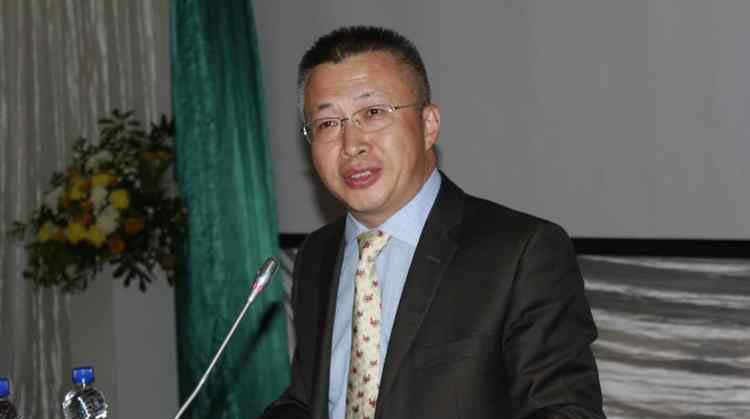
China has remained one of Zimbabwe’s foremost partners on the international arena due to sound relations between the two countries. The Sunday Mail Chief Reporter Kuda Bwititi last week spoke to China Deputy Ambassador to Zimbabwe Mr Zhao Baogang to unpack the highlights of diplomatic relations between the two countries in 2019 as well as prospects for 2020.
***
Q: What are some of the highlights, in terms of diplomatic relations between Zimbabwe and China, in 2019?
A: This year, relations between the two sides were strengthened and cooperation consolidated.
President Xi Jinping and President Emmerson Mnangagwa have been communicating regularly and one of the results of that constant communication was that Vice President Chiwenga was taken to China for treatment.
We want to express our sincere happiness to the Vice President for his recovery.
We hope relations will be elevated in the New Year with more visits by high ranking officials from both countries. In 2019, we had many high profile visits.
Several ministers from Zimbabwe, including the Zanu PF National Chairperson Cde Oppah Muchunguri-Kashiri, visited China to learn from institutions such as the Communist Party of China (CPC) Party School.
We are also happy that Zimbabwe has continued to support issues pertaining to the core interests of China such as Taiwan, South China Sea and Hong Kong.
We support the Government of Zimbabwe under President Mnangagwa and we believe the Zimbabwean Government also supports China.
Q: What are the opportunities that China’s development has brought to Zimbabwe in 2019?
A: This year we celebrated the 70th anniversary of the People’s Republic of China. In the past 40 years, China’s GDP has grown from US$175 billion to US$13,6 trillion in 2018. This is why we have become the number two economy in the world.
We have established the largest health insurance system covering 1,4 billion people.
More than 800 million people have been lifted from poverty in the past decades, as a result of China’s development.
We want to share China’s development with other developing countries such as Zimbabwe. China’s development is a great opportunity for other developing countries.
Under the framework of Belt and Road Initiative (BRI) and Forum for China Africa Cooperation (FOCAC), China will, in the years from 2018 to 2021, provide US$15 billion in grants, interest free loans and concessional loans to African countries.
It will also provide US$20 billion in credit lines as well as US$10 billion in investment and another US$5 billion in special funds for financing imports from Africa countries.
Under BRI, China plans to invest US$750 billion to countries under the old Silk Road route and import US$24 trillion worth of goods into China.
This is a great opportunity to Zimbabwe and will also improve cooperation.
Q: What do you think Zimbabwe needs to do to utilise these opportunities?
A: We hope that in 2020 there will be more consultations at the high level.
We hope that more ministers from Zimbabwe can visit China because knowing each other is the first step for cooperation.
We also wish that Chinese leaders will also continue to visit Zimbabwe. The media also has a role to play because at times they always focus on the negatives instead of the many positives.
Q: China is fully funding construction of the New Parliament building in Mt Hampden. What is the significance of this project?
A: This is one of the largest projects funded by Chinese grants in Africa. It is a symbol of the friendship between China and Zimbabwe. The building is important in the decolonisation of Zimbabwe.
After achieving Independence, Members of Parliament are still working in a building built by colonialists, but this building will bring new life into the political process of this country and speed up the decolonisation process.
Also, it will help in the construction of the new city that Government wants to build.
So the building will open a new space for development because already, many real estate companies are investing in the area and there is also a company that is building a hotel in the area.
Under the category of grants, we have also funded the pharmaceutical warehouse whose construction started this year.
We have also funded drilling of 1 200 boreholes and built a number of schools, including Hatcliffe High.
We have also donated a lot of equipment worth millions of dollars for wildlife protection, things like helicopters, trucks, drones and other equipment for rangers.
We want to support the sustainable protection of Zimbabwe’s environment.
Q: Some people ask, why is China doing so much for Zimbabwe?
A: We believe that this is a globalised world and our objective is that if only one country achieves development, then such a situation is not sustainable.
Our objective is to achieve common development and common prosperity.
Q: What are some of the investment projects to take note of from Chinese investors in Zimbabwe in 2019?
A: Investments are a very important part of bilateral relations. We also encourage Chinese companies to come to Zimbabwe. One of the main investments this year was the Sun Yi Feng tile manufacturing plant in Norton.
The company’s plan was to invest more than US$120 million. So far, it has invested US$40 million for tiles manufacturing. They have now put in place another line of production, for tableware, plates and cups.
They are planning to export their products to neighbouring countries. We expect the company to become an important foreign currency earner. We hope that the Zimbabwean Government will continue working with this investor.
Q: What are some of the challenges that Chinese investors are facing in Zimbabwe?
A: We are happy that President Mnangagwa constantly talks about the ease of doing business.
But some of the challenges faced by investors include power cuts, fuel shortages, double taxation as well as double authentication of certificates.
Power cuts affect production and also cause breakdown of machines. On the issue of double authentication of certificates, Zimbabwe’s laws are a bit tougher than other African countries and it puts obstacles to investors.
A work permit is also very expensive in Zimbabwe because it costs more than US$1 000 and it has to be renewed every year.
Q: On the part of Zimbabwe, what do you think needs to be done to attract more investment from China?
A: There is a fierce competition from other countries in the world to attract investment. Recently, the Zimbabwean Government established an inter-ministerial committee to promote bilateral relations with China.
We appreciate this very much. It is an important committee and we regularly hold meetings. We hope Zimbabwe continues to hold more meetings with investors under this platform.
This will ensure that obstacles raised by investors can be cleared. Zimbabwe should also learn from other countries. In Ethiopia, they have set up a large Special Economic Zone (SEZ) and also constructed a railway line to Djibouti.
In Nigeria, there are also a number of SEZs. We strongly advise that Zimbabwe’s Government should learn from SEZ in other countries.
Zimbabwe should take an action-oriented approach. Recently, I went to my local bank and I was told that it takes two weeks to get a bank card.
Some of the officials here at the embassy do not even have bank cards because they were frustrated by the process.
But as China, we also learn from Zimbabwe which went through three Chimurengas. These are great achievements for the Zimbabwean people.
The fact that land reform is not reversible shows that you never give up. It shows that Zimbabwe is courageous and it dares to struggle against any evil force. This is something that China has high admiration for.
Q: Given the sound relations between Zimbabwe and China, why does it seem as if China is reluctant to give Zimbabwe a financial bail-out?
A: Zimbabwe and China are strategic allies and they are like brothers and sisters. We help each other but as China, we never bail out countries. China does not have the capacity to bail out any country.
We believe that the development and prosperity of a country depend on its own people. In the 1930 and 1940s, China fought a fierce war against the Japanese invading army.
Tens of millions of people died in that war and we won after shedding our own blood. In the 1949s, we set up a new China and started the process of industrialisation.
Although we got help from friends, it was largely the Chinese people who did it for themselves.
We started the process of industrialisation and there was a lot of hard work from our people. From 1978 until now, our development has been because of the hard work of our people.
If we didn’t work hard, we could have never achieved development. It is because of the hard work that Chinese companies have come up with breakthrough investments. So Vision 2030 will not be given to Zimbabwe by another country, it will be up to the people of Zimbabwe to work for themselves.
Q: Looking into the crystal ball, what are some of the expectations for Zim-China relations in 2020?
A: The year 2020 is important because we will be celebrating the 40th year of establishing bilateral relations between the two countries. One Confucius once said, “When a man reaches the age of 40, he becomes a man without doubt.” This means that the man is ripe to understand the world.
He is a man with no doubt. Looking back, there are a lot of issues from the past as well as the future.
The friendship between Zimbabwe and China is cemented with blood and sweat. Both China and Zimbabwe fought for democracy and freedom.
This world is far from tranquil and we have to continue fighting. Whenever we come to the issues that concern our core interests, we always help each other.
In 2008, a draft resolution was tabled at the UN Security Council to impose sanctions against Zimbabwe. Russia and China took decisive action.
It was the first time for China to veto on a UN Security Council for an African country.
Zimbabwe also supports China’s core interests such as the One China Policy, Hong Kong, South China Sea, Taiwan and other issues.
I believe that we will continue supporting each other in these important areas.
Furthermore, the pragmatic cooperation between the two sides is very successful.
For example, in the tobacco sector, in 2005 the industry was almost bankrupt and production was very low. China is a big consumer of tobacco and the two sides came together.
China’s Tian Ze came to Zimbabwe, set up the contract farming model and offered loans to local farmers.
This was a win-win cooperation because the tobacco industry came back to life. Every year, China buys half of the tobacco produced in Zimbabwe, worth about US$500 million.
In 2018, the amount of tobacco was record-breaking and this was an amazing achievement that shows the fruits of cooperation between Zimbabwe and China.
We also had the cement company in Gweru, which was a joint venture between Zimbabwe and China, it did very well.
If we have many projects like this, Zimbabwe’s economy will be boosted in a big way.
As China, we always do everything to ensure that the party exercises leadership over our work.
The successes of both countries must be attributed to Zanu PF and China Communist Party.
These parties give directions. Whenever we have problems, the parties’ intervene and clear obstacles.
Q: We have seen protests in Hong Kong and they bear a striking similarity to opposition-led disturbances in Zimbabwe. How do you relate the two?
A: We share some similarities. In the past six months, there have been riots in Hong Kong and they have included vandalism of properties.
While rioters may have grievances, there are some outside forces inciting the violence in Hong Kong and they want to undermine China’s development.
As China, we have to be careful and look out for outside forces that want to intervene in our internal affairs.
Some diplomats have been supporting these protestors. Here in Zimbabwe, there are similar kinds of demonstrations. Stability is very important, if there is no stability there is no development.
This is why we support the efforts by the Zimbabwe Government to promote peace and tranquillity. Freedom should not impinge on the rights and interests of others.



 Online Reporter