

 admin
admin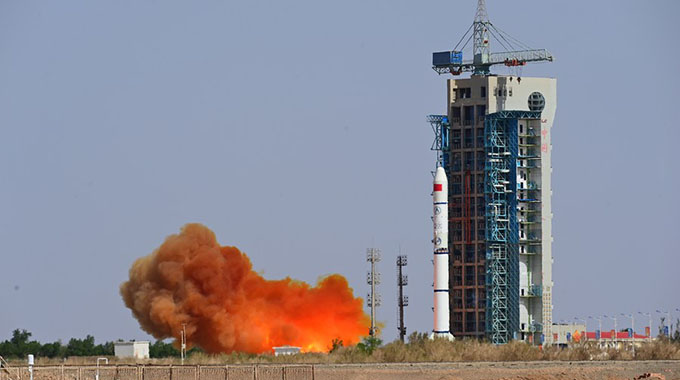
JIUQUAN. – China successfully sent two satellites of “Macao Science 1,” a space exploration programme, into space yesterday.
The China National Space Administration (CNSA) said that the satellites were launched at 4pm (Beijing Time) by a Long March-2C carrier rocket from the Jiuquan Satellite Launch Center in northwest China and entered the preset orbits successfully.
It was the 474th flight mission of the Long March carrier rocket series. The launch also sent a scientific experiment satellite named Luojia-2 into space.
Macao Science 1 takes a twin-satellite approach. Satellite A carries payloads like high-precision magnetometers to detect Earth’s magnetic field. Satellite B is equipped with payloads like high-energy particle detectors and solar X-ray instruments to obtain space environment data.
Macao Science 1 has the capability to complement the observations made by Europe’s Swarm satellites and China’s first seismo-electromagnetic satellite, Zhangheng 1.
This collaborative effort allows for a more comprehensive understanding of Earth’s low latitude magnetic field and space environment changes as well as facilitates the monitoring of the South Atlantic Anomaly (SAA).
According to the CNSA, Macao Science 1 is the first space science satellite program jointly developed by the Chinese mainland and Macao. The project is also the first scientific exploration satellite placed in a near-equatorial orbit to monitor the geomagnetic field and the space environment of the near-equator SAA.
The SAA is a giant region of lower magnetic intensity in the skies above the planet, stretching over the South Atlantic.
The weakening of the Earth’s magnetic field protection over this area allows more radiation from outer space to penetrate and get closer to the Earth’s surface, which easily interferes with the communication of satellites, aircraft and spacecraft passing through this area.
Scientists believe the study of the SAA can help them find the reason for Earth’s weakening magnetic field.
Macao Science 1 has the highest accuracy of geomagnetic field detection in China and will significantly improve the country’s space magnetic survey, said the CNSA. – Xinhua.



 Online Reporter