Online Reporter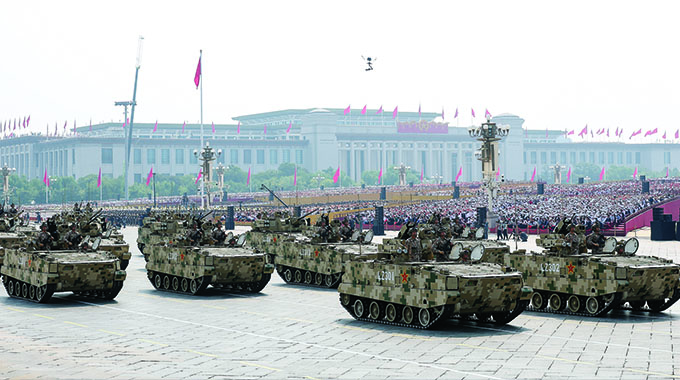
Nduduzo Tshuma in BEIJING, China
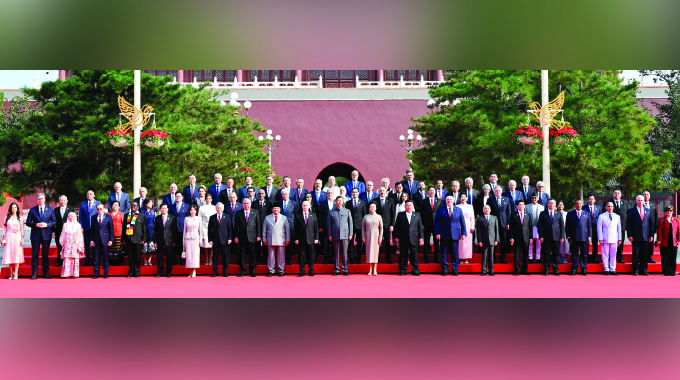
PRESIDENT Mnangagwa yesterday joined 26 world leaders at Tiananmen Square for China’s 80th Victory Day grand parade, where the Asian nation reaffirmed its commitment to multilateralism grounded in mutual benefit and respect.
The commemorative event blended solemn remembrance with a striking display of military prowess, as China unveiled a broad spectrum of advanced weaponry aimed at bolstering its air, sea, and ground combat capabilities.
President Mnangagwa’s presence at the celebrations underscored the enduring solidarity between Zimbabwe and China, dating back to the liberation struggle, during which China played a pivotal role as a key supporter.
Speaking ahead of the event, President Mnangagwa emphasised that China remains Zimbabwe’s foremost ally, highlighting the importance of preserving and deepening the bilateral relationship.
During his visit to the Zimbabwean Embassy on Tuesday, President Mnangagwa reflected on his first trip to China in 1964, when he led the inaugural group of Zanla fighters for military training at the Nanjing Army Command College in Jiangsu.
“Our ties with the People’s Republic of China go back to the days of our liberation struggle. These relations are deeply cherished. For some of you who were young then, we were trained here.
“We were the first Zanla group to receive training here, and since then, we have maintained a close relationship with the People’s Republic of China, both politically and economically. I am, in essence, a product of their military training.
“I share this to illustrate the historical depth of our relationship with China. They supported our liberation struggle, and we were the first trained cadres from Southern Rhodesia at the time. China is among the countries we consider our closest friends,” the President told embassy staff.
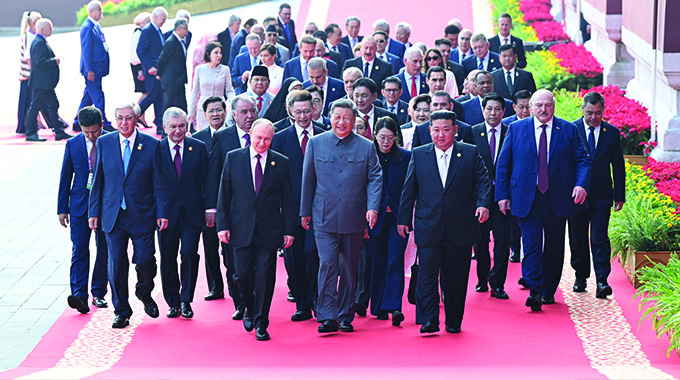
Among the other leaders in attendance were Presidents Vladimir Putin of Russia, Kim Jong Un of the Democratic People’s Republic of Korea, and Alexander Lukashenko of Belarus, among others.
The 80th anniversary of the victory over fascism was not solely a moment of historical reflection but also a declaration of China’s status as a modern global power.
In his keynote address, President Xi Jinping, flanked by senior Communist Party of China (CPC) officials, reaffirmed China’s dual commitment to peace and strength.
“We will remain committed to the path of peaceful development and join hands with all peoples around the world in building a community with a shared future for humanity,” he said.
President Xi reiterated that global security can only be upheld when nations treat each other as equals, coexist harmoniously, and offer mutual support.
Reflecting on the victory over fascism, President Xi noted that through immense national sacrifice, the Chinese people had made “major contributions to advancing human civilisation and safeguarding world peace.”
Tiananmen Square once again became a stage for both remembrance and forward-looking vision. Standing in a Hongqi limousine, President Xi inspected formations of the People’s Liberation Army (PLA), saluting the fluttering flags of the nation, the party, and the armed forces.
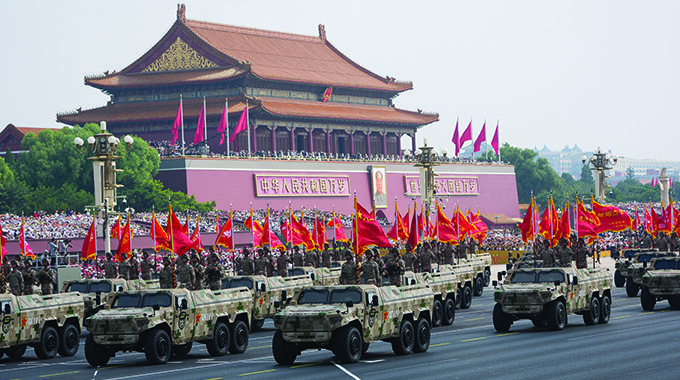
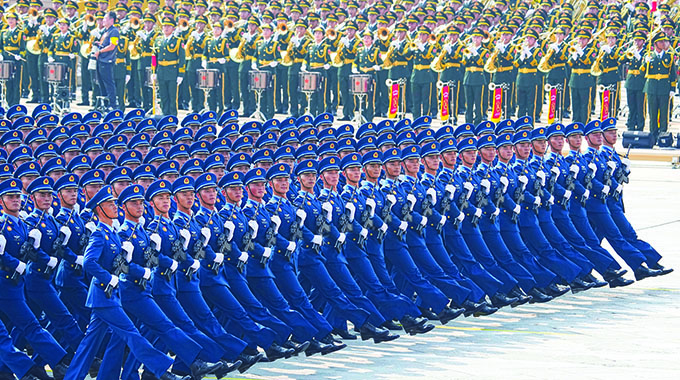
Columns of soldiers marched with precision, interspersed with banner formations honouring 80 heroic units from the resistance war. Overhead, air echelons thundered across Beijing’s skies, with one formation of 26 helicopters forming the numerals “8” and “0” to mark the anniversary. Other aircraft carried banners proclaiming “Justice prevails”, “Peace prevails”, and “The people prevail”.
The celebrations offered China a platform to exhibit its growing military sophistication, with the PLA parading a range of cutting-edge weaponry that captured global attention. Leading the display was a formation of electronic countermeasure systems — five types of equipment designed for aerial and space defence, capable of disabling enemy networks and disrupting digital infrastructure. These systems underscored China’s strategic focus on cyber and information warfare in modern conflict.
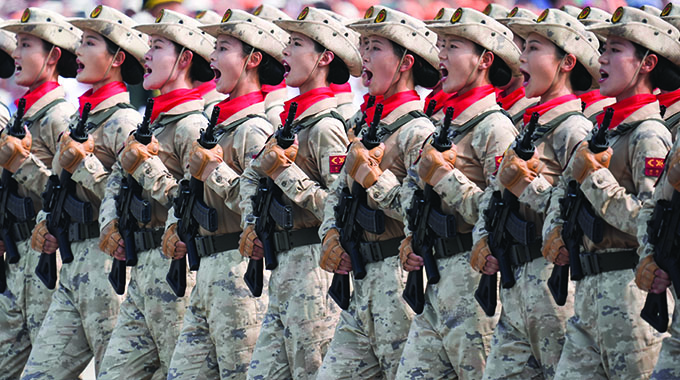
China also unveiled its anti-unmanned aerial vehicle (UAV) systems, comprising a missile-gun integrated platform, high-energy laser weapons, and high-power microwave technology. Together, these form what officials described as a
“powerful shield” against drone incursions, reflecting the increasing significance of UAVs in contemporary warfare.
Air defence capabilities were prominently featured, with the HongQi-20, HongQi-19, and HongQi-29 missile systems offering layered protection through long, medium, and short-range interception. These were supported by four types of carrier-based air defence equipment, extending coverage to China’s expanding naval forces.
The PLA also showcased its hypersonic arsenal, including the YingJi-19, YingJi-17, YingJi-20, and YingJi-15 anti-ship missiles. Travelling at extreme velocities, these weapons are engineered to evade interception and bolster China’s maritime power projection. Their inclusion in the parade served both as a testament to technological advancement and a strategic signal to potential adversaries.
On the ground, a formation of 191 long-range rocket artillery systems — box-shaped and formidable — rolled through Tiananmen Square. These systems are capable of providing tactical support and executing large-scale battlefield strikes, enhancing the reach of ground operations. Following them were the PLA’s new-generation Type-100 tanks and combat vehicles, showcasing improvements in mobility, armour, and firepower for land warfare.
The parade also highlighted the diversity of China’s military branches. The PLA Air Force formation traced its heritage to historic battles of the resistance war.
The PLA Rocket Force, central to China’s strategic deterrence since its re-designation in 2015, underscored the nation’s growing emphasis on missile capabilities. Naval formations further illustrated the PLA’s ambition to develop a world-class blue-water navy.
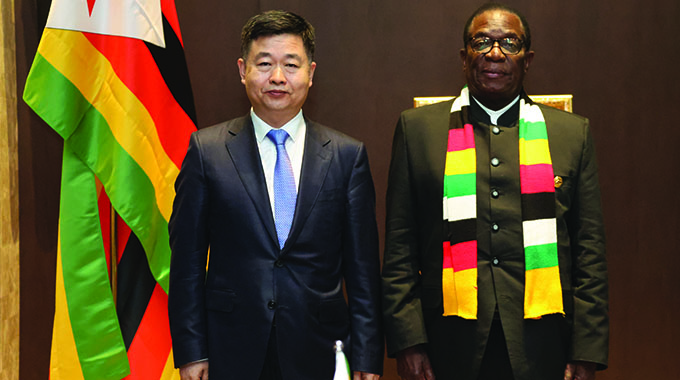
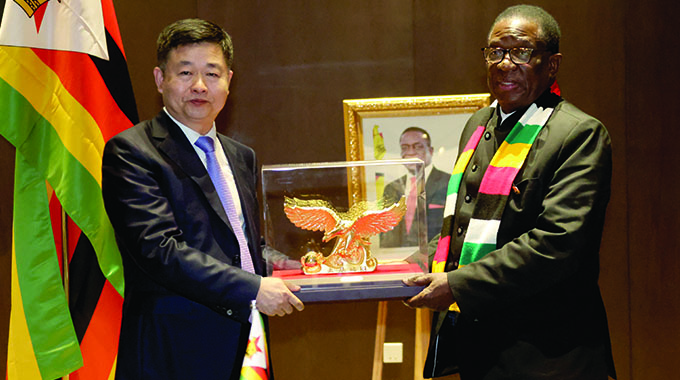
Meanwhile, senior executives from China North Industries Corporation (NORINCO) paid a courtesy visit to President Mnangagwa at his hotel yesterday afternoon. The meeting formed part of a series of high-level engagements undertaken by President Mnangagwa since his arrival on Monday, aimed at strengthening ties with China and advancing economic diplomacy.
Today, the President is scheduled to hold bilateral talks with President Xi, with discussions expected to focus on enhancing bilateral relations and expanding areas of co-operation.