Chronicle Editor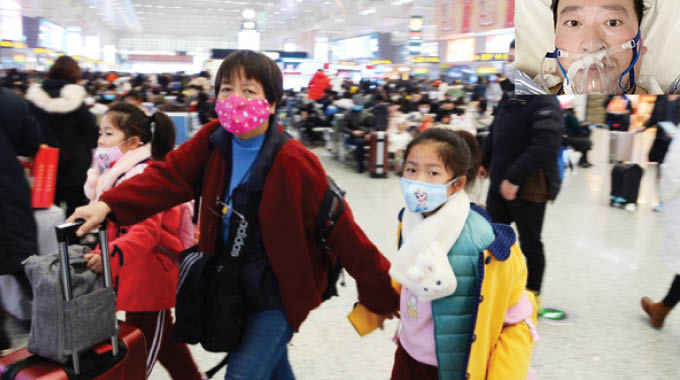
Beijing — Li Wenliang, a medical doctor and one of the first eight people to warn the public about the novel coronavirus, has died late last night due to the infection, sparking a level of collective anger and grief unseen on Chinese social media.
Hailed as a national hero, Dr Li was apprehended by Wuhan police for spreading “rumours” earlier last month.
He had warned his classmates in a private WeChat message about a SARS-like virus spreading in Wuhan, the epicentre of the epidemic. He first came in contact with the virus, after treating a glaucoma patient who at the time was not aware that he had already been infected with the deadly virus.
The news of his death came around 9:30pm local time on Thursday, when Dr Li’s colleague posted on his Weibo, saying he had passed away after being sent to the intensive care unit.
Global Times, China’s English-language state media, first reported the story and opened a social media discussion on Weibo.
His death quickly became the most-talked topic on WeChat and Weibo, China’s two-biggest social media platforms, attracting millions of posts and searches.
In response to the doctor’s death, China’s anti-corruption agency, the National Supervisory Commission, announced yesterday that it is sending a team to Hubei to conduct a “comprehensive investigation.”
In an almost unprecedented scene, people’s Weibo and WeChat feeds were filled with grief over Dr Li’s death.
The topic “Li Wenliang” and “Wuhan Government Still Owes Dr Li an Apology” were trending on Weibo in the first hour following the news, topping the list.
Dr Li’s death has further inflamed a nation already reeling from the outbreak that has so far killed at least 636 people and infected 31,161 others. Earlier on Wednesday, the World Health Organisation (WHO) said that the number of new confirmed coronavirus cases had fallen for the first time since the outbreak began.
“Those who tell the truth are arrested for spreading rumours and those who tell nothing but lies become the leaders,” a post on Weibo said of his death. “What a sign of our times!”
The Chinese government, especially the local leadership, has been facing widespread criticism from the public over the handling of the outbreak.
From when Hubei province admitted its first coronavirus-infected patient in early December until mid-January when there was a clear sign of human-to-human transmission and a potential outbreak, the local government had tried to limit the information flow.
“Why are they still deleting posts on how the local government owes him an apology?! He deserves it! And the government really thinks we are all stupid?” another netizen angrily wrote on Weibo, referring to the hashtags related to Dr Li soon being censored.
However, as the outpouring anger flooded online, asking people to never forget his name in the battle against not just virus but also bureaucracy, Wuhan Central Hospital, the medical facility where Dr Li was receiving treatment, posted on its official Weibo account at 11pm local time on Thursday, saying they were still resuscitating Dr Li.
As more people joined the prayer, hoping for a miracle, information started to emerge on how Dr Li’s heartbeat had stopped for over three hours and the resuscitation was only to calm the public’s rage.
“His condition was critical, and he stopped the heartbeat earlier tonight already, but he was put on intubation and extracorporeal membrane oxygenation (ECMO) just out of pressure from the leaders,” a source at Wuhan Central Hospital, who requested to stay anonymous, said.
Their testimony was later corroborated by a number of posts online, including screenshots of conversations among doctors saying the team only tried to resuscitate him to deflect public anger about this death.
While hashtag ”we want freedom of speech” got censored, ”we DEMAND freedom of speech” started trending.
It’s 5 am in China right now, but many people did not sleep tonight — hashtag “I want freedom of speech” started to trend on Weibo from 1 am and now has nearly 2 million views.
At 3:48am yesterday, the official account of Wuhan Central Hospital posted on Weibo that the death was confirmed six hours after his heartbeat allegedly stopped.
This was greeted by a wave of widespread furore.
“I learned two words today: political resuscitation and performative resuscitation,” the top comment of Wuhan Central Hospital’s post reads.
“As a journalist, I refuse to quote the ‘official time of death’ of Dr Li, which is February 7 early morning,” Muyi Xiao, the visual editor at ChinaFile, an online magazine, said on Twitter.
“It is important for us to determine when he actually passed away, so his death date isn’t assigned by the authorities. He deserves that at the very least.”
Soon, the anger that had been focused on Dr Li’s death morphed into something much larger: an unhapiness about the lack of freedom of speech in China.


 Online Reporter