Online Reporter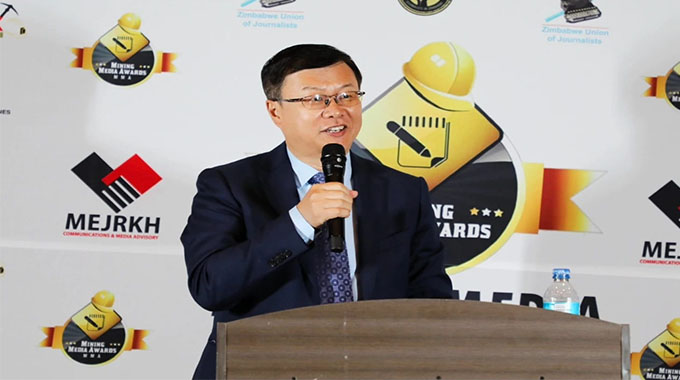
Remarks at the Mining Media Awards
By H.E. Chinese Ambassador Zhou Ding
Crowne Plaza Monomotapa, 21 November 2025
Minister of Information, Publicity and Broadcasting Services, Hon. Dr. Jenfan Muswere;
Deputy Minister of Mines and Mining Development Hon. Dr. Caleb Makwiranzou
Minex Chairman, Mr. Munyaradzi Hwengwere;
Kuvimba Mining House CEO, Mr. Trevor Barnard;
Chairperson of the Adjudication Committee, Mr. John Masuku;
Mining executives;
The media fraternity;
Ladies and gentlemen; Distinguished Guests,
It is a privilege to be here at the Mining Media Awards, celebrating this year’s inspiring theme: “Stories of Growth and Sustainability.” Let me start by extending my sincere appreciation to the visionary organizers of this gathering: Minex, the Chamber of Mines of Zimbabwe, the Association of Mining Journalists in Zimbabwe, and the Zimbabwe Union of Journalists, for the invitation and the opportunity. And to all the award recipients—my heartfelt congratulations to you all!
Dear friends,
As the year draws to a close, it is a fitting time for us to reflect on our achievements and to look ahead to the future. The year 2025 has been a milestone for China-Zimbabwe relations, highlighted by the successful visit of H.E. President E.D. Mnangagwa to China, during which our two heads of state elevated our partnership to a China-Zimbabwe All-weather Community with a Shared Future. This past year, we’ve also proudly celebrated the 45th anniversary of our diplomatic ties — a shared journey marked by remarkable achievements and profound camaraderie. As tonight is dedicated to mining and journalism, I will set those aside and turn now to the theme of this ceremony.
Over the years, Zimbabwe has cultivated a robust mining industry that continues to drive its economic and social progress. I commend Zimbabwean government for its commitment to the sustainable development of its mining sector, and its dedication to our partnership in this field. For years, China has stood as Zimbabwe’s largest foreign investor, with mining being a key area of our collaboration.
In examining Chinese investment in Zimbabwe’s mining sector, I would focus on four key areas:
First, the Chinese investment in Zimbabwe’s mining sector is about driving economic growth. Chinese investment translates into jobs, tax revenue, and human resource development. The numbers speak volumes: according to ZIDA, over 1,000 new Chinese companies have registered here in the past three years, a significant portion is in mining. Overall, China-Zimbabwe trade and investment supports the livelihoods of over a million Zimbabweans, with more than half of this impact stemming from mining. Investors like Dinson Steel, Huayou, and Sinomine each employ thousands locally. They are actively training employees, transferring technology, and introducing advanced extraction and processing solutions. Their partnerships with vocational colleges in both countries are building vital human capital for Zimbabwe’s sustainable mining future.
Second, it strengthens value chains and promotes sustainability. Companies are moving beyond extraction to adding value within Zimbabwe. Dinson now produces 600,000 tons of steel yearly. Its products—pig iron, steel billets, and more—are not exported to China but meet domestic and local demand and generate foreign exchange through regional sales. Environmentally, these companies are leading in protection measures, implementing waste treatment and water recycling systems. I am thrilled to learn that an additional 1,000 megawatts of solar projects by Chinese investors are underway to help address power challenges and support Zimbabwe’s green energy transition.
Third, it builds infrastructure and fosters community development. Mining investments are catalyzing broader development. Dinson is planning to transform the rural area of Mvuma into a new town for 10,000 residents and its employees. Max Mind Investment renovated and widened a 37-kilometer road, greatly improving travel safety for local villagers. As far as I know, the Chamber of Chinese Enterprises in Zimbabwe (CCEZ) is drafting a CSR report documenting over $100 million invested in hundreds of projects—building roads and clinics, drilling boreholes, and refurbishing schools.
Fourth, it is a partnership navigating complex challenges. While we celebrate these achievements, we must also candidly acknowledge the challenges. Mining is inherently complex, and balancing extraction with environmental protection and community interests is a global challenge. The Chinese Embassy consistently urges all Chinese companies to strictly comply with local laws, minimize their environmental footprint, and work hand-in-hand with communities.
No partnership is perfect. In discussing China-Zimbabwe mining cooperation, we should neither offer only praise nor focus solely on shortcomings. Certain narratives, based on unverified information consistently and desperately smear Chinese enterprises. As we look into their allegations against Chinese enterprises, we have found that over 80% of them are exaggerated or fabricated, designed to incite xenophobia at little cost. Such tactics harm Zimbabwe’s business climate, and discourage investors.
Let us be clear: We welcome constructive, fact-based criticism and solution-oriented feedback. This is how we improve. Judging our cooperation should be based on facts, not fiction. As we are fully aware that, “Bad news travels fast, while good deeds go unnoticed.”, we do hope the tangible progress in China-Zimbabwe mining cooperation receives the recognition it deserves, and we call on all parties to reject baseless smears that seek only to divide us. True progress is built on partnership and honest effort, not on rhetoric that offers no real benefit to the people of Zimbabwe.
To ensure the success of Zimbabwe’s mining sector, we must collectively foster a healthy business environment—one that supports Zimbabwe’s long-term development. As H.E President ED Mnangagwa put it in his speech—“We are entrenching a business operating environment that is consistently predictable and transparent, where enterprises and innovation are rewarded and industry thrives.” I applaud this solemn commitment and dedication.
Distinguished Guests, Dear Friends,
As we build China-Zimbabwe all-weather community with a shared future, we are fully aware that this is not a transactional relationship, but one tempered in shared history and mutual commitment. China has stood with Zimbabwe since its liberation struggle. Today, the fruits of this enduring friendship are visible across Zimbabwe: From the expanded Hwange and Kariba South Power Stations, to the modernized Victoria Falls and Robert Mugabe International Airports, from over 1,300 boreholes nationwide, to the iconic New Parliament Building, from the National Pharmaceutical Warehouse to High-Performance Computing Center. These are not mere projects—they are lifelines, delivering tangible improvements to everyday life. The China-Zimbabwe friendship is demonstrated through action, not rhetoric.
Distinguished Guests, Dear Friends,
Last month, the Fourth Plenary Session of the 20th Central Committee of the Communist Party of China was successfully convened in Beijing. At this critical juncture in China’s modernization journey, the session set a clear direction for the nation’s development, including the rollout of China’s 15th Five-Year Plan, which outlines the country’s path through 2030. It also reaffirmed China’s commitment to high-level opening-up and win-win international cooperation.
In this spirit, yesterday our embassy partnered with the Southern African Research and Documentation Centre—a renowned think tank—to host a seminar titled “China-Zimbabwe Dialogue: Aligning China’s 15th Five-Year Plan with Zimbabwe’s Vision 2030.” The event was a resounding success and underscored our shared intent to turn national blueprints into mutual prosperity.
Distinguished Guests, Dear Friends,
To the journalists with us tonight: The Chinese Embassy in Zimbabwe will always stand as a steadfast friend to all of you. If you seek to deepen your understanding of China, we stand ready to build bridges for dialogue. If you intend to cover China-Zimbabwe cooperation, we will spare no effort to facilitate your access to first-hand information.
Through your lenses and pens, you hold a mirror to the industry, reflecting both its triumphs and its challenges in building a sustainable future for Zimbabwe. In this age of social media—where “everyone has a microphone” and misinformation spreads unchecked—there is an even greater need for professionalism, and an unwavering commitment to journalistic ethics, conscience, and responsibility. Every report you file leaves an indelible mark, shapes public perceptions, and fosters mutual understanding.
As a Shona proverb puts it: “Manga chena inoparira parere nhema.” It serves as a reminder that even with the best of intentions, good journalists can cause harm if they don’t stop to verify all facts before rushing to conclusions. May your reporting seek to inform rather than inflame, to unite rather than divide. This is crucial—not only for journalism, but also for Zimbabwe’s long-term sustainable development.
In closing, I wish this awards ceremony every success! Thank you all!