Online Reporter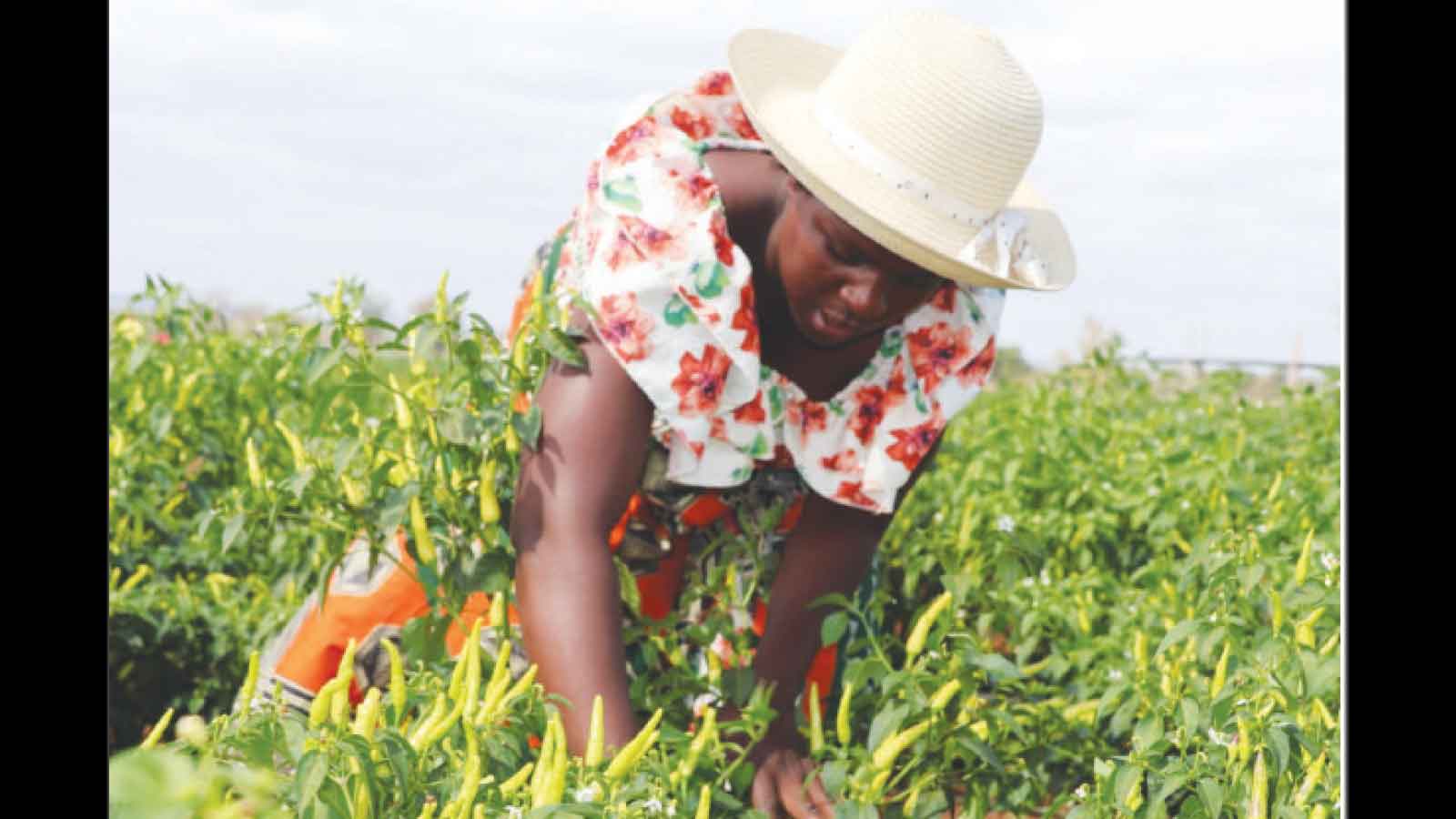
Theseus Mauruki Shambare-Features Writer
HER name is Prayers.
It is an unusual name for a young woman, but in Chidamoyo, a drought-prone community in southern Chipinge, Manicaland Province, it carries a meaning that seems almost written into the landscape around her. For years, farming here demanded something the women had little control over – rain.
When the rains failed, crops dried up in the fields, food became scarce, and household incomes shrank.
Women, often responsible for putting food on the table, carried the heaviest burden of the dry season. They prayed for rain. They prayed that food assistance would come. They prayed for a miracle.
But 26-year-old Prayers Musikiri is now standing in a field where the crops are growing despite the heat.
And perhaps, in a place where survival once depended so heavily on prayer, something is fitting about a young woman called Prayers helping to lead a different kind of response to drought.
The women’s prayers have found an answer — not in the clouds, but beneath the ground.
Beneath Prayers’ feet, water is moving through a network of drip irrigation pipes.
“Food access used to be a challenge in this area because it does not receive much rainfall. Crops would dry up in the fields because it is dry and hot here. But that has all changed since this project came in,” she said.
“They drilled a borehole and installed water tanks and solar panels. They also taught us how to use this drip irrigation system. We no longer have to carry buckets to water the crops. We are very happy with this initiative.”
The transformation is taking place on a one-hectare Village Business Unit, where 60 women are farming together. The VBU is part of the Integrated Rural Resilience Building programme, funded by the Government of Japan through the World Food Programme (WFP) and implemented by Sustainable Agriculture Technology (SAT) to strengthen rural communities against climate shocks and recurrent droughts.
There is a solar-powered borehole, two 10 000-litre water tanks and drip irrigation covering the garden. The women grow vegetables and high-value crops, with 0,1 hectares under covo and the remaining 0,9 hectares under chillies.
They are not growing only to eat. They are growing to sell. That distinction is important.
The garden has already generated US$3 071 from the sale of produce including tomatoes, cabbages, okra, leafy vegetables and butternuts.
A grading shed allows the women to sort their produce, while a holding facility provides space for crops before they are transferred to an aggregation centre.
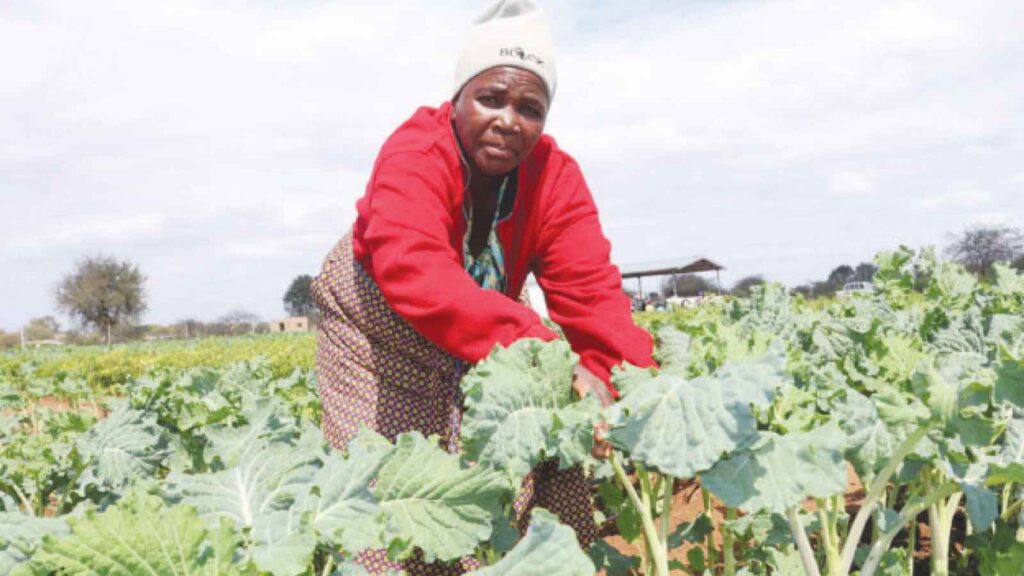
The model is, therefore, changing more than where food comes from. It is changing how women think about farming — from an activity dictated by the weather to an enterprise that can be planned, managed and linked to markets. For 75-year-old Nhlanganayi Dube, the change is particularly significant.
She has spent decades farming in a landscape where rainfall has never been something to take for granted.
Now, alongside women young enough to be her daughters and granddaughters, she is part of an enterprise built around controlled water, production and markets.
“We sell our produce after harvesting to earn money to buy maize and pay school fees for our children. This paprika crop already has a buyer,” she said.
The statement captures the practical economics of the garden. A harvest is no longer simply food. It can become maize bought from the market when household stocks run low. It can become school fees. It can become an investment in another productive asset.
And behind that shift is water.
The geography makes the achievement even more significant. Chipinge is a district of striking agricultural contrasts. Within a relatively short distance, the landscape changes from the cool, wetter Eastern Highlands, where rainfall can exceed 1 000 millimetres a year and supports specialised farming, forestry and livestock production, to the hot and much drier lowveld.
Chidamoyo lies in the harsher end of the district.
Nhlanganayi Dube
Here, rainfall is low, erratic and unreliable, while high temperatures add pressure on crops, livestock and household water supplies.
For farmers whose livelihoods have traditionally depended on rain-fed agriculture, the equation is unforgiving. A missed or poorly distributed rainy season can mean a failed crop. And when the crop fails, the consequences do not stop in the field.
Food becomes scarce. Income disappears. Livestock struggle for water and pasture.
Women, who carry much of the responsibility for feeding and caring for households, are left to find ways of filling the gap.
It is against this reality that the Chidamoyo women are farming. Their one-hectare Village Business Unit (VBU) has effectively created an island of controlled production in a landscape where rainfall cannot be relied upon. Instead of waiting for the next storm, the women draw water from beneath the ground.
Solar panels power the borehole. Water is stored in the tanks before being distributed through drip irrigation lines directly to the crops. The system is designed around a simple principle: use scarce water more efficiently while keeping production going.
During the tour of the VBU, Manicaland agricultural development advisory services director Nhamo Mudada said the approach is particularly suited to areas such as Chidamoyo.
“You see, rainfall in this region is minimal. Because of that, we are drilling boreholes to bring underground water to the crops,” he said.
“If you look at the type of irrigation we are using here, drip irrigation saves a lot of water. It makes it easier and more efficient for farmers to produce.”
The irrigation is also opening the door to commercialisation.
“You can produce anything here using this type of irrigation. You can produce maize, you can produce sorghum. But with the advantage of irrigation, we want farmers to produce high-value crops,” Mudada said.
His point goes beyond one garden.
“We are very sure that if we have more gardens like this, we will be fine. If you consider the one-hectare VBUs being established across the country, if we have 1 000 of them in the province alone, it means we would have added 1 000 hectares of irrigated land.”
The timing could hardly be more important.
Zimbabwe, like other countries across Southern Africa, is bracing for another difficult El Niño season, with expectations of below-normal rainfall and above-normal temperatures placing rain-fed agriculture under renewed pressure.
For communities such as Chidamoyo, this is not an abstract climate forecast. It is a warning about the very conditions they already know.
But while much of the region is preparing for the possibility of drought, the women here have already begun adapting to it.
They have water infrastructure. They have irrigation. They have solar energy. They have market linkages.
They have skills in climate-smart agriculture, horticulture, farming-as-a-business, nursery management and record keeping.
And they have begun building the infrastructure needed to take produce beyond the field.
For generations, the women of Chidamoyo looked to the sky. Now they are looking to a borehole. The gender dimension is equally deliberate.
All 60 members of the VBU are women, including 22 youths.
The garden, therefore, places women not simply at the centre of food production, but at the centre of a rural business.
WFP programme policy officer Munyaradzi Gahadzikwa said the composition of the VBU is significant.
“What is unique about this Village Business Unit is that all 60 members are women. As you know, women make up about 60 percent of Zimbabwe’s population, and about 70 percent of women engage in agricultural activities,” he said.
“So, this makes a difference in terms of empowering women and strengthening their economic empowerment. It also contributes to food security, nutrition security and income security.”
Those outcomes are visible in the garden. The women produce food, generate income and secure markets. They access water too. They also provide water for more than 300 livestock benefiting from the garden infrastructure.
The project combines production with training in climate-smart agriculture, gender, savings, governance and value-chain development. The wider resilience programme also incorporates ecosystem restoration, including gully reclamation and soil and water conservation measures.
It is a reminder that climate resilience is rarely built by one intervention alone.
Water allows crops to grow. Crops create produce. Produce enters markets. Markets generate income. Income strengthens households. And when women control more of that productive chain, the benefits can extend beyond the garden.
There is something fitting about the name of the place. Chidamoyo means what the heart desires, what the heart loves. For generations, that desire was simple: enough rain to carry crops to harvest.
But in a changing climate, desire alone cannot control the weather. The women of Chidamoyo are therefore building another kind of security.
They are investing in irrigation rather than waiting for rain. They are producing for markets rather than farming only for subsistence. They are turning harvests into income for maize and school fees. And they are learning that a dry landscape does not necessarily have to mean a barren one. At the centre of it all stands Prayers.
Her name once might have sounded like a plea. Today, it sounds more like a reminder of how far the women have travelled.