Online Reporter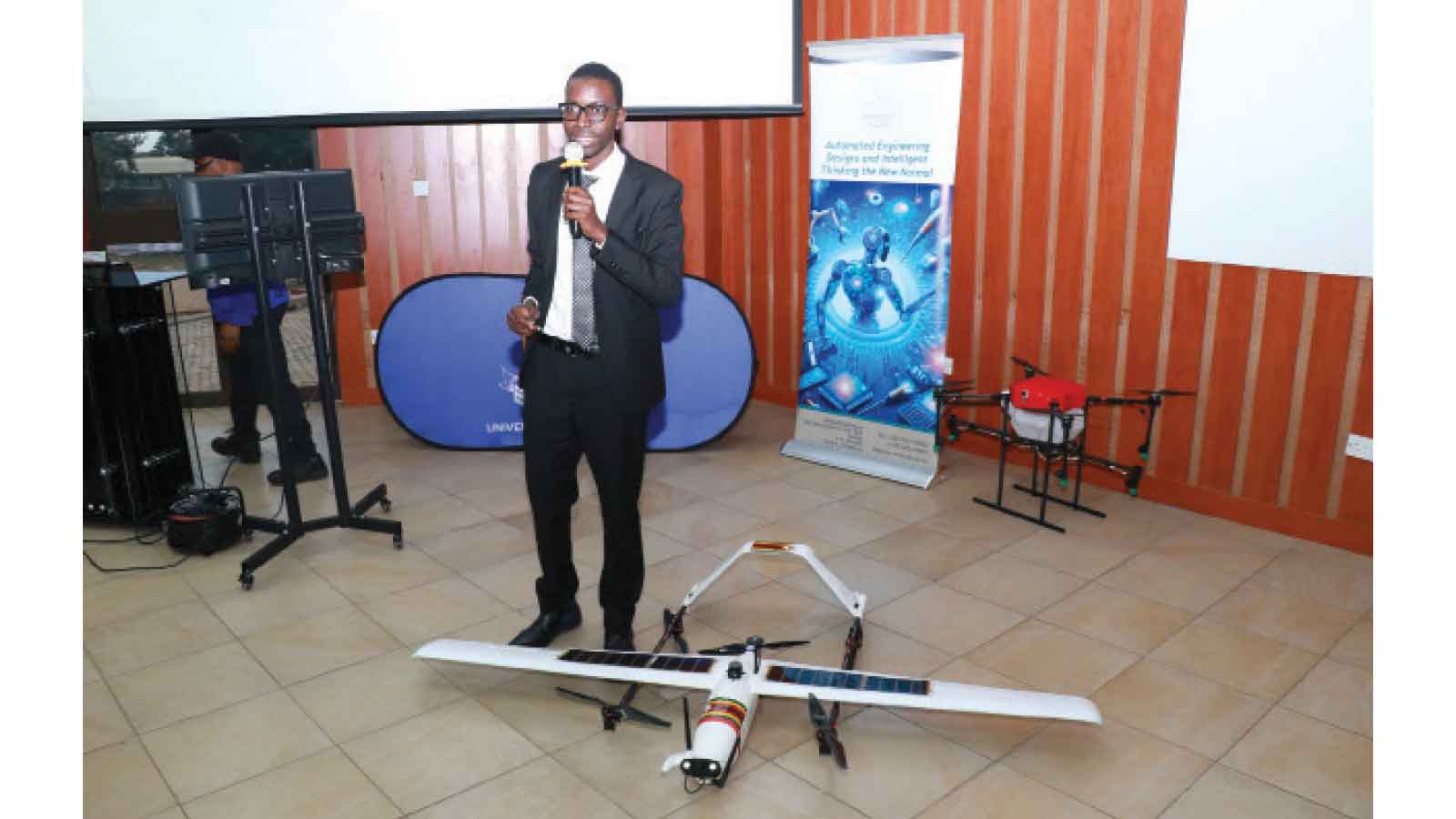
Trust Freddy-Herald Correspondent
IT looks like an oversized toy sitting on the exhibition tarmac until its rotors begin to hum.
Then, Chisiyamhepo — a Shona moniker translating to “that which leaves the wind behind” — quickly transforms into the hardest-working machine at the University of Zimbabwe (UZ).
For decades, the standard script for the country’s brightest young engineering minds followed a familiar, predictable trajectory: memorise intricate formulae from imported textbooks, clear rigorous examinations and almost immediately look across the borders for industrial markets advanced enough to employ them.
But walking through the crowded exhibition pavilions at the university’s just-ended Research, Innovation and Industrialisation Week, it was clear that this old script has been permanently torn up.
The undisputed star of the intensive six-day showcase was not a theoretical thesis paper or a static blueprint.
It was a sleek, metallic unmanned aerial vehicle (UAV) built by an ambitious group of final-year Aeronautical Engineering students: Jabulani Mitole, Evans Sabvure, Sekayi J. Lusewa, Nathanael J. Jambulosi and Tadiwa M. Mandizvidza.
Together, this talented class has engineered a high-tech Vertical Take-Off and Landing (VTOL) drone to tackle two of Zimbabwe’s most stubborn, headline-making crises simultaneously: the ruthless bleeding of critical power infrastructure and the quiet tyranny of distance in emergency healthcare.
While built as a collective capstone breakthrough, the team’s lead innovator, Jabulani Mitole, explained that the aircraft’s poetic moniker carries deep personal and national significance for the young inventors.
“The name was inspired by the majestic eagle, which leaves a literal whirl of wind in its wake during a powerful take-off,” Mitole said. “It captures the core idea of an unmanned aerial vehicle moving with such extreme speed and efficiency that it seems to outrun the wind itself. For us, it signifies that as indigenous Shona people, we can develop advanced flying technologies that truly conquer our own skies.”
This high-tech Vertical Take-Off and Landing (VTOL) drone does not do selfies.
It hunts transformer thieves in the dead of night, flies life-saving anti-venom to isolated villages where roads fail and could soon ferry critical medical samples across the capital’s major referral hubs.
Official data shows that the Zimbabwe Electricity Supply Authority (ZESA) lost transmission and distribution equipment valued at over US$2 million to rampant theft and vandalism in just a 10-month period between January and October 2024.
Addressing Parliament on the scale of the grid’s challenges last year, Energy and Power Development Minister July Moyo revealed that the country was struggling to replace 6 000 transformers that were vandalised, resulting in some public institutions going for months without electricity.
Chisiyamhepo meets this criminal network with automated robotics and artificial intelligence.
Smart proximity sensors mounted directly on vulnerable ZESA transformers link straight to the drone’s automated base station. The moment a vandal touches a cable, attempts to drain transformer oil or breaches a secure substation fence, the sensor beams a digital distress signal.
“The entire system is built to remove human delay from the security loop,” Jabulani explained, gesturing to the drone’s sensory array. “The moment a sensor on a transformer is triggered, it instantly relays the exact GPS coordinates to our automated command base. Without requiring an operator to manually press a button, the drone executes an autonomous launch sequence and heads directly to the scene.”
To avoid false alarms from passing animals or innocent pedestrians, the team developed a sophisticated multi-sensor defence shield.
“The system uses a multi-sensor approach to improve vandalism detection accuracy. A camera mounted on the transformer detects activities such as climbing and loitering or people passing around, using pose-based human action recognition (this involves the camera and algorithms analysing human poses to determine activity, for example, climbing a transformer by someone who is not a worker, indicating possible vandalism or theft), while vibration, magnetic field and acoustic sensors monitor signs of tampering such as cable cutting or tool usage,” he said.
“Sensor data is combined with contextual information such as maintenance schedules and time of day to distinguish legitimate work from suspicious activity, reducing false alarms and improving system reliability.”
Once a legitimate breach is flagged, the drone launches in under 90 seconds, maintaining its batteries at a permanent 96 percent standby charge.
Cruising effortlessly at 80 kilometres per hour, it bypasses all terrestrial obstacles.
To get from the UZ campus to Epworth — a journey that easily takes an hour by road through Harare’s gridlocked traffic — Chisiyamhepo arrives in just 12 minutes, live-streaming crystal-clear 1 080p video footage back to the utility control room and the Zimbabwe Republic Police (ZRP).
“At 80 km/h cruise, it reaches most urban substations in Harare within seven minutes. It takes 12 minutes to reach Epworth from the University of Zimbabwe, which would take one hour by road,” he added.
“Live 1 080p video begins at 150 metres out and is relayed via dual-link communication systems, which increase reliability by avoiding dependence on a single communication channel to the utility control room and ZRP. So, the total time from trigger to law enforcement seeing footage is about 12 minutes for a UZ–Epworth trip. But during the course of the flight, the drone is sending all its live feed.”
Because copper thieves operate in the dark, high-intensity boom lights are mounted on the prototype to pierce the night sky and expose them.
“The current prototype uses a standard HD camera with low-light enhancement (with boom lights for night capability) for cost reasons. It can operate at dusk, night and in lit areas, but it does not yet have dedicated thermal imaging.
“Night-time vandalism is the main use case, so thermal is on the roadmap and we have already tested compatible gimbals. The airframe and power system are built to handle the extra 300–400g for a thermal module.”
Mitole notes that while the current US$2 500 prototype relies on standard HD low-light cameras, production models are structurally rated to carry an extra 300 to 400 grams to integrate dedicated thermal imaging and infrared payloads as a standard feature post-investment.
When it is not pulling guard duty over national infrastructure, Chisiyamhepo switches seamlessly to emergency medical logistics.
In rural areas, snakebites remain a silent and terrifying health threat.
According to the Ministry of Health and Child Care’s Weekly Disease Surveillance Report for the week ending August 31, 2025, a single week saw 20 snakebite cases recorded countrywide.
By late August, the cumulative annual toll had reached 3 174 cases and 12 deaths.
For a patient bitten by a deadly black mamba in deep rural Murehwa, waiting for an ambulance to transport life-saving anti-venom from Parirenyatwa Group of Hospitals in Harare can take over two hours by road.
Chisiyamhepo cuts the direct air distance of roughly 70 kilometres down to an astonishing 55 minutes, completely unaffected by road conditions.
“The real engineering breakthrough here is the Vertical Take-Off and Landing (VTOL) configuration,” Mitole said. “In deep rural communities, you don’t have tarmac runways. This aircraft lifts straight up like a helicopter from a tiny clearing. Once it reaches altitude, the rotors tilt forward to cruise at high speeds like a fixed-wing aeroplane.”
Currently, the prototype boasts a 2-kilogramme payload capacity, enough for 10 vials of polyvalent anti-venom or three to four units of packed red blood cells, using specialised insulated containers lined with phase-change cold packs.
“Our post-investment target is 10 kg payload with a modular payload bay. That will carry a portable mini refrigeration unit and six to eight blood units, or multiple anti-venom doses and ice packs.”