

 Chronicle Editor
Own Correspondent
IN the ever-evolving landscape of the mining industry, Duration Gold Limited has made a strategic decision to streamline its operations. As the proud owner of the Vubachikwe Gold Mine in Gwanda, the Gaika open pit development project in Kwekwe and a portfolio of early-stage “greenfield” exploration projects, Duration Gold has engaged CBZ Capital as its exclusive advisor to conduct a sale process for the Gaika project.
This crucial move comes after extensive consultations with shareholders including five major international investment funds and partners, as well as the Ministry of Mines and Mining Development, which is dedicated to meeting the ambitious US$12 billion target set by the Government. By focusing on optimising its operations, Duration Gold aims to align with the nation’s goals while ensuring the successful development of Gaika, in accordance with international best practices.
The Gaika mine holds a rich history, having been commissioned in 1894 as one of the earliest mines in the country. Over a span of 94 years, it produced approximately 23 tonnes (740 000 oz) of gold, with a significant portion delivered before 1963 when the mine entered a dormant state. It’s remarkable to consider that several modern “Tier One” mines today produce the same level of gold annually as Gaika did throughout its existence. However, Gaika always lived in the shadow of its neighbour, the Globe and Phoenix Mine, which boasted an impressive production of 4 000 000 oz during its lifetime, making it the largest gold mine in Zimbabwe and one of the most prolific globally.
For Duration Gold, the exploration journey of the Gaika project began when it acquired the historic yet abandoned Gaika claims package. Undertaking the challenge of re-examining Gaika’s potential through a fresh set of modern “exploration eyes” was no easy task, as cautionary advice often warns against buying a “used” car without knowing what lies beneath the surface.
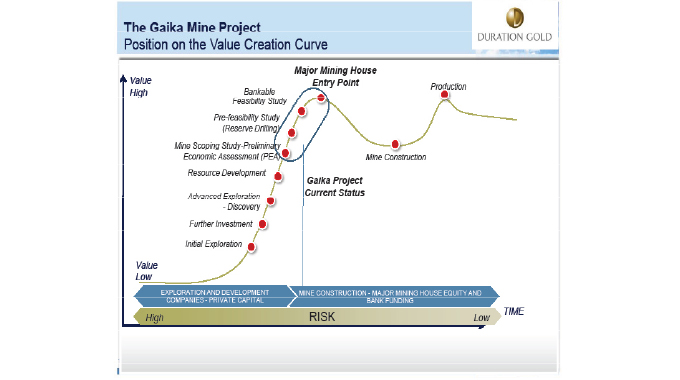
To embark on this systematic journey, Duration Gold meticulously searched for all available historic data, not only in Zimbabwe’s well-regarded Geological Survey but also in countries like the UK, Canada, France, and South Africa. This extensive data collection and digitisation process served as the foundation for developing a working exploration model and assessing the economic potential of the mine. If the journey seemed unpromising at any point along the value curve, Duration Gold knew it was crucial to terminate the endeavour, redirect resources and identify a new destination.
The next phase of the exploration journey demanded an extensive multi-phase, multi-year drilling programme. With over 22 000 metres of drill core logged, assayed and subjected to initial metallurgical analysis, the work confirmed nearly two million ounces of code-compliant resources, following Canada’s NI 43101 standards. The results were meticulously adjudicated by Watts Griffiths and McOuat Limited (WGM), an accredited independent exploration consultant based in Toronto, Canada. WGM acted as an independent “auditor,” ensuring that the results adhered to the best practices required by international equity investors, major mining houses, stock exchanges, and lenders whose support would be crucial for the project’s future.
Cutting corners at any stage of this time-consuming and expensive journey can lead to disastrous outcomes when premature decisions to mine are made. Building a mine and a capital-intensive processing plant without sufficient gold reserves in terms of quantity and quality, or without achieving profitable gold recoveries, only brings tears and regrets.
Unfortunately, Zimbabwe has witnessed several such unfortunate endings throughout the years.
In December 2022, Duration Gold commissioned a Project Scoping Study and Evaluation of Gaika by VBKOM Project Managers (Pty) Ltd, an independent mining consultant based in South Africa. The highly encouraging results, delivered this year, recommended a phased approach to mining Gaika. The plan entails starting with an open-pit mine in three phases, reaching depths of 100m, 200m, and 300m, followed by an underground operation requiring additional exploration and development work.
The construction and commissioning of the first phase open-pit mine would cost approximately US$175 million, with a projected annual gold production of 85 000 oz at a low “all-in” cost per ounce. This initial phase is expected to achieve a three-year payout period, showcasing an attractive return on the invested capital. The mine life for this phase alone is estimated at twelve years.
Throughout the exploration journey, Duration Gold, along with its international investors and joint venture partners, has invested over US$10 million in the Gaika project, excluding the initial contributions made to form the venture, which also amounted to several million dollars.
Now, the Gaika Project stands at a crucial inflection point along the exploration value curve. Should Duration Gold, armed with the necessary expertise, continue advancing the project independently, or should it take the tried and tested route of seeking a major mining house with the technical expertise and financial capacity to rapidly construct the first-stage open-pit mine at a cost of US$175 million?
After careful consideration of what path would be in the best interests of all stakeholders, Duration Gold made the decision to sell. This choice was driven by the company’s commitment to ensuring the successful and expedited development of Gaika, aligned with international best practices, under the capable guidance of a capable group. By doing so, Duration Gold can not only fulfil the nation’s goals but also concentrate on advancing its other projects up the value curve in a manner similar to Gaika.
The company’s streamlining strategy involves fully developing ML 16, which incorporates the Vubachikwe Mine, as well as its other development projects. Additionally, Duration Gold aims to pursue regional greenfield exploration through its Exclusive Prospecting Orders (EPOs) held directly and with its partners, with the goal of discovering new, large-scale mines.
Exploration is a scientific endeavour that demands a meticulous, methodical, and systematic approach. It requires a high tolerance for risk and an unemotional, almost ruthless decision-making process when it comes to continuing or terminating a project that fails to meet strategic criteria.
The ultimate goal of exploration is to discover an economically viable deposit and bring it into production, generating value for all stakeholders. This includes the investors who take on high-risk capital, the government that provides mineral rights and collects royalties and taxes, and the owners, employees, and communities that benefit from a successful mine. The allocation of value to these various participants, often represented by a “Pie Chart,” is a topic that deserves its own dedicated discussion.
To shed light on the mineral exploration process, let’s examine the following steps adapted from the Infographic: The Mineral Exploration Roadmap by visualcapitalist.com:
Exploration Strategy: Choosing where to explore involves two fundamental strategies — working from the known and working from the unknown. Companies either explore outward from known mineralisation clusters or identify prospective areas with potential for discoveries by reviewing all available information.
Prospecting: This stage takes exploration to the field, where prospectors stake claims, map outcrops and showings, and search for indicator minerals. The goal is to find the initial clue that points to something more significant lying beneath the surface.
Early-Stage Exploration: Once something interesting is discovered, exploration efforts ramp up. This phase involves using existing maps, historical data, geophysics, ground truthing, geochemistry, and trenching to identify potential drill targets.
The ”Truth Machine”: Geologists often refer to the drill as the “truth machine” because it provides valuable insights. If a target hits, it signifies progress and potential. If a target misses, it’s time to re-evaluate and find new targets.
Discovery: Eureka! When something substantial is found, it’s time to determine the extent of the mineralisation. This is done through resource estimation, which provides crucial data for advancing the discovery.
De-risking: Mining is an expensive and risky venture, so further data collection is necessary to increase confidence in the project. This stage involves additional drilling, metallurgical tests, environmental assessments, 3D modelling, and mine designs. Scoping studies or preliminary economic assessments (PEAs) are conducted to evaluate the economic potential of the mine.
Final Steps:
At this point in the exploration journey, the vision of the deposit becomes clearer. However, there are still more steps to take before making a production decision. More data needs to be generated to make economically sound decisions. This includes additional drilling, pre-feasibility studies, and ultimately a definitive or “bankable” feasibility study. Only after these steps are completed can the project proceed to secure financing and legal processes.
About the Gaika Mine:
The historic Gaika Gold Mine is located in the Midlands near the City of Kwekwe, Zimbabwe, and falls within the Midlands Greenstone Belt. Greenstone belts are known for hosting significant gold deposits, and the same holds true for Zimbabwe.
Commissioned in 1894, Gaika was one of the earliest mines in the country. Over its 94-year lifespan, it produced approximately 23 tonnes (740 000 oz) of gold, with the majority of the production occurring prior to 1963 when the mine became dormant.
During the early 1900s, Gaika was the second-largest gold producer in the Kwekwe District, although it was overshadowed by the Globe and Phoenix Mine, which held the title of Zimbabwe’s largest gold mine and one of the world’s most prolific producers at the time. The Globe and Phoenix Mine produced a staggering 4 000 000 oz of gold.
The Gaika Mine’s rich history and its potential for further exploration and development make it an intriguing asset. With Duration Gold’s strategic decision to streamline its operations and engage CBZ Capital for the Gaika sale process, the mine’s future lies in capable hands that aim to maximise its potential and contribute to the nation’s mining goals.
As Duration Gold progresses along the exploration value curve, it continues to focus on developing its existing projects, including ML 16 (which includes the Vubachikwe Mine), and exploring new prospects through regional greenfield exploration endeavours, all with the goal of discovering and developing new large-scale mines that can fuel the nation’s growth and prosperity.


 Online Reporter