Chronicle Editor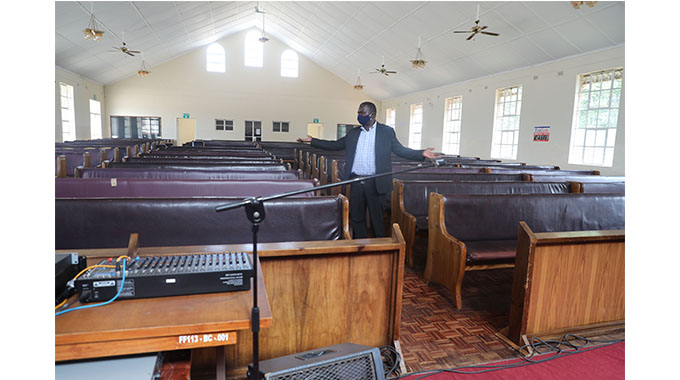
Melody Dube, Features Reporter
ZIMBABWE has so far been through two intense Covid-19 induced national lockdowns imposed in an effort to slow the spread of the pandemic.
Like other countries, Zimbabwe has had to enforce lockdown regulations as it tries to protect its citizens.
As a result, most businesses were forced to shut down with the exception of essential service providers.
Churches were also among entities that were forced to close their doors.
Vice President Constantino Chiwenga, who is also the Minister of Health and Child Care early this year said gatherings were reduced to not more than 30 people at all funerals. All other gatherings at weddings, churches, bars, bottle stores, gymnasiums and restaurants were banned.
According to the World Health Organisation (WHO): “Since mass gatherings have substantial political, cultural, social and economic implications, authorities should assess the importance and necessity of an event and consider the options that it may take place, provided all associated public health risks are adequately addressed and mitigated.”
Due to this recommendation, authorities in all countries are mandated to impose regulations concerning mass gatherings.
WHO recommends that events be hosted online, remotely or virtually.
This is what most churches have been doing since physical church services were considered super spreaders of the virus.
Church services are mostly held on social media sites such as Facebook and WhatsApp as a significant number of people have access to these platforms.
The measures by Government to help slow the spread of Covid-19 should be acknowledged as we have seen a decrease in cases and deaths day by day.
However, churches should not have been subjected to a total shutdown considering their impact in the lives of many Zimbabweans.
Religion has always played a major role in the State’s affairs and should therefore be counted among other essential service providers such as hospitals, pharmacies and supermarkets.
Zimbabwe has relied on faith through many situations.
Churches have over the years played a key role in helping the country deal with many issues and consequently brought us to where the country is today.
Religion has its permanent place in the country’s affairs without a doubt. Its history dates back to the journey that led to liberating our nation from colonial rule in 1980.
The armies relied on spirit mediums for direction during the liberation struggle, although with time, many have segmented between traditional beliefs and Christianity.
In present day Zimbabwe, a significant chunk of the population is Christian.
The worship of God is as important as the need of hospitals to the citizens.
Again, the influence that the Church has always had justifies its necessity in the nation. The country has fought and won many battles over the years with the help of remarkable Church leaders.
Government has worked with Christian bodies such as the Zimbabwe Council of Churches (ZCC) in dealing with issues that have affected the country throughout the years. Church leaders assisted in resolving the political challenges in 2008/9. Recently, they took part in dealing with the catastrophe brought by Cyclone Idai.
Politically, economically and socially the Church lends a hand whenever issues arise.
Christianity is justifiably essential in Zimbabwe looking at the influence that it has. Therefore it becomes unfair to subject churches to an absolute shutdown in cases of a national lockdown. Just as the Christian faith has worked for our nation before, it should have been given this opportunity in the fight against Covid-19 together with Government.
Going virtual was not supposed to be the only option churches were left with.
Although the reasons for the imposition of this measure is acknowledged, it still should have come as an option that churches would voluntarily take.
In the case of churches, measures should have been done in a different way such as minimising numbers per church service.
A shutdown would be decided upon if any particular church did not meet with these requirements.
The Covid-19 era has been a time of fear, uncertainty for the future and hopelessness for many. Hence, comfort and assurance of a better tomorrow was needed. All people, even those not from the Christian family needed somewhere to put their hopes and faith in to go through the situation at hand.
Citizens were going to find that comfort in churches if only they were opened. The benefits of physical interaction exceed those of connecting online. Also, it would have done many better if they had an opportunity to meet with God in His house.
Many have died, not from Covid-19, but from fear and loss of hope.
In future crises in the nation, if ever there be any, churches should be given an equal opportunity to serve like all other essential services.


 Online Reporter