admin
admin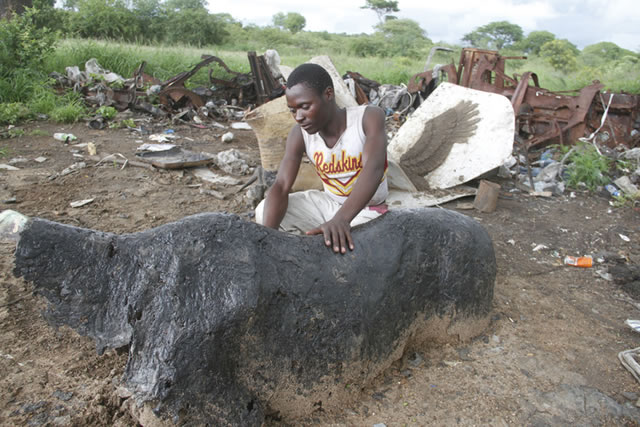
Bongani Ndlovu Saturday Leisure Correspondent
Walking down Bulawayo’s Joshua Mqabuko Nkomo Street, many a stranger has had to pause in terror, with their hearts in their mouths.
It takes a while for the stranger to realise that the lions that have seemingly invaded an urban area, are actually exquisite life-size art.
At Falls Garage, one can see a life-size giraffe nibbling at a tree, a leopard devouring an impala on a tree stump and two guinea fowls foraging in the bush. All these sculptures are part of the visual art that has sprouted over the years around the city. At the mini mall that was created by the Bulawayo City Council, one can find people taking photographs beside the life-size lions and leopards.
Interesting to note is the fact that the creators of these amazing sculptures, use plastic from the council garbage dump, popularly known as Ngozi Mine. They are virtually churning dollars from junk.
Business is brisk for the Ngozi Mine animal sculptors as they say they received a high number of orders during the festive season.
This week Saturday Leisure visited Ngozi Mine, located between Richmond and Cowdray Park suburbs where we found Crispen Sibanda (24), Mandlenkosi Ndlovu (30), Brighton Ncube (20) and Givemore Dube (21) hard at work.
They were working on a wildebeest and a fish eagle that they were going to sell to an arts enthusiast.
“The plastic we use is that one that is used to carry 2kg of sugar or rice. It is the best, because it is durable and malleable,” said Sibanda.
Plastic art seems to be popular in the city as numerous spots have animals crafted from the material. Plastic arts are in the visual art form which involves physical manipulation of a plastic medium by moulding or modelling such as sculpture or ceramics.
The visual arts are art forms that create works that are primarily visual in nature, such as ceramics, sculpture and crafts.
Orders for plastic life-size animals started flying for the quartet in at the middle of last year, increasing dramatically towards the unveiling of late Vice-President Dr Joshua Mqabuko Nkomo’s statue on December 22.
They collect the plastic from Ngozi Mine where the specific type they want is abundant. Sibanda said they are now being approached by many people for orders after they exhibited at the mini mall. He said sometimes people come to his house in Cowdray Park or they meet in town.
“Depending on who wants to have things made people make orders and we take any order. They can come to my house or find me at the mini mall or along Samuel Parirenyatwa along 12th Avenue,” he said.
For the statue unveiling some people ordered two zebras at $25 each, five lions at $25 each and three kudus at $75 each. He said they learnt the trade through observing other people at Ngozi Mine doing the same. The process of creating a plastic sculpture takes roughly a week, he said.
“We make a mould of the animal we want to create using wet sand. After that we use melted plastic to mould around the mould. When we are done, for the feet we use sticks and then wrap them with plastic and mould the feet with hot metal,” said Sibanda.
He said he uses gloss paint for the colours of the animals. The trade has enabled him to support his five siblings who are all going to school.
“I have four younger brothers and one younger sister. All of whom I am taking to school through the sculptures, which fetch me enough money to sustain myself in Bulawayo and my mother in Esigodini,” Sibanda said.
He said more people were taking up the art form and bringing up new ideas.


 Online Reporter