

 admin
admin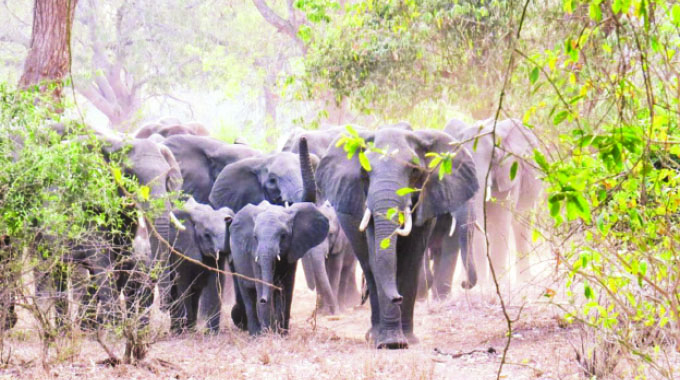
Gibson Nyikadzino-Correspondent
There is a European ignorance creeping in the mind of an African while driven by some non-state actors who continue to see Africa in a monolithic way.
Africa is not a country. It is a continent that has more shared cultural values despite different histories in the entire region. Some decisions that are being made by Europeans and are welcomed by their appendages in Africa are distorting facts and truth around the true nature of what reality is.
The way Zimbabwe is grappling with issues of human-wildlife conflict pertaining the growth of the elephant population and the impossibilities imposed by the Convention on International Trade in Endangered Species (CITES) exposes the political economy around environmental and conservation politics.
Of late, CITES after some soundless research on elephants in West Africa, came up with a general position which emphasised that elephants in Africa are an endangered species and their trade should be stopped before they go into extinction.
Whose measure is used to determine that they are endangered species?
Is the elephant population in West Africa the same as that in Southern Africa? Are elephants in Southern Africa threatened with extinction as those in West Africa?
These are some issues that the CITES has failed to apply in dealing with issues affecting other African countries like Zimbabwe.
Statistically, Zimbabwe and Botswana are home to at least two-thirds of the world elephant population.
In Zimbabwe, if science is still relevant to CITES, the 90 000 elephants in Zimbabwe whose land capacity caters for at least 45 000 elephants cannot be monolithically seen as a threat to the extinction of the elephant specie when compared to those in West Africa.
Changing dynamics and the emerging relationship between the shifting global environment and the institutional inertia of CITES demands a realignment of what is said in theory and practical application.
Where science and empirical reality are needed, CITES uses politics.
In its current form and character, CITES is serving to reinforce and deepen the existing global inequalities.
Of late, non-state actors like CITES have replicated the dominance of the north on nations of the south using the environmental debate in which only their views are holding and directing issues around species and environmental sustainability.
Organisations like CITES are becoming bigger and more powerful than state actors and inherently projecting power imbalances that are now being reproduced among many other international institutions.
There are two things that have dominated the world since the turn of the millennium: the environment and terrorism.
For both, there are positive and negative outcomes they present.
The environment debate has been sold as a platform for hope into the future while terrorism presents dreaded dangers.
While terrorism, either state-sponsored or conducted by terror groups, its condemnation has been globally done without equivocation.
However, the politics around the environment has been presented to the developing countries without sustainability mechanisms, but institutional rigidity.
CITES is now a privatised global platform that is showing and flexing muscles on what non-state actors can do, which is now self-expressing and observable with the political influence the convention now wields.
Political game, political goals
The way the global architecture is designed to run politically, socially and economically has over the years been perfected to ensure that a few people benefit out of it.
A new dimension has however come through, whose advocacy and agenda are also meant to benefit the few and meet their political goals.
Environment and ecological debates panning out in contemporary discourses are already becoming political to benefit a few individuals, or just the white people. Impositions being placed by CITES as a governing institution to control the movement and sale of stocked resources which when disposed, member states can benefit economically, are calculated to further alienate Zimbabwe.
Zimbabwe finds itself in that peculiar picture. Undoubtedly, scientific evidence is showing that Zimbabwe has a huge population of elephants.
Additionally, the country sits on 136 tonnes of ivory and rhino horns worth about US$600 million which CITES does not want sold, even when the proceeds are to be reinvested in environmental projects to curb the human-wildlife conflict.
CITES has not provided Zimbabwe with a penny to deal with the human-wildlife conflict that is affecting thousands in areas like Chiredzi, Chipinge, Hwange, Binga and Mbire.
Millions of people have had their daily livelihoods and crops destroyed by elephants in Zimbabwe.
Without fear of contradiction, with each day the elephant population in Zimbabwe grows, it means the animals are becoming a threat even unto themselves as the land they live is not expanding when their population is.
Because politics is a game of numbers, the case for Zimbabwe to CITES has been walled. Many African countries have voted against the case of Zimbabwe not looking at the scientific scope, but the political angle.
Animal rights activists have been at the fore to turn a blind eye on issues of science and have preferred to serve the master that gives money!
Remember Cecil the Lion
Recall the noise that was made by animal rights activists and conservationists in July 2015 when an American Walter Palmer shot a lion named Cecil at Hwange Game Park.
White animal rights activists used the hashtag #CecilTheLion which appeared almost 250 000 times in 24 hours while propagated by animal rights groups.
They raised awareness and used the same opportunity to look for funds that were believed to be coming to Hwange National Park to ensure that animals are protected from trophy hunters.
Of the over US$10 million raised, no money was channelled to Hwange National Park for the reasons best known to them. This indication clearly exposes how animal rights groups and the so-called environmentalists pursue goals that turn grievances into political issues that financially reward them.
No other alternative?
The continuous rise in the profile of the environment and wildlife issues in politics reflects growing concern that the world may be facing a large-scale ecological crisis.
The politics informing the CITES decision to make it impossible for Zimbabwe to fully benefit from its wildlife resources makes the whole organisation inherently political.
Like how the world is being hoodwinked to look at the case of Zimbabwe along the lines of elephant extinction, even in the energy and coal sector, the developing world is being sold dummies.
Germany, regarded as a champion of green energy, houses one of the biggest open cast coal mines in the world. The mine, Welzow Süd in the Lausitz Lusatia region, sits on an 8900 hectares piece of land. Today Germany heavily relies on its coal deposits to generate electricity, and will be doing so at Welzow Süd for the next 18 years.
Hwange’s coal deposits are nothing compared to those at the Germany mine.
With differences in economic development, Western developed countries continue advocating a stop on the use of fossil fuels to the detriment of developing economies.
The developing world is cautioned and discouraged from using coal to generate electricity yet the developed world has alternatives from centralised technology they do not intend to share with the developing world and also in their use of nuclear energy as an alternative source.
There are pressing issues that affect the developing world they are barred from doing while in the background those who control the direction of world directions find please to do.
Regarding the ivory and energy issues, the reasons Africans are told do not reflect the reality they face.
Even when science proves otherwise, in the developing world, especially Africa, people are told that there is no alternative to the institutional positions set, even when they defy the logic of science.
And we are told that there is no alternative, yet all we need is the wish to survive, for we are the ones experiencing the ecological and environmental dangers of the curse of human-wildlife conflict.
It is high time Zimbabwe’s interests are prioritised!



 Online Reporter