admin
admin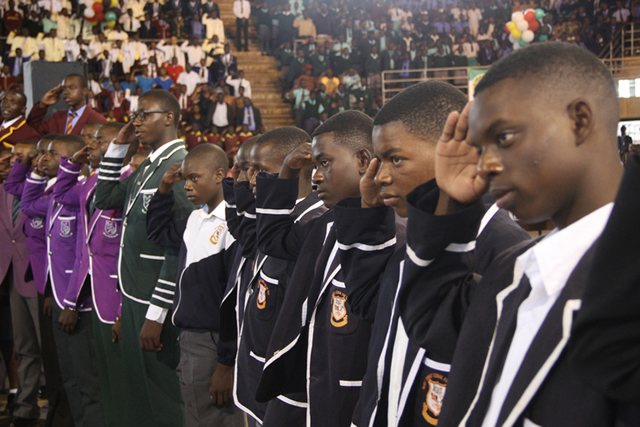

Stanely Mushava and Tafadzwa Ndlovu
Citizenship education, chiefly the building up of students to be responsible, enlightened and engaged citizens has once again come under spotlight following the introduction of the national pledge. Government officially launched the national pledge across all the provinces last week. The pledge is designed to encourage a patriotic work ethic among students.It upholds honesty and hard work, while affirming freedom, justice and equality as national values.
The values promoted by the pledge are fundamental features of citizenship education which is meant to equip students with basic rights, values, duties and responsibilities.
The idea of a pledge has been welcomed, especially considering that genuine patriotism seems to be in short supply, particularly in the country’s corruption-riven corporate and political sectors.
Although there has been dissent around technical aspects, the pledge in principle has been acknowledged as an important instrument of citizenship education.
Veteran educationist Dr Caiphas Nziramasanga told Herald Review that the pledge came about partly in response to the observations raised in the Report on the Presidential Commission of Inquiry into Education and Training which he chaired.
“There were a lot of vandal attitudes which were being allowed to develop from the school level to the national level.
“As we were doing our research, we observed that students across the country lacked a sense of ownership and values and they were growing with this negative energy into society,” Nziramasanga said.
“Violence and vandalism were becoming prevalent among students and yet when you go back to our values you that what we call Zimbabwe is the people, the land and the property. Whatever grievances you have, you never go against this three because they are the nation and when you go against them you are also prejudicing future generations.”
The commission, which submitted its findings at the turn of the millennium, observed that citizenship education was going to be a central feature of education in the 21st Century.
It recommended, among other things, that citizenship education be internalised in students through participation in appropriated civic activities at school, community and national level.
The pledge reads:
“Almighty God, in whose hands our future lies, I salute the national flag.
“United in our diversity, by our common desire for freedom, justice and equality. Respecting the brave fathers and mothers who lost lives in the Chimurenga/Umvukela and national liberation struggles.
“We are proud inheritors of the richness of natural resources. We are proud creators and participants of the richness of our natural resources.
“We are proud creators and participants in our vibrant traditions and cultures. We commit to honesty and the dignity of hard work.”
The Nziramasanga Commission particularly acknowledged the challenge of globalization.
It further remarked that schools were supposed to take their place as key social engines to inculcate a sense of identity and responsibility.
“In the fast and interdependent global village of the 3rd Millennium, Zimbabwe cannot watch its youths tossed about by all winds of change. We should progressively select the influences we need,” the commission noted.
It also warned against the danger of schools producing a disenchanted generation which is not loyal to Zimbabwe, rather favouring foreign influences.
Dr Nziramasanga noted the deviant practices such as homosexuality being adopted by some Zimbabweans through online media and other influences.
“But a person with appropriate civic education knows who he is and is clear about what to shun. Cases of corruption and tax evasion are also a result of people lacking civic education.
“The pledge is just one part of the effort to correct this but other social engines such as family, religion and the media must also collaborate towards the development of a morally rounded citizen,” he said.
Higher education has incorporated civic education with compulsory courses such as Peace Leadership and Conflict Transformation in state universities and National Strategic Studies in teachers’ and polytechnic college.
While these are bent to critical engagement with civic issues, the pledge breaks down basic values for internalisation by students at the primary and secondary levels.
The content of the pledge is, however, currently the subject of religious and civic controversy.
The pledge does not acknowledge a particular faith but opens with an invocation of God and affirms allegiance to different national symbols.
Dissenting motivations vary among parents, teachers and church leaders, but opponents concur that it was necessary to consult and solicit contributions for the pledge from the cross-section of stakeholders in order to forestall scruples.
Opponents to the pledge, as it is presently constituted, say that debate must have preceded the pledge instead of being deferred to the “post-mortem.”
Dr Nziramasanga, however, argues that the pledge was reached upon consultatively since the principle and much of its content are drawn from a nationally ratified constitution, technically developed and endorsed by elected representatives at cabinet level.
He took exception to critics’ objections to the content, arguing that national symbols represent the country to which everyone should be loyal.
As for public perception that there was a looming separation of the church and school, given the ban on churches from operating in school premises, speculation about the overhaul of Scripture Union and the scrapping of prayer at assembly, Dr Nziramasanga said education and religion can perfectly co-existed in schools.
“There are positive values in religion, particularly Christianity, which concur with our indigenous values of Ubuntu. Prayer itself is a form of moral instruction.
“I do not think there is need to curtail the positive influence of religion in schools, especially considering that most schools are Christian.
“There is no contradiction between citizenship education or education in general, with religious extra-curricular activities. But if the ministry chooses to go the separation route, there must be consultations and a clear statutory instrument to that effect,” Nziramasanga said.
However, some Christian leaders argue that the Primary and Secondary Education Ministry must have opened the door for citizens to directly contribute instead of presenting a document which was no longer on the table for deliberation.
Primary and Education Minister Dr Lazarus Dokora argues that the wording of the pledge is drawn from the preamble of Zimbabwe’s Constitution and is not call to paganism.
“There is no other God that is acknowledged in the school pledge, neither does the school pledge demand worshipping or bowing to any other god,” Minister Dokora said in his opposing affidavit.
“The new framework is premised on among other things, values, so eloquently described by the Presidential Commission of Inquiry into Education and Training (CIET) chaired by Dr Caiphas Nziramasanga as missing from our education system,” he said.
Minister Dokora maintained that the pledge is not a prayer but simply a commitment which begins by acknowledging God.
In an interview with Star FM, Dokora addressed issues of faithful retention.
“The preamble to that Constitution has given us the terms. We have simplified where the Constitution said as forbears. The Constitution, also in the preamble, commit to honesty and the dignity of hard work, that’s all we are committing to,” he said.
“And we said if we say ‘we’ for the little ones, they might get lot so we sought editorial authority to say we should be saying so I for the junior and secondary schools so I commit to the dignity and honesty of hard work who doesn’t want to commit to honesty, who doesn’t want to commit to the dignity of hard work?” Minister Dokora challenged.
Apparently, the minister is fighting on two fronts.
Other dissenting opinions are altogether against the invocation of God from secular motivation.
“Maybe we should have started earlier because there are others who say ‘Why acknowledges God? We are on our own here on earth.’ Then I said look ‘It’s not me. We are finding ways to teach a value system so if you have problems with the pledge, means you have problems with the constitution,’” he said.
“So what you take to the High Court or what you take to the Constitutional Court it not the pledge but it’s the Constitution.
“And, of course, the Constitutional Court is where the experts are and they will be able to help us all but otherwise the words are taken from that preamble,” Minister Dokora added.
Meanwhile, the conservative tendency of Zimbabwe Christians is jittery that the pledge will be the ministry’s instrument for supplanting the Lord’s Prayer from schools.
Zimbabwe is a secular democracy but Christianity is the majority religion, estimated at above 70 percent of the country’s population, and prayer has been an enduring feature in schools, apparently as a trace of the missionary factor in the country’s educational sector.
Parents opposed to the pledge argue that it is a prayer which elevates secular symbols such as the national flag and deceased liberation war heroes, which scenarios they equate to idolatry and ancestral worship.
As such, opponents to the pledge argue that presenting it as a compulsory requirement violates the liberty of conscience, a value provided by Zimbabwe’s Constitution.
Critics have also invoked a constitutional line of attack that “no person may be compelled to take an oath that is contrary to their religion or their belief”?
Some have gone so far as to suggest that “Almighty God” is being merely invoked as a mediator to these “secular symbols,” hence going against the scruples of religious people who regard God as the supreme authority.
Others are challenging the ministry on the basis that implementing the pledge is essentially requiring an oath from minors.
Thando Nkomo, an academic with the National University of Science and Technology (Nust) said there must be a balance whereby Christians should respect the desire of the nation to have a pledge, while Government maintains its sensitivity to liberty of conscience.
“Zimbabwe is a secular nation not a theocracy. Citizens are fortunate that they have not been put in situations that compel us to deviate from freedom to exercise religious beliefs and practices. When a country enacts laws that seek to curtail worship, then we can get worried,” Nkomo said.
“If some people feel that the pledge is a call to paganism, then they should not be forced to participate. Forcing someone to act against their will is a suppression of liberty of conscience,” he said.
Nkomo said it was ideal to consult and solicit content from different stakeholders like parents and teachers before coming up with a pledge.
“The content of a nationally binding pledge should have been debated and agreed upon. Policies should come from the peoples. Leaders must not come up with policies without consulting the people who elect them,” Nkomo said.
“When we came up with a new national anthem, there was involvement and transparency. That’s why people did not have problems with it,” he said.
Solomon Saungweme said Government, parents, teachers, traditional leaders, religious groups and other stakeholders are also important contributors to civic education.
“A national pledge is ideally common ground where we hold things that are most assuredly believed among us about Zimbabwe. The diversity that is upheld in the pledge must have been reflected in the authorship of the same. Given this missing dimension, the current pledge falls short of its ‘national’ adjective.
“The idea is not just to make people pledge; rather people must be convinced and convicted about what they are saying. In the church we say ‘I believe, therefore I speak. Belief and conviction cannot be played down,” he said.
On a summative score, patriotism and social engines such as religion and the media are not mutually exclusive and must be allowed to grow together.
Feedback: [email protected] and [email protected].


 Online Reporter