admin
admin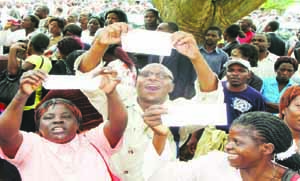
In other countries, the protracted demands for a salary increment would have ground public service delivery systems to a halt.
Some say it is a “miracle” that the civil service is still able to offer services under such circumstances.
Perhaps the fact that the public service is still functional shows the high level of patriotism of the nation’s civil servants.
For the last two years, the public servants have been seized with negotiating for a salary increment, with the matter becoming topical and contentious.
Strikes and demonstrations have been held and several threats of work stoppage issued, but the civil servants are still to get what they think they duly deserve.
After all their efforts, it appears the civil servants are now at a crossroads regarding what type of action will jog the Government into action.
What really is the way forward for civil servants? What options do they have?
“There has been a protracted argument with no solution in sight,” said Mrs Tendai Chikowore, chairperson of the Apex Council, an umbrella body representing Government workers.
“Our hope now lies with President Mugabe, with whom we have requested a meeting. We cannot say what the course of action is before we meet the President.”
Mrs Chikowore said civil servants had noted that certain politicians were turning their plight into a political circus.
“We are not politicians,” she said.
“We have told our members to be patient and they have understood our position.”
That civil servants are among the lowest paid workers in Zimbabwe is in no doubt.
Many are wondering how the Government workers are surviving, considering that the lowest employee gets US$150 against the poverty datum line of more than US$500.
Yet the salary dispute is set to drag on, with the Minister of Finance, Tendai Biti, saying there is no money for that purpose.
This has thrust Mr Biti in the position of number one enemy for the civil servants, who view him as the major stumbling block to their salary demands.
Mr Biti’s predicament has not been helped by reports indicating that recent diamond sales have raised enough money to pay the civil servants.
The civil servants had their hopes raised recently when reports indicated that money for their salaries had been found.
But Minister Biti turned their joy to sorrow when he told them a few days later that no salary increase would be effected.
In fact, the Minister of Mines and Mining Development, Cde Obert Mpofu, recently said a verification and reconciliation of proceeds from diamond sales showed that nearly US$167 million had found its way to Treasury.
President Mugabe had since indicated that the civil servants would get a salary increment from the diamond proceeds.
“We met with Minister Biti who acknowledged and accepted the reconciliation of the US$174 million and this was reported to Cabinet,” Cde Mpofu said at a recent Press conference.
“The objective (of the verification and reconciliation) was to address the plight of our civil servants. The civil servants’ plight needs our united attention.”
Despite such assurances, civil servants still find themselves not sure of when they will get the much-awaited salary increment.
They were further irked recently when it emerged that Government ministers had been awarded a salary increment of 200 percent.
The ministers were reportedly now earning US$2 300 per month before deductions and taking home US$2 000.
This was set against the US$150 that is earned by most civil servants.
Zimbabwe Teachers’ Union chief executive Mr Sifiso Ndlovu said the civil servants’ salaries should be treated as a national problem.
He said the national budget’s capacity must be enhanced to ensure that more resources are available for the civil servants’ salaries.
“Nothing tangible has come out of all our discussions despite putting our suggestions on the table,” said Mr Ndlovu.
“There is absence of a clear direction from ministers on the issue of civil servants.”
The civil servants feel hard done by the Government ministers who seem to squabble while their plight is not addressed.
Mr Ndlovu said it was within President Mugabe’s powers to give direction over the issue.
“We feel that the President is putting his shoulder behind the wheel,” he said.
“But we are seeing a new development where some ministers want to use our poverty for their own benefit.”
It is obvious that Mr Biti has created a storm for himself because of his utterances, especially against the civil servants.
It appears that almost everyone, including some from the MDC-T, are blaming Mr Biti for failing to act with regards to the salary increment.
There are reports that the minister plans to divert proceeds from the diamond sales to pay part of the country’s US$7 billion external debt.
The Public Service Commission (PSC) chairperson, Dr Mariyawanda Nzuwah, recently told a parliamentary portfolio committee that Mr Biti had shot down a proposal for a salary increment for civil servants.
He said the PSC submitted a proposal to Treasury of a basic minimum monthly salary of US$300 against the civil servants’ demands of US$500.
Dr Nzuwah said it was unbelievable that Treasury believed a person could survive on a salary of US$150.
“When they walk into a shop, the storekeeper does not say because you are the least paid, I am reducing the price,” said Dr Nzuwah.
The International Monetary Fund (IMF) has also been embroiled in the civil servants’ salaries dispute and has urged Mr Biti not to effect any increment.
IMF deputy director for the African Department Sharmini Coorey said salary increments for civil servants would derail economic recovery.
Such utterances have incensed civil servants, who are finding it difficult to make ends meet.
Government statistics indicate that there are 236 000 civil servants.
Observers believe that sustainable solutions to the plight of civil servants would be to avail long-term incentives.
The benefits could include housing schemes, mortgage facilities and any other incentives that can reduce the workers’ expenses.
Although the Government has limited resources, it has in the past managed to offer incentives such as transport and low-cost housing.
If such initiatives are pursued, civil servants would have fewer commitments when they receive their salaries.
But it remains to be seen what solutions will be brought forward by the Government to solve the problem.
In the meantime, the civil servants remain waiting, hoping that one day their prayers will be answered with a living wage.-The Sunday Mail



 Online Reporter