Chronicle Editor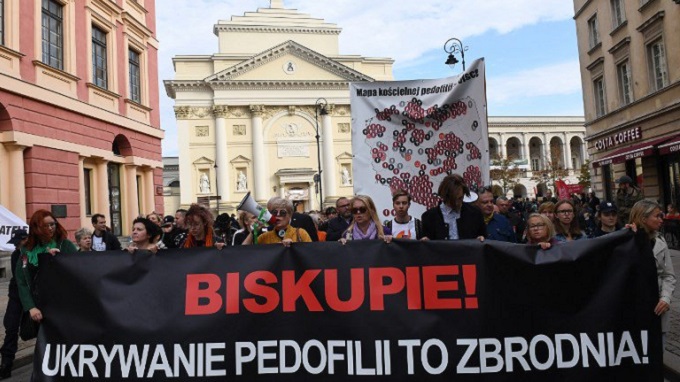
ALINOWKA (Poland) – The former Catholic priest of the Polish village of Kalinowka is serving three years in jail for molesting five schoolgirls.
But Marta Zezula, a mother whose testimony helped convict him, says the priest’s victims are the ones made to feel guilty.
“We are witches . . . because we have pointed at the priest,” Zezula fumed as she shovelled straw into a chaff cutter in her barn in the tiny settlement in eastern Poland.
Many parishioners believe she and other mothers of those molested “simply convicted an innocent man”, she said. Home to about 170 people, Kalinowka is a short drive from the main road, but feels more remote.
The Holy Cross church, built in 1880, sits on a hill overlooking rolling farmland and forests full of deer.
Krystyna Kluzniak, hurrying into the well-kept church on a chilly November evening, said people should give the jailed priest a break. “The priest was cool and we miss him,” she said.
The priest, who cannot be named under Polish law, is now on trial again, charged with molesting another child. His lawyer, Marek Tokarczyk, said he denies the allegations. “We need a fair trial,” Tokarczyk said.
Similar scandals have shaken the Catholic Church and split communities in the US, Ireland, Australia and elsewhere.
But Poland is one of Europe’s most devout nations, where most people identify as Catholics and the Church is widely revered.
Priests were active in the fight against communism and in 1989, led by a Polish pope, John Paul II, the Church helped overthrow Communist rule.
Divisions over allegations of abuse are particularly stark here, said Marek Lisinski, the director of “Have no fear”, a group that advocates for victims of clerical abuse. Parishioners often side with priests and ostracise victims and their families, Lisinski. said.
In October, “Have no fear” published a map that revealed the scale of the issue. It used black crosses to mark places where 60 priests had been convicted of abuses dating back to 1956.
Afterwards, Lisinski said, people called in to report another 300 cases of suspected abuse by priests which they had not raised with the Church or police for fear they would be doubted or shunned.
– Reuters.



 Online Reporter