Online Reporter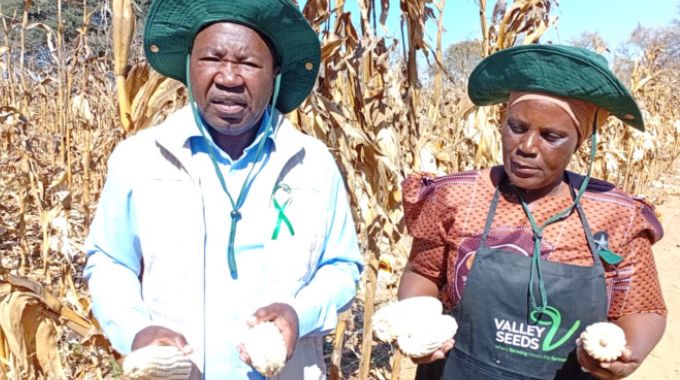
Raymond Jaravaza, [email protected]
FOR years, every farming season brought fresh disappointment for the Mthombeni family of Village 1B in Umguza District, Matabeleland North Province.
As temperatures rose, rainfall became increasingly erratic and prolonged dry spells scorched their fields and the family watched their harvests shrink year after year.
Like many communal farmers in the drought-prone district, Mr Sofly Mthombeni and his wife, Ottilia, struggled to produce enough maize and small grains to feed their family, let alone sell surplus grain to the Grain Marketing Board (GMB).
Their fortunes, however, took a dramatic turn three years ago when they embraced Intwasa/Pfumvudza, the Government’s climate-smart conservation agriculture programme that has become one of the flagship food security interventions under the Second Republic.
The programme, which promotes minimum soil disturbance, efficient water harvesting, mulching and timely planting, is specifically designed to help farmers in low-rainfall regions such as Matabeleland North, where most areas fall under natural regions four and five, characterised by high temperatures and unreliable rainfall.
Today, the Mthombeni family has become one of Umguza’s model farming households, demonstrating how climate-smart agriculture can transform rural livelihoods even in some of Zimbabwe’s harshest farming environments.
Their success farming story recently attracted senior Government officials led by the Permanent Secretary in the Ministry of Lands, Agriculture, Fisheries, Water and Rural Development, Professor Obert Jiri, who visited the family homestead on Friday during a field day attended by farmers and agricultural stakeholders.
The family’s transformation reflects President Mnangagwa’s broader drive to attain national food security and build climate-resilient agricultural systems through programmes anchored on the Agriculture and Food Systems
Transformation Strategy, the Presidential Inputs Programme, irrigation development, mechanisation, village business units (VBUs) and conservation farming.
The 2025/26 summer cropping season proved to be the family’s most rewarding after Umguza received above-normal rainfall.
“We managed to harvest six tonnes of maize from our Intwasa plot. The advice from our local Agricultural Business Advisory Officer was invaluable because she guided us from planting right up to harvesting,” said Mr Mthombeni.
He encouraged fellow communal farmers to adopt the conservation farming model.
“My advice is for other villagers to embrace Intwasa because it improves yields. Even during drought years when rainfall is poor, the programme helps farmers to harvest something.”
Besides maize, the couple also recorded bumper harvests of sorghum and groundnuts.
“We reserved part of our land for sorghum and groundnuts and both crops performed very well. We have also been encouraged to try sugar beans next season and we are looking forward to that,” said Mr Mthombeni.
Beyond improving household food security, the maize stalks will provide valuable livestock feed during the dry season when grazing becomes scarce, further strengthening the family’s resilience.
For Mrs Mthombeni, the greatest advantage of Intwasa is that it makes successful farming possible even for households without tractors or draught power.
“Traditional farming requires farmers to plough using tractors or cattle, but Intwasa allows us to prepare planting stations using simple tools such as hoes and picks.
“Many families do not own cattle or donkeys, but they can still realise good harvests using this method. Since we
started practising Intwasa, our yields have improved significantly,” she said.
Recognising the family’s success, Government announced that the Mthombeni homestead will become one of the village farmer field schools where surrounding communities will receive practical demonstrations on climate-smart farming under the guidance of agricultural business advisory officers.
The initiative forms part of Government’s plan to establish 35 000 village farmer field schools nationwide as centres for knowledge sharing and farmer-to-farmer learning.
Supporting the initiative, Valley Seeds commercial business director Mr Tichawona Mapongah said the company would equip the learning centre with stationery, writing boards and other teaching materials.
“The Mthombeni family has demonstrated that climate-smart farming is the future of agriculture in Zimbabwe. Their homestead will become a learning centre where neighbouring farmers can acquire practical skills on Intwasa/Pfumvudza and replicate the success in their own fields,” he said.
Mr Mapongah said farming must increasingly be viewed as a business capable of transforming rural livelihoods and contributing to national economic growth. The agricultural sector continues to play an increasingly important role in the country’s economic transformation.
Agriculture has grown from a US$5,6 billion industry in 2020 to US$10,3 billion in 2025 and is projected to reach US$15,8 billion by 2030, driven by increased production, value addition, climate-smart farming and expanded irrigation under the Second Republic.
President Mnangagwa has consistently underscored agriculture as the backbone of Zimbabwe’s economy, with the Government pursuing policies aimed at achieving sustainable national food self-sufficiency, building resilience against climate change, expanding irrigation infrastructure, increasing mechanisation and transforming agriculture into a commercially viable sector that contributes to the attainment of Vision 2030.
Addressing the gathering, Prof Jiri said the village farmer field schools would become a critical pillar in accelerating agricultural knowledge transfer across rural Zimbabwe.
“The village farmer field schools will be established at the homesteads of our 35 000 village heads across the country, with Agricultural Business Advisory Officers conducting weekly practical lessons,” he said.
Prof Jiri said the training will cover crop production, livestock management and other farming enterprises.
“Government expects village heads to mobilise their communities so that every farmer benefits from these practical lessons,” he said.