Online Reporter
Limukani Ncube
IN the heart of Nkayi, under the fading Matabeleland North Province sunset, culture did not just appear – it arrived clothed in meaning.
At this year’s Imiklomelo KaDakamela Cultural Festival, men did not simply dress, they expressed identity. From Zimbabwe to Tanzania, Zambia, Botswana, Kenya and South Africa, chiefs, royalty, scholars, Government and local authority officials and villagers came together in a vibrant display of colour, leather skin, feathers and beads.
Yet beneath the spectacle lay a deeper question: what do these traditional garments truly represent?
What became apparent is that what people put on at cultural festivals is more than just fabric or leather. It is a language of identity, heritage and pride. The late historian and cultural expert, Pathisa Nyathi, is on record saying traditional attire carries a lot of meaning.
“Regalia or dress expresses a people’s culture in more ways than one. It expresses their historical experiences, their view of the world, ideas about gender issues, socio-economic and political standing, among other considerations.”
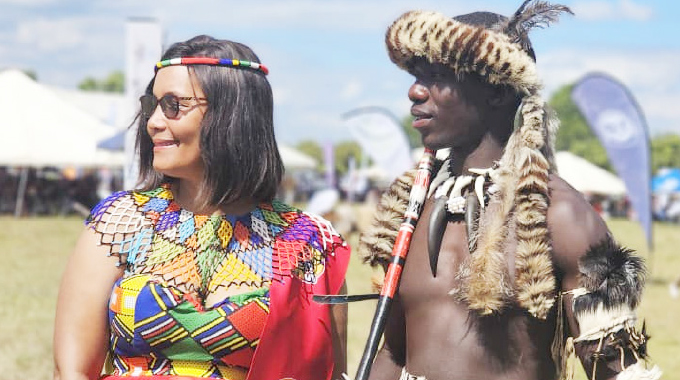
The most striking feature of the Chief Dakamela festival was the dominance of amabhetshu – the traditional leather apron worn by Ndebele/Zulu men. To the untrained eye, it is simple attire. However, to those who understand, it is a statement of identity, discipline and heritage.
According to a culturalist, poet and musician, who attended the Nkayi cultural event, Albert Nyathi, amabhetshu are not worn casually.
“Traditionally, they are reserved for ceremonial and cultural occasions. They symbolise manhood, responsibility and belonging and their patterns and materials can reflect status and lineage. They are for such events.
“You can see that even those dressed in modern clothing have submitted to tradition with many donning leather headgear, signalling respect for culture in a rapidly modernising world,” said Nyathi. Across the Chief Dakamela festival grounds, attire revealed a silent hierarchy.
Some men wore izikhindi – minimalist animal-skin garments that speak to ancient warrior traditions. Others appeared in full regalia, adorned with feathers, skins and symbolic accessories. The attire symbolised different aspects of people’s livelihood.
Adding deeper meaning to the occasion, South Africa’s Zulu royals, led by Prince Thulani Zulu, honoured Chief Dakamela with a symbol of leadership when they gave him a lion-claw necklace (inzipho zeBhubesi) during the festival. They explained that in African spirituality, lion claws embody bravery, strength and protection. It was not just a gift. It was a recognition of authority, courage and custodianship of culture.
And not everyone wears amabhetshu from any animal. For example, in Nguni culture, a leopard skin is not fashion; it is royalty, reserved for kings and chiefs. And feathers (ifefe) signal rank and spiritual connection. Each garment and the skin of the animal used represent hierarchy and social standing.
“Kings and chiefs use certain animal skins which show their status. Lions and leopards are not for any ordinary person,” added Nyathi.
He pointed out that each element carries meaning. It also applies to women, as a woman’s leather skirt (isidwaba) carries dignity and womanhood. Beadwork speaks to relationships, respect and identity, while headgear speaks to maturity and social standing. These are not costumes. They are arches worn on the body.
“However, one of the most misunderstood aspects of traditional attire is access. Not everything is for everyone. Certain skins and ornaments are earned, not bought. Some regalia is restricted to chiefs, elders, warriors, the young and the old and wearing them incorrectly is not fashion – it is cultural misrepresentation. This applies to both men and women.”
One of Chief Dakamela festival’s most powerful images came from the cross-border presence of Nguni cultures. The AmaNdebele from Mpumalanga in South Africa stood out in their multi-coloured blankets, blending artistry with identity. Botswana and Zambia traditional chiefs and royalty representatives echoed similar traditions – rooted in their shared ancestry. Despite borders, the message was clear that culture travels and identity endures.
Arts practitioner and choreographer Saimon Mambazo Phiri says what started as a local cultural gathering has grown into something much bigger, now drawing participants from across the region. Imiklomelo KaDakamela has become a regional meeting point for culture.
It is also emerging as a research hub, attracting university students and academics and serving as a living archive of African identity.
“This is no longer just a festival. It is a knowledge system where culture, history and identity are recorded in real time. It has grown significantly and has the potential to become even bigger. We all need to support this initiative,” he said.
The festival’s growing influence has not gone unnoticed. This year, it was graced by Hon Emily Jesaya, the Deputy Minister of Sports, Recreation, Arts and Culture, as guest of honour, following last year’s attendance by Tourism Minister Hon Barbara Rwodzi.
This level of endorsement signals one thing: Culture is no longer peripheral, it is national policy.
While modern fashion continues to dominate urban spaces, festivals like Imiklomelo KaDakamela remind Zimbabweans of a fundamental truth that traditional attire is not outdated – it is encoded history.
As drums echoed and fires burned into the night, one truth stood clear: Africa’s future may be modern, but it is rooted in its past.
At Imiklomelo KaDakamela, that memory is not written in books — it lives in what people wear, carry and proudly preserve.


 Bongani Ndlovu