Chronicle Editor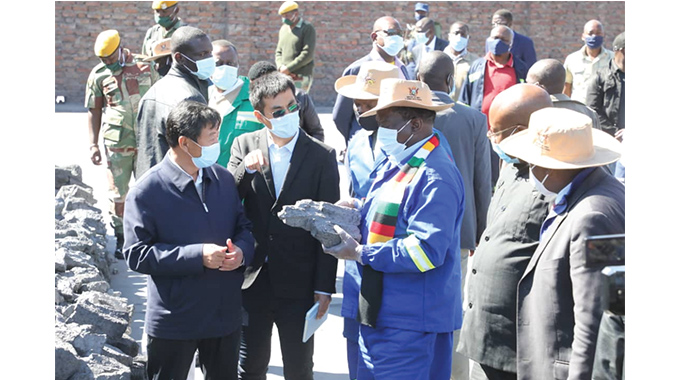
Prosper Ndlovu recently in Hwange
THE growing coal and energy projects in Matabeleland North province will add greater impetus to the country’s re-industrialisation agenda with cross-cutting impact on wider business operations, Industry and Commerce Minister, Dr Sekai Nzenza, has said.
The energy supply gap is one of the major constraints affecting domestic industries while potential foreign investors also pay critical attention to energy efficiency. Competency in this sector, coupled with a robust domestic raw material base and supportive doing business environment, are some of the top investment pullers.
Reflecting on last week’s two-day visit to Hwange by President Emmerson Mnangagwa, where he toured several coal mining, coke and power generation projects set to yield an additional 3 000MW to the national grid, Minister Nzenza said the fruition of these projects lays a solid base for a thriving manufacturing industry and commerce. The projects run into billions of dollars and dovetail the mining sector’s US$12 billion economy by 2023.
The manufacturing sector is expected to benefit more from these investments and contribute significantly in terms of export earnings, trimming budget deficit and creating high value jobs as expressed in President Mnangagwa’s vision of creating an upper middle-income economy by 2030.
“The visit to the coal mines with His Excellency and ministers was a significant milestone in demonstrating the synergy between mining and industry. Thermal coal is used in the processing of many agricultural products such as soya beans oil, cotton seed oil, tea processing , tobacco curing,” she told Business Chronicle.
“Zimbabwe has significant amounts of high-quality coking (metallurgical) coal, a highly specialised coal with particular chemical and metallurgical properties required for industrial purposes.
“The primary use of coking coal is to produce coke, which is utilised as a reductant in steel production.
“Steel in turn, is the cornerstone of any modern civilization, with applications in construction, plant and machinery, transport and household appliances.”
As Government works on resuscitating key industrial units guided by the “Local Content and Import Substitution Strategy”, the mining sector in particular and the agriculture sectors, are the key sources of raw materials. Industry relies heavily on coal for wider energy usage and other critical buy-products.
“Investments in coking coal production at this juncture is, therefore, critical to the country in support of Government’s efforts to revive Zisco,” said Dr Nzenza.
“Specialists in the steel industry say that it takes around 770 kilograms of coke to make one tonne of steel.
“My ministry is already working with Ministry of Mines, Ministry of Environment and ZIDA (Zimbabwe Investment Development Authority) focusing on the resuscitation of Ziscosteel and RHA Tungsten, another tungsten mine in Hwange.

The mining is closely related to manufacturing in that the sector consumes intermediate goods produced by the manufacturing sector and in turn, the manufacturing sector utilises output from the mining sector as raw materials into production processes.
“The mining sector procures machinery and equipment; transport equipment, wood and wood products; chemicals, rubber and plastics; non-metallic mineral products; and fabricated metal products, among other products of the manufacturing sector,” said the minister.
In Zimbabwe the mining sector produces vast minerals ranging from gold, platinum group of minerals, diamonds, chrome, coal, copper, nickel, lithium, cobalt, among many others. All these minerals are inputs into manufacturing processes of various products. Dr Nzenza said the envisaged revival of Zisco, will also add iron and steel to our mineral produce.
“The interrelatedness of the mining and manufacturing sectors should mean that growth in one sector has spillover effects on the other. Unfortunately, the positive growth spillover effect is not being realised in our case,” said the minister.
“We are enjoying limited benefits from our mineral resources because the intermediate inputs into our mining sector are being imported hence helping to build foreign manufacturing base and in addition most of our mineral resources are exported as unprocessed raw materials, which also build foreign manufacturing industries at the expense of local manufacturing.”
Dr Nzenza said the efforts to create a robust integrated industry should contribute to tax revenues, job creation and increased GDP for the country.
As such, she said the Ministry of Industry and Commerce was implementing the Local Content Strategy to increase domestic sourcing of intermediate inputs into the mining sector. The Ministry is also implementing the Zimbabwe National Industrial Development Policy, which encourages value addition and beneficiation of mineral resources.



 Online Reporter