

 admin
admin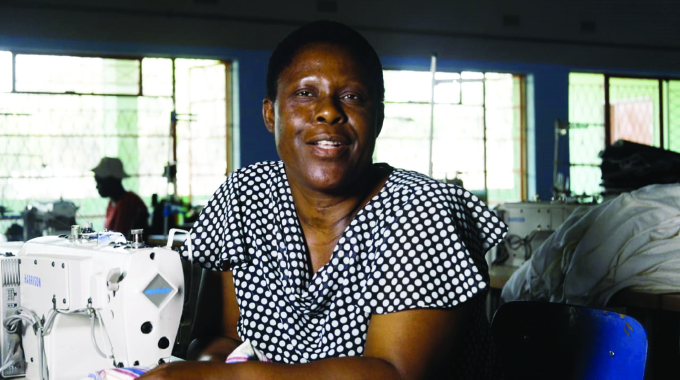
Elliot Ziwira Senior Writer
For 52-year-old Evelyn Matogo of Rockville, Chitungwiza, about 25 kilometres south of Harare, tailoring is not just stitching hastily cut pieces of cloth, hemming them up and passing them on as garments.
Rather, it is an art requiring astuteness of mind, business acumen and foresight, which only a conducive environment can support.
Exuding the confidence of one used to working the cloth to perfection, Matogo presses her foot down on the control, and guides the needle for a flawless stitch on the garment, a part of which is on the throat plate of the sewing machine in front of her.
Brimming with enthusiasm, she momentarily takes her eyes from the Harrison heavy-duty sewing machine that has become her companion for all of five years now, as The Herald would later learn, to share her threading journey.
“I joined the group in 2017. I used to work from home using domestic sewing machines,” she reveals.
Matogo is one of the 12 members of Chitungwiza Clothing Cluster in Unit A, which was funded by the Common Market for Eastern and Southern Africa (COMESA) through its industry and agriculture division in partnership with the European Union (EU).
The cluster comprises men and women united by a desire to sustain their families through economies of scale, and a shared vision. Besides permanent members, the cluster also employs members of the community depending on season and weight of orders.
Scores of citizens have reaped dividends from funding earmarked for inclusive industrialisation, private sector development and agricultural growth and transformation. One of the sectors that have benefited from such inclusivity is the clothing cluster under the cotton value chain.
The Herald has recently visited the cluster to get an appreciation of how the members are faring following COMESA’s contribution.
Giving a new lease of life to the textile and garment sub-sector, which has been reeling from setbacks in the decade following the turn of the millennium, COMESA has played a crucial role in the revival of the cotton-to-clothing value chain in Zimbabwe.
This was done through the COMESA Adjustment Facility (CAF), Regional Integration Support Mechanism (RISM), funded by the EU.
The first phase of the funds disbursement saw Zimbabwe getting €4,2 million through a Grant Agreement between the country and COMESA signed in September 2014.
The Chitungwiza Clothing Cluster and the Bulawayo Leather Cluster were buoyed by state-of-the-art machinery worth a combined US$250 000 from the EU through COMESA. They are among the 220 clusters supported by the Government of Zimbabwe in partnership with other stakeholders since 2018.
Casting a glance in either direction within the walls of the factory reveals the extent to which technology has gone in changing stories. Upon entry, one’s attention is immediately consumed by the whirring, swishing and whispering of both humankind and machines as dreams are fashioned from cotton.
The first-class equipment that captures the discerning visitor’s eye includes a computerised 6-header embroidery machine, 24 heavy-duty sewing machines, a single-header embroidery machine, an elasticator, and a computerised cutting machine.
In addition, there are buttonholes and overlocking machines.
Hence, for Matogo and her fellows at the cluster, COMESA’s intervention was heaven sent as it offered them a favourable environment for their enterprises to thrive under one roof.
“Joining the factory has helped me in many ways, both in terms of customer reach and access to equipment under one roof,” she says, adding, “Working from home was limiting because I only had a sewing machine, which means having to find an overlocking machine elsewhere.”
Formerly known as Chitungwiza Clothing Factory, the cluster specialises in the production of formal wear and school uniforms, which include jerseys and tracksuits, as well as doing cut, make and trim under toll manufacturing for big retail chains.
Cognisant of the central role that small and medium enterprises play in global economies, particularly in developing countries, the 21-member bloc aims to bolster regional integration and improve trade with the region and the EU for the greater good.
According to the World Bank, SMEs account for 90 percent of businesses and over 50 percent of employment globally.
Although seven out of 10 formal jobs in emerging markets and developing countries such as Zimbabwe are provided by SMEs, their growth has been impeded by financial constraints owing to reluctance by banks to provide them with loans.
Furthermore, research reveals that only 27 percent of women in developing countries have access to formal banking products, accounting for only 10 percent of total loans. Thus, women are closed out of opportunities that would otherwise empower them.
This is why COMESA’s intervention in bracing up SMEs in member states is vital.
To achieve this, funds have been set aside for management training skills for SMEs in garment making, fostering market linkages and procurement of top-notch equipment to heighten efficiency, hence enhancing trade competitiveness on the global stage.
In line with the philosophy, in April 2016, COMESA launched a garment making project valued at US$200 000 in Kisumu, Kenya, which benefited 430 SMEs.
Through COMESA’s commitment to reinvigorating value chains, many faces have been lit up across the agriculture and leather industries in Zimbabwe.
As Matogo testifies, many livelihoods have been transformed.
Elatedly, she says when she heard that the clothing cooperative was recruiting tailors, she inquired, and was called for an interview which she passed.
Although she was bringing in vast tailoring experience, Matogo was taken aback by the equipment before her eyes, most of which she had not put her hands on before.
“Since it was the first time for me to use industrial machines, I had to learn how to use them, which I successfully did,” she says.

Because everything she requires is within an “arm’s reach,” she can now concentrate on honing her tailoring art.
“Here there is everything, overlocking, embroidery machines, and all, which we use free of charge. Customers know that all their tailoring needs are met at the garment cluster, so they throng here in their numbers,” says Matogo.
The acquisition of equipment and pooling of resources has enabled the cluster to build a broad clientele base, rolling out high quality apparels that find home in upmarket retail houses and learning institutions across Zimbabwe and beyond.
COMESA capacitation has boosted the cluster’s production levels to over 200 garments per day, and empowered it to be cash flow self-sufficient.
“Because we are a company, when we receive big orders, say to supply school uniforms, we work as a team through line work with each member undertaking a specific task,” Matogo says. “If there are no orders to work on as a group, each member works independently to meet individual customer demands.”
Another member of the cluster, Toria Mheta (46) of Unit ‘O’, Chitungwiza, weighs in, saying the investment has enabled her to do all that tailoring involves without changing bases.
“I have been working here for five years now. I first joined as a temporary worker, and later on became a member of the cluster,” she says, all smiles. “I was taken in by the equipment here. I am happy that I can now meet the demands of my customers owing to improved efficiency.”
Efficiency occasioned by acquisition of premium equipment by COMESA in collaboration with the EU, has resulted in a self-sustained people, cheerful and motivated enough to start thinking of going it alone in business after cutting their teeth at cluster level.
“I know that even if I am working on a uniform, I only have to commit an hour and I will be done, unlike in the past when I was working from home. I had to leave my work half-done to find an overlocker, buttons and the like,” Mheta says. “Now, everything is found under one roof, which saves time.”
Mheta says her income has since improved from the time she joined the cluster, and is now thinking of daring the tailoring gods on her own.
“I now have savings. When we get orders, we are left with substantial personal savings after sales. Soon, I will be able to buy my own heavy-duty sewing machine,” she says.
Twenty-three-year-old Edwin Wafawanaka from Triangle, who has just joined as a contract employee, is overjoyed for being a part of the fast growing clothing group.
After graduating with a National Diploma in Clothing and Designing at Kaguvi Vocational Training Centre in Gweru, Midlands Province, Wafawanaka cast his net wider for opportunities, until the hornbill led him to the garment making cooperative in Unit A, Chitungwiza.
Today may be his first here, but it is certainly not his last.
It is only the beginning of a longer journey in which unity of purpose overrides individuality, for there is always strength in numbers.
Integration, embodied in COMESA, supported by the EU, and embraced by the Government of Zimbabwe, remains key in creating opportunities for the transformation of livelihoods across the region.
COMESA has, indeed, struck the right thread in Zimbabwe’s clothing cluster.
l This story was funded by COMESA



 Online Reporter