Online Reporter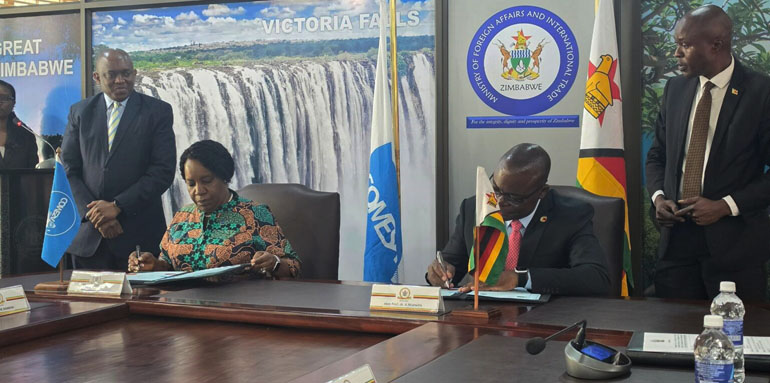
Lloyd Makonya
Correspondent
WHEN Zimbabwe welcomes leaders from across Eastern and Southern Africa for the 25th COMESA Summit in Harare next month, the country will be doing more than hosting another high-level regional meeting.
It will be placing itself at the centre of one of Africa’s most significant economic markets, a regional bloc of 21 countries with a population approaching 650 million and a combined economy estimated at around US$1 trillion.
Zimbabwe and the Common Market for Eastern and Southern Africa formally signed the agreement in Harare on Monday, paving the way for the 25th COMESA Summit of Heads of State and Government, scheduled for October 22.
The signing was described by Foreign Affairs and International Trade Minister, Professor Amon Murwira as a formal commitment between Zimbabwe and the COMESA Secretariat towards a successful summit.
The summit’s theme: ‘One Market, One Future: Advancing Inclusive Industrialisation, Investment and Regional Integration in COMESA’, provides an important lens through which to view what the gathering could mean for Zimbabwe.
For Zimbabwe, the real measure of success should begin after the summit ends. Can the country turn its role as host into increased trade, investment, industrialisation, jobs and opportunities for its businesses? That is the question that matters to the ordinary Zimbabwean.
The COMESA bloc brings together 21 countries and a market of hundreds of millions of consumers. Zimbabwe’s own population is only a fraction of that figure. If the country is serious about transforming its economy, it cannot afford to think only in terms of the domestic market. The market for a Zimbabwean product should increasingly be Africa.
A manufacturer in Mutare should be thinking about Zambia, Malawi, Kenya or Rwanda as potential markets.
A farmer in Makoni should not have to think only about selling produce within Zimbabwe. A technology company in Harare should be looking beyond Zimbabwe’s borders.
Our people should be able to see Cairo, Lusaka, Maputo and Nairobi as part of their potential commercial geography. This is the fundamental promise of regional economic integration.
It is about making the borders that divide African economies less of a barrier to the movement of goods, services, capital and investment. Yet there is an important paradox at the heart of the COMESA opportunity.
The bloc represents an economy of around US$1 trillion, but intra-COMESA trade remains relatively small compared with the bloc’s overall economic potential.
COMESA’s own trade statistics show intra-COMESA exports at about US$14 billion in 2024, while exports to the rest of the world were around US$202 billion and imports from the rest of the world about US$277 billion.
That gap should concern African policymakers, but it should also excite Zimbabwean businesses. It means the regional market is far from saturated. There is enormous room for African countries to trade more with each other, build regional supply chains and reduce dependence on markets outside the continent. Zimbabwe’s opportunity is to ensure that it is not merely a consumer in that emerging regional market, but a producer.

This is where the COMESA Summit intersects directly with Zimbabwe’s Vision 2030 ambitions and the newly implemented National Development Strategy 2 (NDS2).
NDS2 seeks to stimulate private-sector-led growth, improve export performance and integrate Zimbabwe more effectively into global value chains. That objective is impossible to separate from the question of markets.
A country can have factories, mines, farms, universities, skilled workers and entrepreneurs, but if its producers cannot access sufficiently large markets, industrialisation will remain constrained. Regional integration provides part of the answer.
COMESA gives Zimbabwean producers a much larger commercial space in which to operate. Market access alone will not make Zimbabwe competitive, Zimbabwe must produce goods and services that are competitive in price, quality and reliability. That brings the discussion back home to some of the country’s biggest economic questions of electricity, transport infrastructure, access to finance, production costs, standards, customs efficiency, technology and the ease of doing business.
Regional integration cannot compensate for an uncompetitive domestic production base.
If it costs more to manufacture a product in Zimbabwe than to import the same product from outside the region, a larger market will not automatically solve the problem. The task, therefore, is two-sided.
Zimbabwe must continue to make it easier for its businesses to reach the COMESA market while simultaneously making those businesses more competitive. This is particularly important when considering Zimbabwe’s vast mineral endowment. For decades, the country has exported significant quantities of raw or minimally processed commodities, capturing only part of the value generated from its natural resources.
The policy direction has increasingly shifted towards beneficiation and value addition. Zimbabwe’s restrictions on the export of unbeneficiated minerals illustrate this approach.
In 2022, the Government introduced Statutory Instrument 213 of 2022 controlling the export of lithium-bearing ores and unbeneficiated lithium, requiring a written permit for such exports. The instrument was subsequently repealed and replaced by SI 5 of 2023, which broadened the regulatory framework around exports of unbeneficiated base mineral ores.
The significance of this policy goes beyond mining. It is about asking a fundamental economic question: how much value should Zimbabwe capture before its resources leave the country? Consider lithium, the mineral has become strategically important to the global energy transition because of its role in battery technologies. If Zimbabwe simply extracts ore and exports it, much of the higher-value economic activity associated with processing, refining, manufacturing and downstream industries takes place elsewhere.
But if the country develops the capacity to process minerals, manufacture intermediate products and ultimately participate in regional value chains, the economic benefits can extend far beyond mining royalties and export receipts. This is precisely where the COMESA conversation becomes relevant. Zimbabwe does not necessarily have to build every stage of a sophisticated industrial value chain alone. Regional integration makes it possible to think in terms of African value chains.
Zimbabwe can supply minerals, agricultural products, manufactured inputs or processed commodities while another COMESA country provides another stage of processing, logistics, technology or market access. The objective should be to ensure that more of the value generated by Africa’s resources remains within Africa. That will be a much more meaningful interpretation of the summit’s emphasis on inclusive industrialisation and it fits squarely into Vision 2030.
Zimbabwe’s ambition of becoming an upper-middle-income economy cannot be achieved simply by extracting more resources. It requires greater productivity, investment, exports, industrialisation, innovation and higher-value economic activity.
NDS2 provides the immediate policy framework for that journey. COMESA provides part of the external market and regional platform through which the journey can be accelerated. This is why the summit should not be viewed as an isolated diplomatic event.
There is another reason why Zimbabwe’s COMESA moment is significant. The country is not approaching regional integration in isolation. COMESA is part of the wider architecture of African integration, including the Tripartite Free Trade Area involving COMESA, the East African Community and SADC, as well as the African Continental Free Trade Area.
Zimbabwe therefore has an opportunity to use its COMESA leadership to strengthen the argument that Africa’s economic future depends increasingly on Africans trading with Africans. Foreign markets will remain important. Zimbabwe needs investment and export earnings from Europe, Asia, the Middle East and elsewhere but an Africa that consumes what it produces, manufactures more of what it currently exports as raw material and develops regional value chains will be economically stronger and less vulnerable to external shocks.
Zimbabwe’s recent regional leadership of SADC gives it an additional platform from which to advance that argument. The country has moved from chairing SADC to taking on the COMESA leadership agenda, with Government signalling that regional market integration and acceleration of the African Continental Free Trade Area will be among its priorities. Professor Murwira has described COMESA as an influential building block of the AfCFTA and emphasised the need for Africa to trade more within itself.
This is the bigger strategic picture. The COMESA Summit is not simply about Zimbabwe hosting African leaders. It is about Zimbabwe positioning itself within an economic geography that is becoming increasingly important. The summit should therefore be judged not by the number of dignitaries who attend, the quality of the opening ceremony or the elegance of the official communiqué. Its real test will come later. How many Zimbabwean companies will enter new COMESA markets?
How much will Zimbabwe’s intra-regional trade increase? And, most importantly, will ordinary Zimbabweans feel the economic benefits?
These are the questions that should define the success of Zimbabwe’s COMESA moment because the real opportunity is not the summit itself. It is what Zimbabwe does with the doors that the summit opens. The country has been given a platform to showcase its economic potential to a regional market of hundreds of millions of people. It now needs to show that it can produce for that market.