Chronicle Editor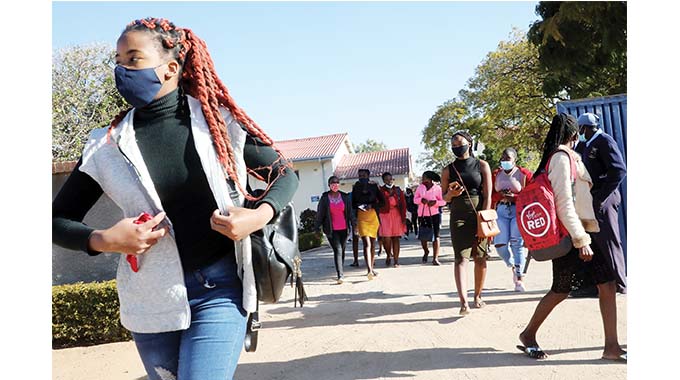
After a long period of consultations and observing the progression of Covid-19, the Government has taken a decision to partially re-open schools between September 14 and 28.
Learners taking Cambridge examinations return to class for the first time in about six months on September 14 with those sitting for the Zimbabwe School Examinations Council (Zimsec) examinations resuming classes on September 28. This includes Upper Six, Form Four and Grade Seven classes, all other grades continuing on their enforced holiday. Examinations run by Zimsec will start on December 1 while those run by the University of Cambridge are likely to begin earlier.
We anticipated that this announcement was going to be made around this time of the year given that public examinations taken countrywide in June and July progressed with no Covid-19 case being recorded.
College and university students also took their final examinations over the same period with no challenge but a general spike in Covid-19 cases countrywide forced the institutions of higher learning to close once again, missing the August 31 deadline by which they were supposed to have concluded the tests.
Strict infection prevention measures were put in place when school children wrote their June-July public examinations. This involved social distancing, wearing of face masks and hand-washing with soap or hand sanitiser.
School infrastructure was also disinfected, especially those that had earlier been used as quarantine centres for people returning from abroad. These operating procedures were hailed for ensuring that no pupil or invigilator tested positive for Covid-19. That is the template that the Government and school authorities will use when schools re-open in the next 25 days and run until the last exam is taken in December. We are hopeful that that template will work when candidates are back learning and later, when writing their examinations.
Speaking to the media in Harare on Tuesday, the Minister of Information, Publicity and Broadcasting Services, Senator Monica Mutsvangwa said the Ministry of Primary and Secondary Education was working closely with other ministries and stakeholders to guarantee the safety of pupils and staff during the examinations period.
Standard operating procedures, she added, have been distributed to all schools, while infection prevention training for teachers and support staff from public schools is already underway.
That the Government consulted as many as 15 stakeholder groups, among them teachers’ representatives, school authorities and the relevant parliamentary portfolio committee is also important. We are sure that these stakeholders made their contributions which the Government considered before making the Tuesday announcement.
Decisions that are taken after wide consultations tend to work better than those taken unilaterally. Therefore, the re-opening of schools for exam-writing kids should be safe and smooth for everyone.
Recognising that some schools and parents might be unable to mobilise enough resources, Primary and Secondary Education Permanent Secretary Mrs Tumisang Thabela said yesterday, the Government will provide personal protective equipment (PPE) to all learners when schools reopen. Treasury, she added, had released $350 million to prepare learning institutions for safe reopening.
“In preparing for the reopening of schools we are going to implement measures that were used in running the June Zimsec examinations that were Covid-19 free,” said Mrs Thabela.
“So far what Government has allocated is $350 million also partners are assisting us but if we find anything lacking, we will approach the Government with our pleas.”
This package should be enough to enable all schools to resume work on an equal footing and ensure that the risk of contracting and spreading the coronavirus is reduced.
We implore everyone and every stakeholder to work hard for children and their teachers to be safe even as the resumption of classes comes at a time when cases of Covid-19 are increasing. By Tuesday, 6 559 people had been infected with the coronavirus, 203 losing their lives to it since the first case was reported on March 20.
On Sunday, 6 497 had been infected with 202 fatalities. The increase in cases, driven by community infections, started in July, meaning that the disease is now in the population, not among those returning from abroad as was the case in the first four months of the pandemic. Therefore, anyone is potentially a spreader of the infection hence the need for extra vigilance when schools reopen.



 Online Reporter