Chronicle Editor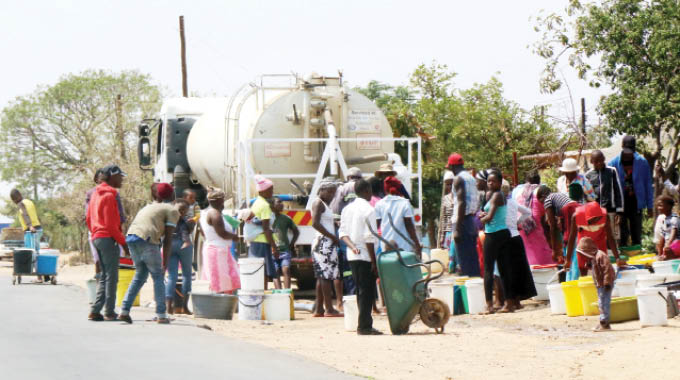
After decommissioning two major dams last year, Bulawayo City Council is likely to stop using a third one by the end of this month, deepening the water shortage in the city.
Last year, council stopped using Upper Ncema and Umzingwane dams after they had got depleted. The third reservoir, Lower Ncema would be offline in the next three weeks as it would have run out of water. The decommissioning of that dam will result in a supply deficit of 59 megalitres (ML). The water shedding exercise in the city whose residents are going for five days a week without running water, would worsen.
The Government stepped in last week with $10, 6 million to enable the Zimbabwe National Water Authority to rehabilitate 15 boreholes at the Nyamandlovu Aquifer to boost abstraction from that underground source and pumping to council treatment works. The Minister of Local Government and Public Works, July Moyo, speaking after touring the underutilised water source, pledged more resources.
“We went to Nyamandlovu Aquifer area so that we try to augment water systems in Bulawayo,” he told Chronicle.
“This is because they are going to run out of water from Lower Ncema dam. The city will lose a lot of water and we have to look for replacement areas. The aquifer has two areas that we can enhance. The first one is already sending three megalitres to Bulawayo which I think we can enhance to 10ML. Then there is another area which we need to repair some boreholes and drill new ones. We can also have another 10ML that we can do in order to avert water shortages. The city reckons that when they decommission Lower Ncema they will have a deficit of 59ML. So, we have to look at the alternatives and I have already said to the town clerk and his engineers that give us a list of the areas that you can quicken and they are working on it right now.”
Indeed it is not looking good for Bulawayo in terms of water supply, but the Government intervention last week should go a long way in ameliorating the situation. Through that intervention, Bulawayo will add seven megalitres of water for its residents. After the second tranche of spending that the Government has pledged, Bulawayo would be able to pump an additional 10ML to homes and businesses.
The additional 17ML will not make up for the 59ML to be lost when Lower Ncema is disconnected but we commend the Government for demonstrating a commitment to alleviating the water shortage in Bulawayo.
Council recently said it needed $910 million or US$22, 75 million to undertake three water projects. Part of the money would be used to construct a 42km Mtshabezi-Ncema 450mm water pipeline, upgrade the 11km Umzingwane–Ncema 900mm water pipeline and equip and drill 20 boreholes in Nyamandlovu.
We recognise, as the Government itself does, that the rehabilitation of boreholes at Nyamandlovu and extraction of more water from there, building of new pipelines and expansion of existing ones will not be permanent solutions to the city’s water crisis.
That’s why the Government is building the US$120 million Gwayi-Shangani Dam, a key part of the National Matabeleland Zambezi Water Project, the more permanent solution to Bulawayo’s water woes. A lot of more will have to be be spent for Zambezi water to flow into Bulawayo. Because of the huge sum of money required, it is likely to take some time before that happens but completion of the dam, expected by the end of next year, would be a giant step forward.
Work was at 39 percent at the latest update in January with engineers confident that they would meet the December 2021 deadline. Government allocated $400 million to the project in the 2020 national budget.
It is possible that the Covid-19 pandemic will delay progress on the site as it would at various projects nationwide, but once the dust settles, we foresee the Government putting in more resources to get the project going.
These projects are important and must be undertaken with speed but we are worried that Bulawayo is losing a staggering 40 percent of its water due to damaged and aged infrastructure. This represents an enormous loss for Bulawayo not only in terms of the precious liquid itself but also in terms of resources spent on treating water and pumping it along the city’s leaky infrastructure plus revenue that is foregone.
Council must thus intensify the water infrastructure rebuilding project that is underway so that less water is lost before it reaches homes and businesses. When the infrastructure is renewed, residents would be assured that almost all water in the city’s supply dams will end us in their homes.


 Online Reporter