Chronicle Editor
LAND preparation improves site conditions in a number of ways. It reduces weed competition for light and nutrients, improves soil, water, and air conditions, among others.
As the farming planting season beckons, it is important that farmers take off their winter jackets and put on their farming gear, because early preparations are important to a successful farming season.

It is also vital for smallholder farmers and even communal farmers to know their soil types to avoid planting wrong seed varieties that lead to poor yields. Farmers are now operating in a modern world where such operations are key, and can be easily done. In the past, some farmers planted late maturing seed varieties in regions that require early maturing seeds because they lack information on the types of soil and the rain pattern in their areas. Working closely with extension officers in designated areas is key, as officers will give farmers the right information on what type of crops and variety to plant.
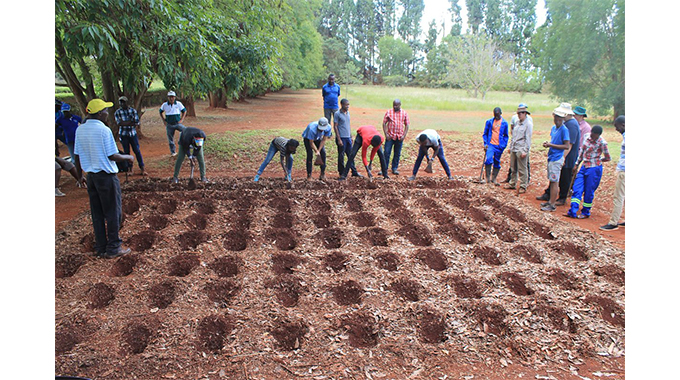
Our sister paper, Chronicle reported last week that farmers in Matabeleland are geared for the summer cropping season following the delivery of agricultural inputs for the 2022/2023 farming season under the Climate-Proofed Presidential Inputs Scheme, popularly known as Intwasa/Pfumvudza.
In Matabeleland North Province, 165 000 farmers are set to receive inputs under Intwasa/Pfumvudza while 130 000 farmers in Matabeleland South will benefit under the programme. In the previous season, Bulawayo farmers harvested 5 000 tonnes of maize.
Intwasa is a concept aimed at climate proofing agriculture by adopting conservation farming techniques and involves use of small plots and applying the correct agronomic practices for higher returns.
The Intwasa/Pfumvudza programme, designed for small-scale farmers will this season benefit 2,3 million households in the communal, A1, small-scale commercial farming and old resettlement sectors to produce cereals, oilseeds and legumes in the forthcoming summer cropping season.

Acting director of agricultural rural development and advisory services for Bulawayo and Matabeleland North provinces, Mr Dumisani Nyoni said based on the agro-ecological factors, traditional grains will be at the forefront in the region with limited option on maize.
“This year’s Intwasa/Pfumvudza cropping programme is going to be focused more on climate proofing than what we have done in the previous two seasons. This year Government will only supply inputs to farmers based on their agro-ecological region as opposed to the farmer’s interest,” he said.
In Matabeleland North, there are three agro-ecological regions based on the amount of rainfall that is received.
“We have natural region three with a household population of about 14 000, natural region four, which has the bulk number of 99 000 households and region five with about 52 000 households. This year, we are saying farmers in regions four and five are supposed to concentrate more on the production of traditional grains because they are able to withstand moisture stress and low levels of rainfall than maize,” said Mr Nyoni.
In short, it is now all systems go for this year’s cropping season.


 Online Reporter