

 admin
admin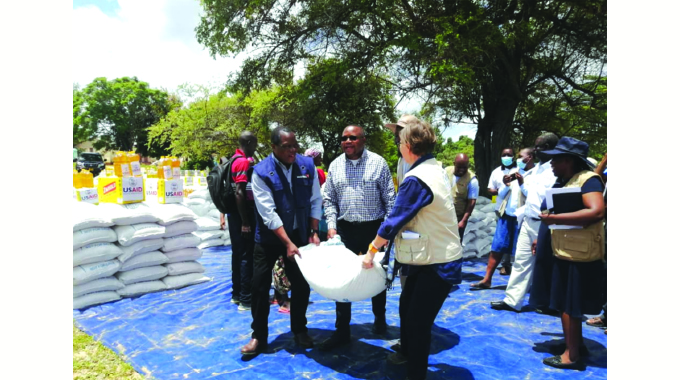
Yeukai Karengezeka
Features Correspondent
Anatoria Nengomasha (51) from Mataba Village in Mudzi has depended on farming for the survival of her family.
She is not just a farmer, but a mother of five children who is looking after 11 grandchildren. She also looks after her ailing husband.
While the husband’s sickness has affected her time to work in the field, the situation has been exacerbated by the change in weather patterns due to climate change, which in turn has affected yields in the fields for the past few years.
Resultantly, food security at the household level has been compromised and intervention through emergency food relief programmes has helped immensely in alleviating hunger in vulnerable families during the lean season.
Lean season refers to the period between planting and harvesting time and stocks usually deplete and food prices increase.
This lean season programme, which began in October last year and runs until the end of this month, pegged food-insecure people in the country at 3,8 million.
Rural people are often negatively impacted by climate vulnerability, hence the need for food assistance as they wait for harvesting time.
Mrs Nengomasha is one of the many people who are benefiting from the Lean Season Assistance (LSA) programme being run by the UN agency, World Food Programme(WFP), in eight drought-prone districts in Zimbabwe.
“Life has not been easy, especially now that we are harvesting very little due to changing weather patterns, the crops we harvest can no longer sustain us till the next harvest season,” she said at the Nyamhondoro food distribution point where she was receiving her monthly portion.
“However, I am grateful for such donors like WFP who have been giving us cereals, oil and maize from October last year to cushion us.”
Mrs Nengomasha said all her grandchildren now had adequate food and have a balanced diet.
The US$36,7 million initiative benefitted 700 000 people from dry districts — Buhera, Hwedza, Chivi, Mudzi, Bikita, Nkayi, Mangwe and Mt Darwin.
People from Mudzi said their crops were affected last season as they received erratic rains which affected their yields.
While most of them are still planting maize, it has proven not to be compatible with the climatic conditions.
Mr Patrick Gadaga (78) from Nyamhondoro also relies on the food he harvests to feed his family. Although he planted maize and sorghum, the output is not promising due to excessive rains.
“This programme has been very helpful in making sure that we get food and eat healthy,” he said. “I do part-time work, tilling other people’s fields to get extra food. My request is that may the Government and its donor partners help with programmes like goat keeping and poultry that can enhance our livelihoods. At my age now I can no longer do much in the field.”
For Gogo Ganai Magaya from Mapundu Village, her crops were affected by lack of fertilizer.
“I planted maize, millet, ground nuts and sorghum, but they did not grow well because of lack of fertilizer,” she said. “It was very expensive, so by the time more rains poured, the crops were already affected.
“But with such a food aid programme in place, it is helping us a lot to feed our grandchildren at home. We wish that it may continue all year round.”
In Chiredzi, at least 440 000 people benefit from the food programme.
While many farmers expressed gratitude towards the food programme they pleaded with the partners and Government to consider rehabilitation of irrigation infrastructure as a long-term measure of food sustenance.
In Hwedza, WFP partnered with Japan and USAID to mobilise food that was being distributed in the area.
“Here in Hwedza we encountered a disaster which affected our yields and this was our first time to receive food from WFP through its implementing partner CARITAS,” said Mrs Gonzo. “We harvested very little, but this initiative has helped us a lot in sustaining our families.”
In Ward 2 in Chiredzi East, framers in the area usually plant small grains, beans,maize and tobacco.
Chief Ruzane also known as Washington Mbavha from Hwedza thanked the Government for allowing its partners to offer aid.
“We have 15 wards in Hwedza benefiting from this WFP programme. Our families and our children are leaving home full same and our wives are not lacking food at all,” he said.
Chief Ruzane said development partners should help them to revamp the irrigation systems and drill more boreholes in the district.
“We are saying to Japan, WFP and other non-governmental organisations who are accepted here in Zimbabwe that we have many rivers in this area where irrigation systems can be set up which will help, rather than always relying on NGOs, as we will have enough water to irrigate our crops,” he said.
“As for us chiefs, we have a programme which we call Zunde and we are pleading with them to come and drill boreholes for us and give us pipes instead of relying on the government for assistance. As chiefs in communities, we will be giving our people through Zunde.”
According to the ZimVAC 2022 assessment report, Hwedza is one of the country’s 15 districts with a high cereal insecurity prevalence.
Ward 2 councillor Rodreck Kadungure said in the long run they wanted their children to practical subjects that can empower them to make a living after finishing their studies.
“It is our humble request that may our learners be offered special subjects like agriculture, IT and computers and we would be more grateful if they have demo plots at school,” he said.
WFP country representative and director Ms Francesca Erdelmann, told The Herald recently in Hwedza that her organisation would continue to assist affected households during lean seasons.
“I believe it is our duty to ensure that we offer immediate food help to affected families that live in areas that are prone to droughts and we will continue to source funds so that the programme keeps running as it complements Government’s efforts in feeding the people,” she said.
She said she was pleased that some areas they used to support no longer required food aid.
“Over time we have been doing some resilience programmes with the communities around the country,” she said. “Roads have been built for the communities, irrigation schemes have been put in place among other things.
We are very happy that in some areas where we have invested resilience for a number of years, they are no longer on the top list of beneficiaries for food aid during this lean season.”
While some beneficiaries expressed fear that they might face hunger post-lean season, the Government assured the people that it will continue with the food mitigation programme until May.
In this initiative, at least a single beneficiary per household gets 10 kilogrammes of grain every month. For instance if a family has seven members it receives 70 kilogrammes of grain monthly.
Speaking in Mudzi recently, during one of the distribution days by WFP, the Minister of Public Service, Labour and Social Welfare Paul Mavima hailed the partners for their support to the Government.
“We appreciate the work you are doing here as the entire team,” he said. “It is our prime responsibility as Government to address food insecurity issues, but we appeal for help to the community of nations through the UN system which WFP is part.”
Minister Mavima urged affected communities to adopt and intensify the planting of small traditional grains which are drought resistant to realise better harvest and improve food security at the household level.
He urged people to desist from dependency syndrome and work hard.
“Households should move away from internal dependency that is receiving aid from Government and external dependency that is from international donors,” said Minister Mavima.
“We want to be a proud nation that feeds its own people so that we grow as a nation. We cannot talk of good health, good education, when primary needs have not been satisfied first.”



 Online Reporter