Chronicle Editor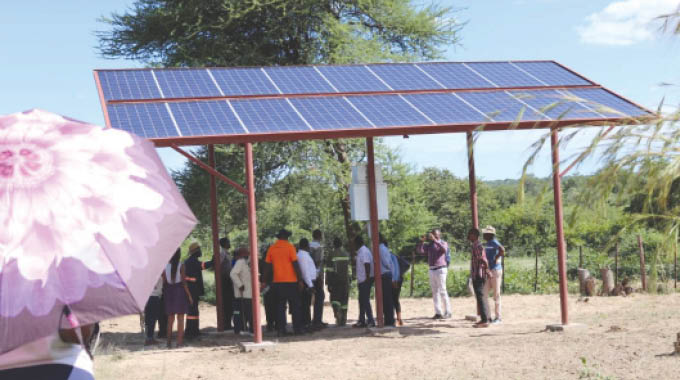
Vincent Gono, Features Editor
TUCKED in the deep parts of Nkayi district close to Lupane in Matabeleland North Province, Singeni community in ward 25 is a little divorced from everything that represents modern civilisation.
It is an area where one comes face to face with a subduing remoteness. The area is completely cut from the rest of the country as there are no defined roads, there is no radio and television transmission, and no cellphone network connectivity. The communities are however, not fazed. They are probably used to their life. They have accepted their fate and are seemingly contend with it.
However, like most parts of the district, the community sustains itself through agricultural activities. Their major economic drivers are livestock and crop production but there is a problem of water accessibility making it difficult for agricultural activities to sprout and usher the communities into a life of bountifulness.
Due to scarcity of water, the district was affected by the drought that decimated villagers’ livestock and a number of farmers have sad tales to tell. Their livestock also face the problem of diseases such as foot and mouth, anthrax and other tick-borne diseases.
Until recently, Singeni community had no dip tank and the villagers were travelling a long distance to dip their cattle in Lupane while women and children especially girls would agonise over water scarcity, walking more than 5km to the nearest water source. The new Singeni community dip tank now services 117 households with more than 1 700 cattle.
“We used to travel very long distances to the watering points. Sometimes our girl children would go to school late as they will be looking for water. We couldn’t dig up wells, the water table is very low so we depended on the river at times even drinking with our animals,” said a villager Ms Sithabiso Dube.
She said the villagers did not have gardens to grow vegetables because they had no access to water. As a result, they would buy the vegetables each time they travel to Nkayi centre which she said was a bit strenuous and was eating much into their shallow pockets.
Ms Dube said through the Zimbabwe Resilience Building Fund (ZRBF) — Matabeleland Enhanced Livelihoods, Agriculture and Nutrition Adaptation (Melana) project they managed to get water close to their doorsteps while their cattle were no longer dying of diseases as a dip tank was constructed in their ward. They no longer travel the painful and energy sapping distances to Lupane to dip their cattle.
“Life has become a little more comfortable than before. The ZRBF-Melana project has shone a lot of light in the dark alleys of our community life. We are beginning to see things more clearly. We can now sustain ourselves through their trainings and through working with them,” she added.
Councillor for Singeni ward 25 Mr Elmon Sibanda said the community was gratified by the development as the community was capacitated for sustainable development.
“Villagers in this community as in the rest of Matabeleland are into cattle farming. Cattle are therefore of much value to our communities but they were suffering because we had no dip tank anywhere close to us. We used to travel more than 10km to Lupane to dip our cattle and we also have no close water source for us and our cattle. As a result, a number of farmers lost their cattle in the past few months due to drought and diseases,” said Cllr Sibanda.
He added that the dip tank construction project started in 2017 with ZRBF-Melana gathering the construction material. After that they drilled the borehole, laid pipes and set the tanks.
“We have been having problems with diarrhoeal diseases because of the water that we were drinking. We have no clinics close by and our roads are bad, the closest clinic is Mbuma which is a very long-distance from here. We used to get water from unprotected wells but now we have piped water. We can now do projects such as piggery, poultry, gardening and even fish farming,” he said.
The dip tank committee chairman, Mr Enock Moyo, said they were doing all they could to ensure the infrastructure that was constructed was well taken care of. He said they were fundraising for dipping chemicals and in most cases Melana always come to their help in the procurement of the chemicals.
The District Development Co-ordinator for Nkayi, Ms Matilda Mlotshwa, said it was refreshing that there were development partners that were working in the communities to improve the livelihoods without creating a culture of laziness.
“We are happy that the approach is not to give out fish but to teach the communities how to fish. All the programmes that ZRBF — Melana are doing are people-centred and are going a long way in creating resilience in communities as well as helping us retain teachers. Women and girls are also greatly assisted as their traditional role of looking for water has been made easy because we now have taps running,” she said.
She said out of the 30 wards in the district, 28 were in dire need of food aid adding that projects undertaken by ZRBF — Melana were going a long way to alleviate poverty.
According to Melana head of project Ms Kudzai Nyengerai, the Melana project is implemented in the districts of Nkayi, Bubi, Umguza in Matabeleland North province and in the district of Umzigwane in Matabeleland South province where absorptive, adaptive and transformative capacities of communities are weak, leaving them vulnerable to shocks and stresses that include drought, dry spells, animal diseases, crop pests, fire outbreaks, floods, wildlife conflict, environmental degradation, HIV/Aids, diarrhoea and economic challenges.
She said so far 38 196 people have benefited from the projects hinting that the resources were not really enough. Ms Nyengerai said the buy-in from the communities was encouraging and called for an addition of implementation time to ensure effectiveness. In these districts, drought, dry spells, animal diseases and environmental degradation are the most severe physical hazards, confirmed by the communities.
The Zimbabwe Resilience Building Fund is a development initiative supported by the Ministry of Lands, Agriculture, Water and Rural Resettlement with funding from the European Union (EU), the Embassy of Sweden, The United Nations Development Programme (UNDP), and the UK Department for International Development DFID to the tune of USD80 million.
The ZRBFs overall objective is to contribute to an increased capacity of communities to protect development gains in the face of recurrent shocks ad stresses enabling them to contribute to the economic development of Zimbabwe.



 Online Reporter