Online Reporter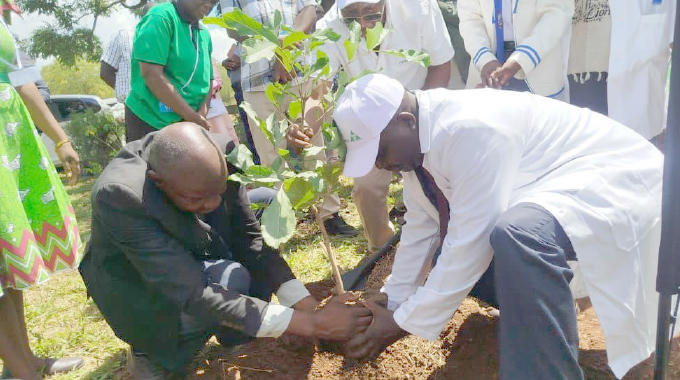
Sukulwenkosi Dube-Matutu, [email protected]
COMMUNITIES have been urged to fully harness the medicinal, environmental and economic benefits of trees while safeguarding forests through sustained tree planting and conservation efforts.
Speaking during the Matabeleland South provincial tree planting event at Amazon Christian Academy Secondary School in Insiza District, Minister of State for Matabeleland South Provincial Affairs and Devolution Albert Nguluvhe said tree planting is a shared national responsibility that must be embraced at all levels of society.

His remarks were delivered on his behalf by the provincial director for infrastructure development and environment, Mr Daniel Njowa.
“This provincial commemoration is a vital extension of the national launch, bringing the vision of a greener Zimbabwe closer to our communities and ensuring that every citizen plays a role in nurturing our forests,” said Minister Nguluvhe.
This year’s National Tree Planting Day was officially launched at the Zanu-PF 22nd National People’s Conference in Mutare, Manicaland Province, by President Mnangagwa, setting the tone for nationwide participation and action.
The programme runs under the theme “Trees and Forests for Ecosystem Restoration and Improved Livelihoods”, which spans from 2021 to 2025. The theme aligns with the National Development Strategy 1 (NDS1), Vision 2030, and global Sustainable Development Goals (SDGs).
Minister Nguluvhe said trees and forests play a critical role beyond environmental preservation, contributing significantly to health, climate stability, tourism and economic development.
“Trees and forests are more than just part of our natural landscape; they are integral to our health, our ecosystems and our economy. They produce clean air, maintain water quality and provide habitats for diverse flora and fauna, which form the backbone of our tourism industry,” he said.
He added that forests regulate climate, capture carbon dioxide and help mitigate the impacts of extreme weather events such as floods and droughts.
However, Minister Nguluvhe expressed concern over the rapid depletion of forests globally and locally.
“Globally, between 2015 and 2020, about 10 million hectares of forests were lost annually. Africa alone loses nearly four million hectares each year, almost double the world average. Zimbabwe is not spared, with approximately 262,000 hectares of forest lost annually,” he said.
As the country transitions into the implementation of National Development Strategy 2 (NDS2), Minister Nguluvhe said forests will remain central to achieving national development goals.
“Government is committed not only to tree planting but also to sustainable forest management. Sustainable harvesting, value addition and market development for products such as wild fruits, medicinal plants, fibres and craft materials will be promoted to ensure their integration into domestic and international markets,” he said.
Minister Nguluvhe urged communities to view tree planting as a long-term investment in livelihoods rather than a symbolic exercise.
“As we plant fruit trees, we are not only restoring our environment but also creating opportunities for future harvests that can generate income and improve livelihoods. Imagine every household, whether rural or urban, establishing its own orchard,” he said.
He added that communities can form co-operatives to market produce, schools can support feeding programmes using fruit trees, and traditional leaders can mobilise communities to protect communal woodlands.
“By embracing this collective responsibility, we transform tree planting into a practical engine of economic empowerment, ecological restoration and social resilience,” he said.
Also speaking at the event, Forestry Commission board member Mr Stewart Mantula said trees and forests remain central to the livelihoods of many communities and industries, calling for collective conservation efforts.
“Each year, the Forestry Commission distributes seedlings, co-ordinates planting events and engages stakeholders to restore degraded landscapes. This year, we are adopting a devolved approach to encourage community involvement and ownership,” he said.
Mr Mantula said the devolved approach fosters deeper community connection to environmental issues and promotes sustained engagement beyond National Tree Planting Day.
“As the lead agency in the forest sector, Forestry Commission will continue refining and implementing policies that meet the needs of stakeholders across the country,” he said.
Traditional leader Chief Sibasa of Insiza District said trees have long held cultural and spiritual significance, warning against the growing disregard for traditional conservation practices.
“Large trees were traditionally believed to protect homesteads from lightning, yet people are cutting them down. Some trees are sacred and should never be cut, but these traditions are being ignored,” he said.
Chief Sibasa urged communities to respect nature, saying environmental degradation threatens both cultural heritage and survival.
The Tree of the Year is the Sausage Tree, known as Mumvee in Shona and Umvebe in IsiNdebele.
Indigenous to Zimbabwe and Southern Africa, the tree is valued for its ecological, cultural and medicinal uses and has sustained communities for generations.