admin
admin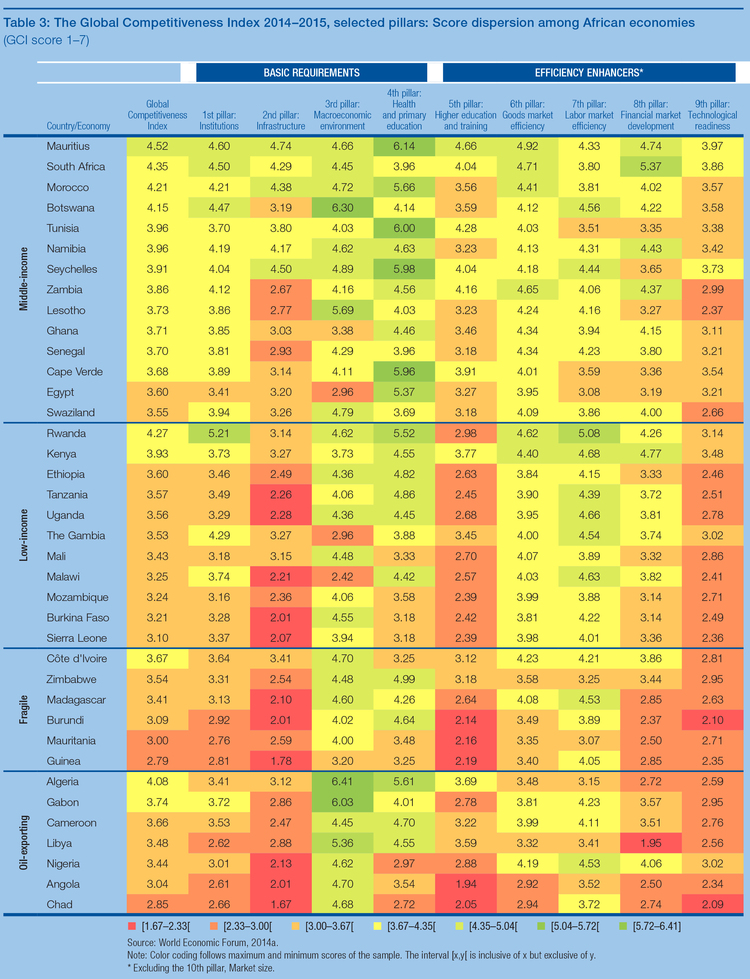
. . . Report resonates with Zimbabwe’s agenda
THE Africa Competitive Report 2015, which indicated that Zimbabwe’s global competitiveness continues to improve, with the country now ranked at position 124 from 131 reported in 2013, has raised hopes that the country’s broad economic reforms are on track.

The ranking currently considers 144 economies. Being a by-product of the International Monetary Fund (IMF), the World Bank, Africa Development Bank (AfDB), the Organisation for Economic Development and Co-operation (OEDC) and the World Economic Forum (WEF), the biennial report is a key indicator of how key economies are faring and what they need to do in order to ensure sustainable growth.
Zimbabwe’s progress continues to be noted. There are, however, doubts on whether the present economic growth being experienced in sub-Saharan Africa is sustainable, especially as statistics show that agricultural production is dropping, while the manufacturing sector has stagnated.
“The dichotomy of a largely agricultural society under-performing in the basic drivers of competitiveness on one hand, alongside the rapidly growing role of the service sector coupled with a rapidly reforming business environment on the other, raises the question about the sustainability of Africa’s path of development, particularly whether development toward a rising service sector that bypasses manufacturing is viable,” explains the report.
Crucially, Zimbabwe, which is the chair of the Southern African Development Community (SADC), has successfully pushed the region to adopt an industrialisation policy that is meant to add value to production.
Highlights
Different reports usually address distinct, but related themes, and the 2015 report focused mainly on how best to transform Africa’s economies.
“It is based on the assumption that increased competitiveness — by definition — is a critical driver for structural transformation and broad-based growth,” noted part of the report.
In contrast, the 2013 edition explored the potential of regional integration as a stepping stone to building economies. Notably, the WEF began releasing reports in 1998.
Positive Developments
Africa’s growth rates have averaged 5 percent for the past 15 years and its rapid population growth is believed to be the tonic for a lucrative emerging consumer market. An estimated 450 million workers are expected to join the workforce between 2010 and 2035. Also, the pervasive influence of mobile technologies continue to provide hope for instruments that could be used to drive economic growth.
Concerns
Experts, however, continue to worry about the inequalities in growth and continued poverty levels on the continent. It is estimated that one out of two Africans continue to live in extreme poverty.
It might seem, according to the report, that agricultural productivity is not improving despite the continent boasting arable land. The manufacturing sector seems to have stagnated as well.
However, it is believed that there is now significant growth in the service industry.
Interesting quotes
from the report
On Africa’s growth: “It will be necessary to raise productivity across all sectors of the economy to achieve higher growth and create quality employment and turn this progress into sustainable and inclusive growth”.
On agriculture: “For decades, the typical path out of poverty was increased agricultural productivity followed by growth in manufacturing . . . Across the region, agriculture’s share of GDP is declining and manufacturing is stagnating, while the service sector, in contrast, is increasing as a share of total employment and GDP, providing critical inputs to boost other economic activities.”
On the mobile revolution: “And despite Africa’s mobile revolution, the region as a whole is not keeping pace up with the rapid pace of technological advancements elsewhere. Only one-fifth of the region’s population is using the Internet, compared with 30 percent in Southeast Asia, 40 percent in Latin America and the Caribbean and 80 percent in the Organisation for Economic Co-operation and Development (OECD) economies
“Even in instances where the Internet is being used, its potential is not being fully harnessed.”
On infrastructure deficit: “The GCI (Global Competitiveness Index) data confirm once more the region’s pronounced infrastructure deficit — a critical bottleneck to reaping the benefits from increased regional integration . . . Data suggest that, to date, only 11,3 percent of trade in Africa is intra-regional and that total exports remain heavily skewed toward export of raw materials . . .
“Africa — based on a sample of 48 economies — is generally roughly the same power as Spain, although Africa’s population is nearing 1,1 billion while there are only 49 million people in Spain.”
DOWNLOAD HERE: See full report on our website


 Online Reporter