

 admin
admin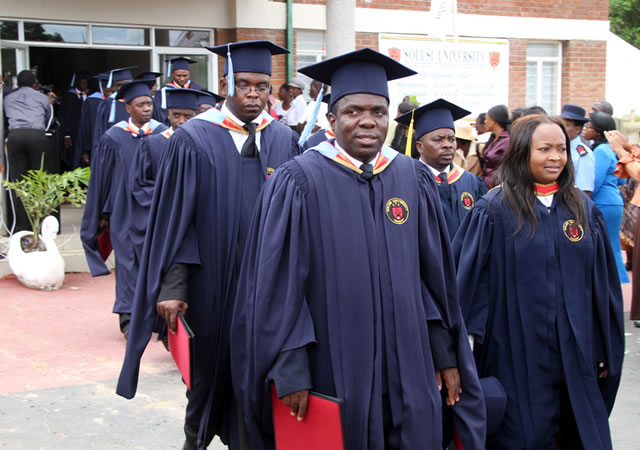

Chronicle Reporter
Government and other stakeholders will soon convene a conference whose main objective will be to raise money to fund higher and tertiary education, a Cabinent Minister has said.Addresing graduates and guests at Solusi University at the weekend, the Minister of Higher and Tertiary Education, Science and Technology Development, Dr Olivia Muchena said the conference on higher and tertiary education whose main objective is to mobilise money for universities will be held soon.
Dr Muchena said financing higher education remained critical for both State and private universities.
“My office is aware that non-state universities including Solusi do not access any government support. Prior to the illegal sanctions induced economic down turn, university students in non-state universities including Solusi had access to students’ grants just like those in State universities but that is no longer the case,” said Dr Muchena.
She said she was aware of the challenges faced by all universities in attracting and retaining qualified lecturers and professors.
“This problem is even more acute among non-state universities whose revenue is mainly from tuition fees,” she said.
Dr Muchena said former students of the different universities could also assist the institutions in mobilising the required resources.
She challenged the 6,802 members of the Solusi University alumni to contribute $100 per year each into an endowment fund that will be used to fund development programmes or projects at the institution.
The fund, said the minister, could be invested on other projects apart from being used to support students. To show commitment towards mobilising resources Dr Muchena donated $200 into the Solusi Alumni Fund, which is equal to two years subscription.
Dr Muchena applauded the Seventh Day Adventist run institution’s philosophy of transformative and redemptive curriculum, which she said was significant to the Zimbabwe Agenda for Sustainable Socio-Economic Transformation (Zim-Asset).
“We cannot achieve sustainable socio-economic transformation without individuals and communities that have been transformed through education and learning and in particular academic excellence,” she said.
Dr Muchena also encouraged the university to produce more science educators that will champion technology and innovative led development as well as research.
This, she said, will enhance value addition, beneficiation and productive exploitation of the country’s natural resources.
A total of 445 students graduated with degrees from different academic disciplines.
The graduates had completed undergraduate and masters’ degrees from the Faculties of Arts, Business, Education, Science and Technology and Theology and Religious Studies.
Females dominated as they accounted for 52 percent of the graduates.
What is today Solusi University and the mother of Seventh Day Adventist Mission stations in Southern Africa, was established around 1894 as a mission station. In 1905 the mission started training teachers.
In 1994, President Mugabe granted the institution a University Charter, authorising the institution to operate as a non-state university.
To date 6,802 graduates have been churned out by Solusi.


 Online Reporter