admin
admin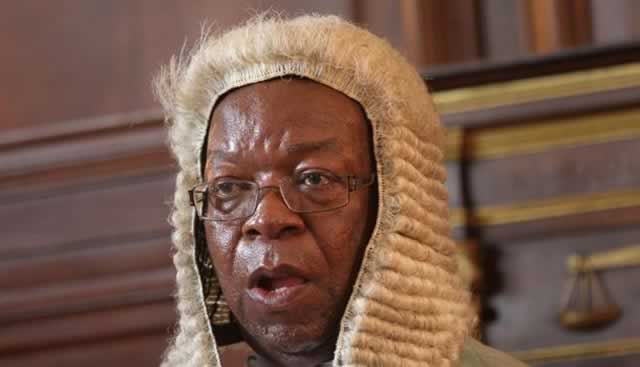
Fidelis Munyoro Harare Bureau
The Constitutional Court yesterday struck off the statutes Section 121 (3) of the Criminal Procedure and Evidence Act in a case in which it condemned the prosecution for locking up suspects for seven days while considering an appeal against granting of bail.
Chief Justice Godfrey Chidyausiku was ruling in a constitutional challenge brought by four MDC-T activists — Fanuel Kamurendo, Shelton Masamba, Tendai Kamurendo and Wilbert Ndiweni — seeking to invalidate the law.
The Section allows the prosecution to revoke bail for seven days while it weighs the option of appealing against magistrates’ decision to grant bail to suspects.
The full complement of the Constitutional bench unanimously agreed to scrap off Section 121 (3) of the Act saying it violated the former Constitution.
“The application in this matter succeeds. It’s declared that section 121 (3) of the Criminal Procedure and Evidence Act Chapter 9:07 is unconstitutional in that it’s ultra vires sections 13 (1) and 18 (1) of the former Constitution of Zimbabwe,” ruled Chief Justice Chidyausiku.
Details and reasons for the order, the Chief Justice said, would be provided in due course. This means the law now does not exist.
Earlier on Chief Justice Chidyausiku rapped the prosecution, represented by Edmore Makoto of the Prosecutor General’s Office, for arbitrary use of the section of the law to deprive suspects of their liberty for an ulterior motive.
Makoto had submitted that Section 121 (3) of the Act was justified in a democratic society to prevent the abuse of the administration of justice by the judiciary.
He twice requested the court to adjourn to allow him to consult with his superiors as the heat from the nine-member panel of judges became unbearable.
But the Chief Justice would have none of it as he insisted that he concludes his argument.
Makoto was asked to show the court the provisions of the Constitution that give the prosecution authority to override magistrates’ decisions in bail matters.
He rummaged through Section 13 of the Constitution, which deals with limitations of people’s liberties in a bid to find answers to pounding questions from the inquisitive bench.
“The court gives a person his freedom. Which provisions of the law say after that another authority can take away that freedom? Tell us that provision which says you can go beyond that and override the judiciary decision?” the Chief Justice asked.
At that point Makoto conceded that he had no meaningful argument and sought to rely on the procedures in a bail application.
The Chief Justice pointed out that the prosecution was abusing the provision to hit back at the judiciary for disagreeing with it.
“What further abuse of power can be worse than that?” quipped Chief Justice Chidyausiku. “You lock up people in jail for seven days, you don’t appeal. You’re deriving pleasure in keeping people inside for no good reason. What legal object do you want to achieve in keeping people inside for seven days? It’s more sadistic rather than a legal object.”
The Chief Justice said the prosecution was wrong in trying to play “the protector of violence” and disappear after the suspects charged with that crime were released at the expiry of the seven-day period.
Makoto said they had used the provision to also prevent an outbreak of violence considering the politically charged situation prevailing at the time the four were arrested.
They were facing charges of politically-motivated violence.
Thabani Mpofu, instructed by Kudzai Kadzere of Kadzere, Hungwe and Mandevere Law Firm, argued for the four. In his submissions, he underscored the obnoxious nature of the impugned law.
He said 121 (3) was far too wide and negated a judicial determination validly made and binding upon the parties.
“A statute which eliminates the judicial process in matters of personal liberties is plainly unconstitutional,” argued Mpofu.
He argued that the provision left the entire discretion on whether a person should be restored his liberty in the hands of an authority rather than the judiciary. “It allows prosecutors to conduct themselves capriciously, maliciously, vindictively and irrationally,” he said. “What is wrong is to allow prosecutors to do so in the face and in defiance of a judicial determination in a matter they would have been involved.”
The four were arrested in February 2013 in Chitungwiza and charged with a crime of malicious damage to property after they destroyed posters of President Mugabe and one of the late General Solomon Mujuru.
They were also charged with disorderly conduct. They were granted bail at the magistrates’ court but the prosecution invoked bail in terms of Section 121 (3) of the Act.
They challenged the decision at the Constitutional Court.


 derick.khumalo