Online Reporter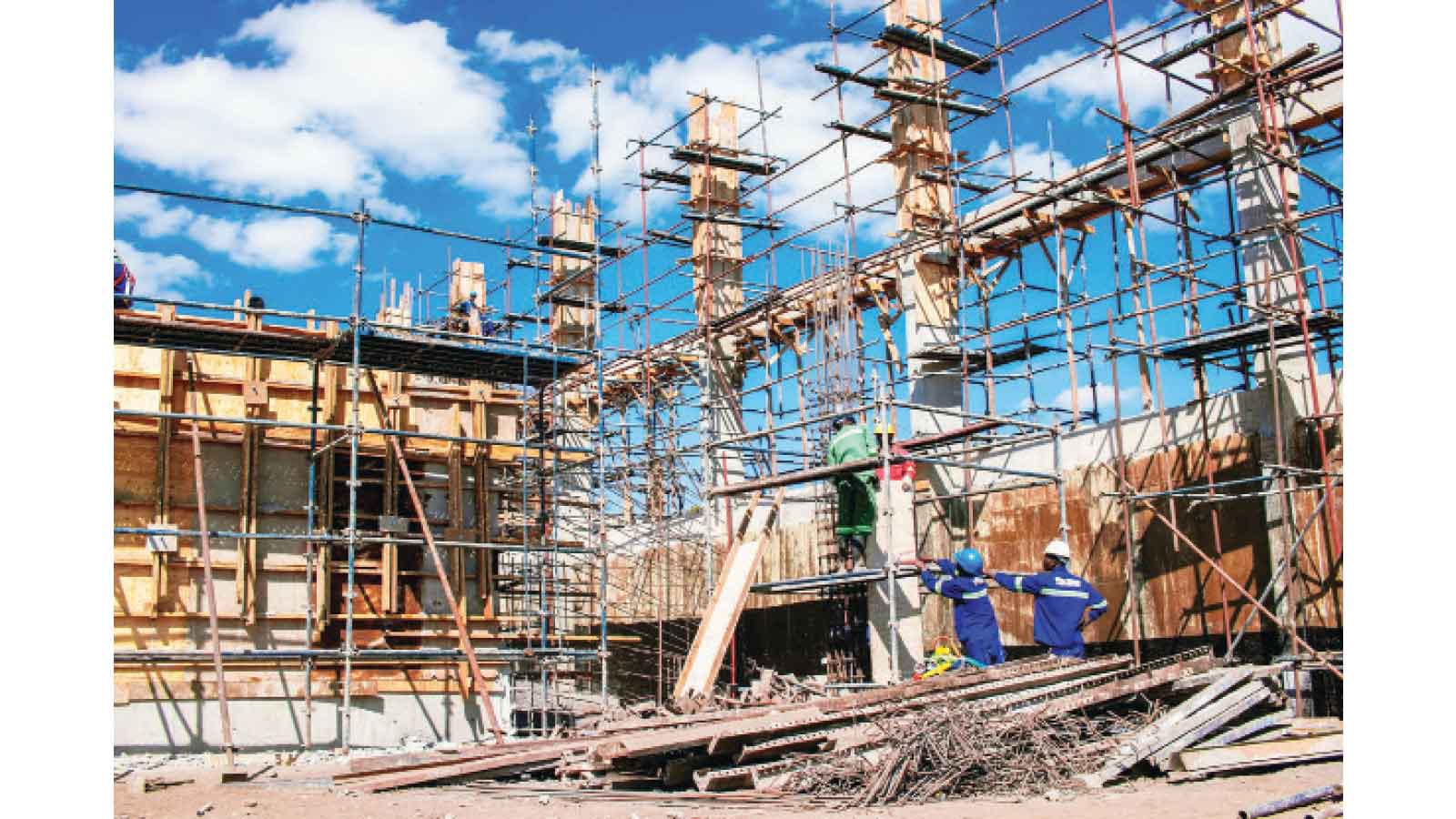
Theseus Shambare-Features Writer
THE rhythmic clang of hammers, the whir of drills and the scent of fresh concrete fill the air at Chisipite Shops in Harare, where workers move with purpose across a busy construction site.
Just 11km away, in Mount Pleasant, scaffolding rises against a bright skyline as steel beams glint under the sun.
Under light traffic, the drive between these two sites takes less than 20 minutes — a short journey bridging two hubs of Zimbabwe’s urban revival.
At Manah Construction, 28-year-old Caston Zuvaringeni adjusts his helmet, wipes his brow and climbs a scaffold with steady confidence.
Nearby, 29-year-old Linda Chikore, clad in a bright orange vest, measures timber for a new residential block.
For both, this is not merely work. It is a step into dignity, opportunity and safety.
“Before, safety was an afterthought. Now I feel valued. I know my life matters,” said Zuvaringeni.
Chikore added, “Being a woman in construction still draws attention, but I now know the law supports me and I could run my own project tomorrow.”
Just a few years ago, many small and medium-sized construction companies in Zimbabwe were known for one thing — chasing profit, costs and speed.
Health and safety were minimal, contracts informal and labour unregistered. The race was to finish fast, pay little and move to the next job.
For Taurai Magombedze, life in the construction sector had long been a grinding battle for survival.
“We would work odd hours, and sometimes even when the project owner was paid, we would go home for months without receiving a cent.
“We did not even know that we had rights” he said.
At one point, Magombedze recalled, he walked from Epworth to Mount Pleasant just to report for duty — a journey that captured the desperation and exploitation that defined his working life. But that reality is now shifting.
The three-year Decent Work in Construction Project, led by the International Labour Organisation (ILO), supported by the Swedish International Development Cooperation Agency (Sida) and anchored in the Southern African Development Community (SADC) framework, has begun embedding safe, fair and formal working conditions in small enterprises across Zimbabwe, Mozambique and South Africa.
Through the Ministry of Public Service, Labour and Social Welfare, Zimbabwe has been at the forefront in upholding this initiative.
Launched in 2023 with funding of 50 million Swedish krona, the initiative is already shaping new habits in one of Africa’s fastest-growing but riskiest sectors.
Following up on the progress, the ILO and SADC delegation conducted a progress assessment in Zimbabwe and provided feedback.
At the 6th Project Steering Committee Meeting held in Harare, ILO director for Zimbabwe and Namibia, Mrs Philile Masuku, praised the tangible progress.
“Yesterday’s field visit offered us an invaluable opportunity to witness the real results of our collective efforts,” she said.
“We saw how integrating decent work principles into small construction enterprises is no longer a theoretical goal but a lived reality — demonstrated through improved occupational safety, fair working hours, formalised employment and stronger social dialogue.”
She added: “We also heard inspiring testimonies from workers and employers alike — confirming that when businesses invest in better working conditions, productivity rises, morale improves and trust deepens.”
In Zimbabwe, employment in construction has surged from about 10 000 workers five years ago to about 17 000 today.
Across the SADC region, construction contributes between three and 13 percent of gross domestic product and employs around five percent of the workforce.
The Ministry of Public Service, Labour and Social Welfare has inspected over 240 construction firms and trained more than 1 000 workers in occupational health and safety.
Labour director Mr Clemence Vusani said: “The construction industry drives infrastructure development, a pillar of our National Development Strategy 1 and National Development Strategy 2 goals. Health and safety know no boundaries. One fatality is one fatality too many.”
Construction remains among the most dangerous sectors in Southern Africa.
South Africa’s Department of Employment and Labour reports between 1,5 and two construction-related fatalities each week, ranking it among the top four high-risk industries.
In Zimbabwe, the Zimbabwe Congress of Trade Unions (ZCTU) recorded 4 912 injuries and 76 fatalities across sectors in 2024.
Studies in Harare reveal occupational diseases such as musculoskeletal disorders, hearing loss and dermatitis among construction workers.
These statistics underscore the urgency of formalising employment and ensuring compliance with institutions like the National Social Security Authority (NSSA), so that workers enjoy protection when accidents occur.
At Chisipite shops, Chikore mentors younger women, teaching them how to demand contracts, organise protective gear and speak up when scaffolding feels unsafe.
Zuvaringeni recalls how he once worked without a harness until training made proper equipment mandatory.
Small and Medium Enterprises Development Corporation (SMEDCO) chief executive officer, Mr Obert Ngwenya, said 84 MSMEs had been trained in decent work, compliance, business management and gender inclusion.
“We have seen informal operators formalise, improve margins and confidently bid for public tenders,” he said.
The SADC Secretariat notes that the project’s expected impact spans “meta, macro, meso and micro levels,” aiming to shift behaviour, policy and law so that people in construction enjoy decent work.
Development partners share this vision.
Hassan Guyo, programme manager at the Embassy of Sweden in Addis Ababa — the funding partner — said Sweden’s support for the Decent Work and Labour Rights initiative across Mozambique, South Africa and Zimbabwe was designed to transform the sector’s culture.
“We wanted to bring about a behaviour change in how people think about construction, labour rights and decent work.
“Another goal was to strengthen policies, laws and regulations so that workers, men and women alike, enjoy safe, fair and dignified conditions,” he said.
“Though this phase ends in March 2026 and we will not be able to fund a second phase due to budget constraints, we are satisfied with the results achieved and confident that the knowledge and good practices can be sustained and shared across all SADC member states.”
Similar shifts are already visible in Mozambique’s Beira corridor and South Africa’s KwaZulu-Natal Province, where small contractors trained under the same programme are adopting formal safety and labour practices.
In short, according to ILO and SADC officials, Zimbabwe’s experience is becoming a blueprint for the region, proving that formalised, safe and resilient small construction enterprises can boost jobs, productivity and regional integration. What does this mean for Zimbabwe and beyond?
For Zuvaringeni and Chikore, it means a career they can rely on. For contractors, it means moving beyond “profit only” to a sustainable, respected business, and for Zimbabwe, it means construction is not just rebuilding skylines, but rebuilding lives.
And for SADC, it means a model of decent work that advances regional development, trade and human dignity.
As the sun sets over Mount Pleasant’s skyline and cranes silhouette the Chisipite horizon, the buildings rising are more than structures. They are the physical embodiment of transformation.
Workers are safer, and SMEs are formalising, while policy is shifting.
Indeed, this is construction reimagined. From the ground up, change is being built.