Chronicle Editor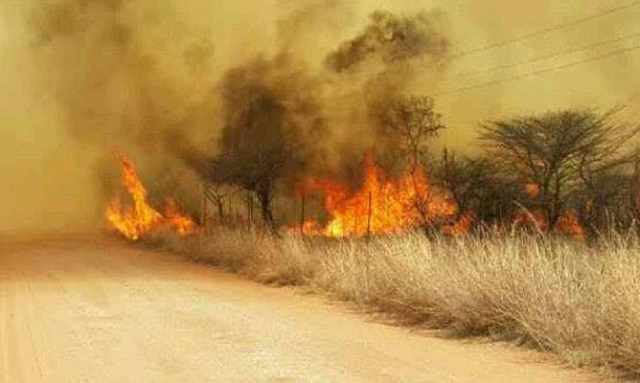
LAST week, a veld fire ravaged vast expanses of grazing land in the Somabhula area of Midlands Province. It was a saddening sight to see a very critical component of livestock survival being razed to ashes due to one careless incident.
It is no secret that Somabhula that is characterised by large open lands with very minimal tree cover has been providing most of the hay bales sold in Bulawayo and the surrounding areas, which are experiencing arguably the most drought in recent history.
It is common to see huge trucks ferrying hay bales from the Somabhula area to different parts of the Matabeleland region, in fact, depots of hay bales have mushroomed in Bulawayo City as enterprising individuals cash in, from the desperation of livestock farmers.
It is thus sad and frightening to see a critical source of hay going up in flames due to a veld fire and predictably the market responded immediately with hay bales increasing by at least 10 cents in price.
One can only posit that hay bales, which had remained stable in both price and supply will suddenly become scarce and pricey due to a decrease in supply as a result of this veld fire. This pen pleads with communities in places of abundance in so far as hay bales are concerned, to guard and keep this critical resource for the benefit of the nation in general and livestock farmers in particular.
It is easy not to value something especially if you have it in excess but believe you me, gold is currently of less value to the livestock farmer compared to hay bales.
This is also a call to the regulatory authorities like the Environmental Management Agency (EMA) to take firm punitive measures on culprits who start veld fires like the Somabhula veld fire.
Farmers without fire guards should not be spared, they make an otherwise harmless and easy-to-control fire, spiral out of control with dire consequences to the environment and the welfare of livestock.
We are approaching the last three most critical dry season months, from September to November and livestock farmers need all the support they can get including access to hay bales.
Talking of support to livestock farmers for drought mitigation, this pen wishes to acknowledge and applaud the Government’s efforts in that regard. I am aware that pursuant to its drought mitigation strategy, the Government has started distributing feed towards drought mitigation centres, with one district in Matabeleland North Province having recently received feed for distribution to livestock farmers.
I have previously lamented the general lethargic response to drought situation by both the Government and its development partners but am very happy to eat my words this time around as the Government seems to have responded in time to avert a looming catastrophe.
One hopes that development partners will also follow suit and provide this critical support to livestock farmers in time to save animals from poverty deaths.
The Government alone is unlikely to be able to adequately meet the demands of livestock farmers but support from development partners will definitely go a long way to ease the burden. It is an all-hands-on-deck type of approach, which will save our farmers from a disaster of their lifetime.
The private sector should also be responsive and less rigid. Why should a farmer from Matulungundu in Gwanda South go to Gwanda Town to get stockfeed? Livestock farming happens in communal areas not in towns, let’s take the feed there.
This is the time when stockfeed suppliers and retailers need to think outside the box and bring innovative ways of getting the feed to the users.
As an example, why can’t stock feed retailers have mobile sales where a 30-tonne truck can go to specific rural business centres on specific dates and have farmers buying from there?
Several smallholder farmers buying small quantities aggregate into a huge order, which can justify delivery at the farm gate, which in this case is a local business centre.
It is paramount for all players in the value chain to find a way of making stock feed easily accessible and save our national herd, otherwise many can be driven into either extinction or bankruptcy as the livestock industry takes a heavy knock from this phenomenal drought on our doorstep.
Uyabonga umntaka MaKhumalo.
Mhlupheki Dube is a livestock specialist and farmer. He writes in his capacity. Feedback [email protected] <mailto:[email protected]> cell 0772851275.


 Online Reporter