Chronicle Editor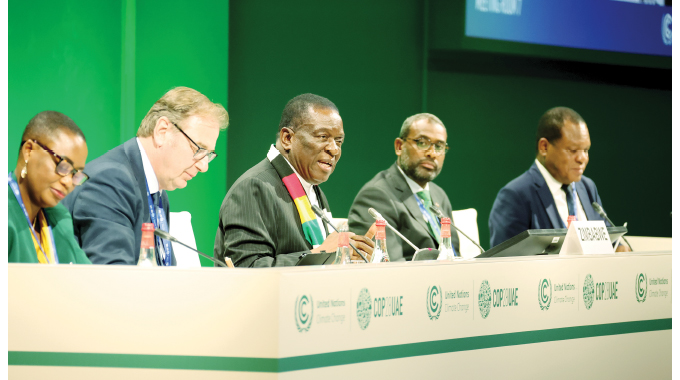
Leonard Ncube, Senior Reporter
THE annual global climate summit, the 28th United Nations Framework Convention on Climate Change, commonly known as COP28, ended in Dubai recently with countries endorsing a call to transition from fossil fuel usage to renewable energy towards net zero by 2050.
The global north celebrated the outcome as the “beginning to an end” of the fossil fuel era by laying the ground for a swift, just and equitable transition which will result in reduced emissions and scaled up finance, according to a report by the United Nations.
In a demonstration of solidarity, negotiators gathered at the summit with the general aim of addressing some climate action issues towards a 1,5 degrees Celsius limit.
However, to the global south, the outcome of the two-week-long summit does not reflect the aspirations of the developing world whose desire was to see commitment in climate financing and a just transition that would allow economies to transition without being affected.
Zimbabwe was among nearly 200 countries whose political, business, private sector and civic society leaders met at the Expo City, Dubai, in the United Arab Emirates.
There were over 85 000 participants who ignited the Expo City and the whole of Dubai, boosting tourism for the UAE’s populous and action packed city.

Dubbed action COP, the COP28 was expected to ratify the importance of collective action to stop climate change and the critical role of finance in low-carbon transition and renewables.
The overarching aim was and remains to keep the global temperature limit of 1,5 degrees Celsius within reach.
Already, 2023 was said to be the hottest year in historic weather patterns and most countries are staring serious drought due to the El Nino condition that has been causing serious heat waves.
Countries were represented by negotiators and thought leaders whose engagements illuminated corporate progress towards global climate goals and pathways for climate finance, biodiversity, phasing out of coal fired power, renewable energy financing, evolution of carbon markets, adaptation and global stock take.
The question remains whether the conference achieved its targets and if there is justice in the transition, especially looking at the fact that the developed world realised growth through fossil fuels and oil which the developing world has not benefited from.
Developed countries, in the process of exploiting fossils and oil for development of their nations, polluted the atmosphere and caused global warming which has caused the climate change which is affecting third world countries including African nations.
Developing countries are responsible for less than five percent of global warming yet they suffer the most from the effect of climate change with endless droughts, recurrent floods, pandemics and diseases.
African nations formed the African Group of Negotiators which was chaired by Zambia Minister of Environment Collins Nzovu in an effort to have a collective voice as a continent.
Some have called for use of nuclear energy saying it is the most efficient and clean source.
Climate finance took centre stage at COP28 as countries pledged new funding and the total pledges now stand at US$12,8 billion from 31 countries.
Commitments of US$174 million were made to the Least Developed Countries Fund and Special Climate Change Fund while US$188 million pledges were also made to the Adaptation Fund, although the financial pledges remain a drop in the ocean compared to what is needed to support developing countries in the transition to clean energy and implementation of their NDCs.
Fossil fuels were on the table for the first time at COP and the decision that came leaves the world divided, with Africa on one hand feeling the decision is unjust because developed countries have since benefited from oil and fossils while they are far behind in terms of technology, financing and economic growth.
There are concerns about fissures that exhibited during the course of the summit where the Green Zone and Blue Zone negotiators hardly concurred and the final day of the COP28 summit saw negotiators going for a 24-hour stalemate.
Developed nations and their private sector were constantly on the same page while the position of developing nations, particularly Africa, was clearly overlooked or not supported.

“While we did not turn the page on the fossil fuel era, this outcome is the beginning of the end. Now governments and businesses need to turn these pledges into real economic outcomes without delay,” said UN climate change executive secretary Mr Simon Stiell in a closing speech.
The summit started with a World Climate Action Summit which was attended by more than 150 Heads of State and Government, including President Mnangagwa who joined his counterparts from across the globe and discussed the operationalisation of the loss and damage fund and financing mechanism.
This paved the way for commitments with developed countries pledging to finance the loss and damage fund.
The United Nations Office for Disaster Risk Reduction and the UN Office for Project Services will host the secretariat of the Santiago Network for Loss and Damage and as well as be a platform for catalysing technical help for the global south which is suffering the effects of climate change.
The global Goal on Adaptation was also agreed upon to ensure resilience to the impacts of changing climate and spells out the need for financing, technology and capacity building, which is what African countries are fighting for in line with the outcomes of the COP26 in Glasgow.
President Mnangagwa said Zimbabwe and Africa as a whole did not warm the globe yet they were bearing the burden of climate change caused by developed countries.
King Charles of England also attended, but USA’s Joe Biden was conspicuous by his absence, with critics saying climate action decisions cannot be far from the political economy of the world.
King Charles speaking at the high level session said dealing with climate change is a huge task.

“The hope of the world lies in the decisions you (negotiators) will take. Bring together the public and private sector in dealing with climate change. Let’s accelerate innovation and deployment of renewable energy and regenerative agriculture because we want a future that is in harmony with nature,” he said.
What is missing in his words is harmony between developed and developing countries who feel hard done by the outcome of the summit.
Brazilian President Luiz Inacio Lula da Silva said the generation that destroys the environment is not the one that pays the price, as he warned about destroying the environment which should be kept in its pristine nature for future generations.
Tanzanian President Samia Suluhu Hassan made an appeal to create hope for Africa saying climate financing was one way of creating hope for the continent.
All governments and businesses need to turn the pledges into real economic outcomes with developed countries owning up the US$100 billion pledge made at previous COP meetings.
While not satisfied by the outcome, developing countries should use the outcome to develop stronger climate action plans that are due by 2025.
Youths were also significant participants at the summit and used music and various forms of art to advocate for just transition and climate financing to allow for management of the environment.
The AGN raised a number of critical key issues such as water, food, health, ecosystems, infrastructure, poverty and culture.
AGN chair Minister Nzovu said they were waiting for the final text to be made official on the outcomes.
“What has come out clear is the establishment of an annual ministerial dialogue and calls for an annual report from developed countries on the delivery of the doubling of adaptation finance, setting the tone for accountability.
“The text includes an unprecedented reference to a transition away from all fossil fuels enabling the world to reach net zero by 2050,” he said.
Energy is the number one challenge in Africa and the African Union has urged private and public sectors to accelerate energy growth.
Oil and gas will play a critical role in Africa’s economy as the continent has not yet had a chance to transform its economies through natural resources which developed countries used to cause global warming.
Africa Voluntary Carbon Credits Forum executive director Mr Anglistone Sibanda said there is a need for the global south to understand the geo-political dynamics and that Africa is never on the table but on the menu at the UN platforms.


 Online Reporter