admin
admin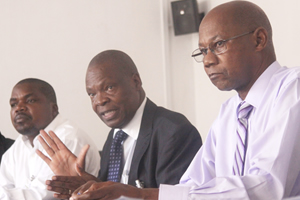
told Parliament that the city did not have capacity to treat the raw sewage due to limited resources.
Harare uses eight treatment chemicals to clean water.
Dr Mahachi, who was giving oral evidence before the Parliamentary Portfolio Committee on Environment and Natural
Resources, chaired by Tsholotsho South MP Mr Maxwell Dube (MDC), said the treatment of a third of raw sewage was a major improvement since they took over from Zinwa in 2009.
There was no treatment of sewage at all then.
Treasury gave council US$17,1 million to upgrade and replace sewer pipes in 2010.
“The sewer reticulation for the City of Harare is not for the current population. It was meant for a population that is much less than the current one,” he said.
“The main treatment works is able to treat 154 mega litres per day. What we have been able to do now is that it treats 54 mega litres a day from the zero treatment that was there in 2009.”
Murehwa West MP Mr Ward Nezi said tap water was not clean and in some cases it smelt like effluent. But Dr Mahachi insisted that the water was clean and met the World
Health Organisation standards.
Meanwhile, a South African company, Zetachem, recently met Mayor Muchadeyi Masunda and made a presentation of the chemical and offered to do free trials.
Mr Masunda reported the matter to a recent full council meeting expressing hope that the chemical could be the answer to Harare’s efforts to reduce water treatment costs.
He said if the trial is satisfactory, the company will be asked to tender for a supply contract like other suppliers.
Initial trials were held in September and October last year with positive results.
The chemical, a coagulant and flocculent, has capacity to eliminate the use of aluminum sulphate, activated silica, sulphiric acid and lime.
Four other chemicals will however, remain in use.
Council also discharges two thirds of its raw sewage into Manyame River while Chitungwiza discharges its raw sewage into Nyatsime River.
Harare uses up to 150 tonnes of liquid aluminum sulphate a day or 80 tonnes of powder aluminum.
Tests indicated that 30 tonnes of Zetafloc 4030 can replace the aluminum quantities completely.
Monthly costs of the four chemicals are estimated at US$1,6 million while with Zetafloc 4030 Harare will need US$970 200 per month.
According to the presentation, the chemical will result in 40 percent savings while eliminating the labour of dissolving huge amounts of aluminum sulphate and the inhalation of dust.
Unicef country representative Dr Peter Salama yesterday said 11 out of the 20 local authorities have so far officially confirmed their preparedness to takeover the responsibility.
The rest have however, responded verbally.
“The Unicef support to the water treatment chemicals, began of course as an emergency response measure to the cholera outbreak and let us remember that nowhere in the world has Unicef supported water treatment chemicals for governments because that’s really their responsibility.”
Dr Salama said the Emergency Rehabilitation and Risk Reduction programme, which incorporates water treatment chemical support to local authorities and rehabilitation of water treatment plants started in 2009 and was expected to end in June 2010.
However, it was postponed twice to June 2011 and subsequently March 2012.
He said under the direction of the Ministry of Water Resources Development and Management and the Ministry of Local Government, Rural and Urban Development they agreed to stop the programme tomorrow.
“The situation is much better now, we got official confirmation from 11 out of 20 local authorities that they are ready and willing to take over, including Harare and Bulawayo,
the major cities. The others have unofficially said they are also ready,” Dr Salama said.
Bulawayo, Chegutu, Gweru, Harare, Kadoma, Kariba, Kwekwe, Marondera, Masvingo, Victoria Falls and Zvishavane have officially communicated that they are ready to take over.
Dr Salama said since 2009 and 2011, Unicef has spent US$64,3 million in Zimbabwe in the water and sanitation sector with the major donor being the Australian Government.
“We were there to support them in monitoring the situation or procurement of chemicals because we realised that we have been able to procure water treatment chemicals at a lower price,” Dr Salama said.
He commended efforts by the Government, donors and civil society in combating cholera since 2008, a development that has seen a significant reduction in cholera cases compared to the 2008-2009 period.
During that period, cholera claimed about 4 000 lives. Over 100 000 people were treated of the disease.
In contrast, Dr Salama said there has not been a confirmed cholera case since mid 2011.
Harare is currently battling a typhoid outbreak that has affected 2 000 people.
Dr Salama said it does demonstrate that the water reticulation system is still fragile.
He said Zimbabwe has sophisticated urban water infrastructure, which requires millions of dollars to repair.



 Online Reporter