Remember Deketeke, Zimpapers Correspondent
FAMILIES who watched their homes reduced to rubble despite having acquired land through legally recognised processes must be compensated by local authorities found to have unlawfully demolished their properties, Government has said.
This comes as Government has directed all 92 local authorities across the country to immediately suspend demolitions and engage affected parties in negotiations, in a move aimed at protecting residents while efforts to regularise properties and settlements are pursued.
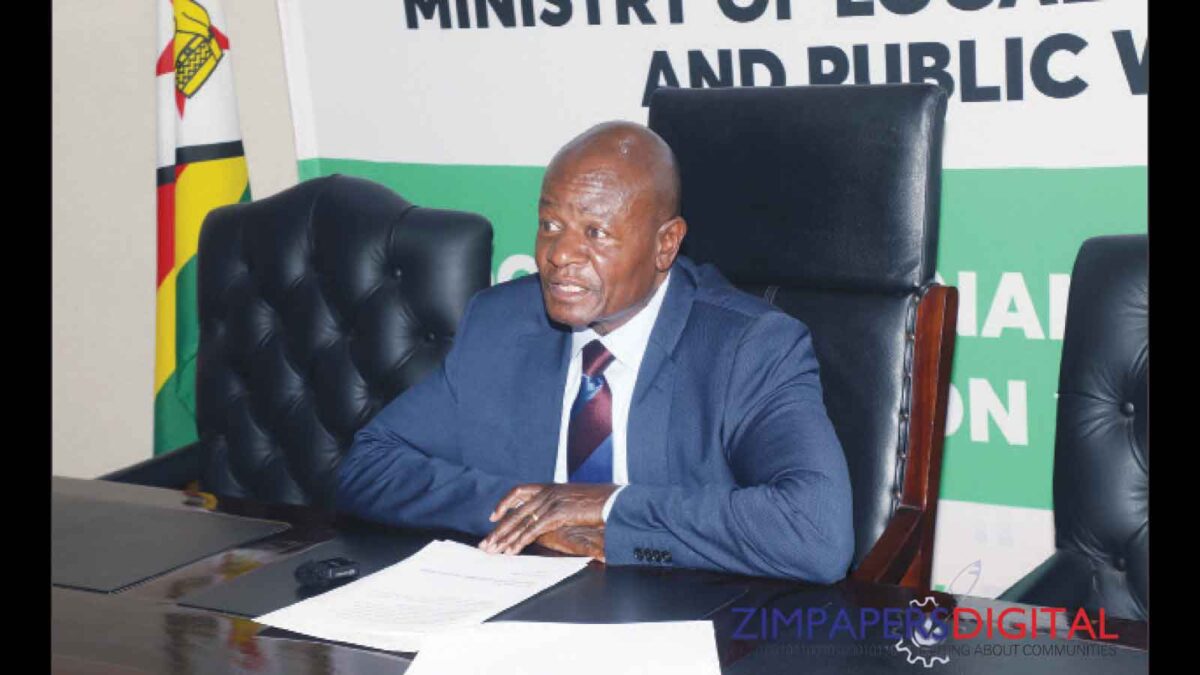
In an interview with ZTN Prime yesterday, Local Government and Public Works Minister Daniel Garwe said councils must take responsibility for irregular demolitions, with affected residents urged to produce documentation to substantiate their claims and access compensation.
Minister Garwe said Urban Councils Association of Zimbabwe (UCAZ) president Harare Mayor Jacob Mafume had invited affected residents to submit documents showing that they had acquired land and obtained approved building plans before their properties were demolished.
“The mayor has invited those whose houses could have been irregularly demolished to come with the documentation to prove that while the land was irregular, the approved plans were there,” he said.

He said a compensation framework was being developed to consider different circumstances, including land ownership and the approval status of properties, before determining the appropriate remedies.
Minister Garwe urged affected residents to give local authorities an opportunity to undertake due process, saying Government would monitor the exercise and assist where necessary.
His remarks reinforce the position taken by Mayor Mafume, who said local authorities could be held financially liable where residents successfully proved that their properties had been unlawfully destroyed.
Addressing journalists on Tuesday, Mayor Mafume said councils had a responsibility to consider the plight of residents affected by demolitions and facilitate compensation where wrongdoing was established.
“Nothing is perfect. No institution can provide perfection in its application of the law. We look at everything that has affected any resident or anybody within a particular locality, and we look at compensating that individual once they prove their claim at law,” he said.
He said compensation was not an act of goodwill where a local authority had unlawfully destroyed someone’s property, but a legal obligation.
“For as long as the particular individual can prove that the action taken was unlawful and in violation of the law, then you compensate. Where you have wronged an individual or a group of individuals, you are liable to compensate,” Mayor Mafume said.
The compensation debate is particularly significant for families in areas such as St Martins, where some residents say they acquired stands through official City of Harare processes, paid for the land and received allocation documents before their houses were demolished.
For such families, the destruction of their homes raises questions about why residents should bear the financial consequences of decisions and transactions involving institutions entrusted with administering urban land.
Combined Harare Residents Association director Mr Reuben Akili has also called for compensation, arguing that residents should not be made to suffer for transactions in which local authorities themselves were involved.
Early this week, Minister Garwe said that Government had communicated the directive through the representative bodies of local authorities to ensure compliance across the country.
“We have directed…all 32 urban local authorities to suspend any form of demolition.
“If there are any sticking issues, they should provide time for the parties to negotiate. That is number one,” he said.
Minister Garwe said Government was concerned about anxiety among residents but maintained that some reports of demolitions circulating on social media were misleading, with several cases involving disputes between private parties rather than local authority enforcement.
“The demolitions that are being talked about, some of them are fictitious. The majority are basically false alarm bells being rung.
“If there are any demolitions, they are between private sector members who have taken each other to court, and we are encouraging negotiations instead of demolitions,” he said.