Tawanda Musarurwa, Zimpapers Business Hub
THE Government remains confident the economy will achieve the five percent growth target this year despite mounting pressures from global geopolitical tensions and El Niño-induced drought risks, Finance Minister Professor Mthuli Ncube has said.
During the first nine months of the year 2026, the economy is estimated to have recorded robust economic growth.
This is evidenced by an estimated annualised half-year growth of 4,8 percent, mainly driven by agriculture, manufacturing and wholesale and retail trade.
Amid strong performance across all key indicators, growth is forecast to remain strong in 2027, but slow down to 3,5 percent due to the impact of the projected drought on agriculture, a key anchor of Zimbabwe’s economy.
The projected economic slowdown in 2027 follows bullish growth of 8,3 percent in 2025, which Minister Ncube said was the fastest in the Southern African Development Community (SADC) and second fastest in Africa.
Next year’s growth will be mainly underpinned by construction sector growth (5,5 percent), manufacturing (5,2 percent), mining and quarrying (5,1 percent), as well as wholesale and retail trade (4,7 percent).
While agriculture will likely be moderated by the super El Niño, the Government’s mitigation strategy through accelerated expansion of irrigation infrastructure, alongside other climate-resilience measures, is expected to cushion the sector, safeguard food security and contain the impact of drought on livelihoods.
The economy is also expected to register strong expansion premised on several key assumptions. These include entrenched macroeconomic stability, underpinned by prudent fiscal and monetary policies, sustained mineral output performance, beneficiation and ongoing investments in the sector, continued implementation of doing business reforms to improve the investment climate and agricultural resilience initiatives.
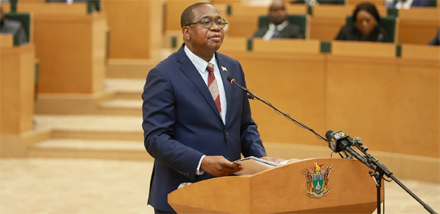
Presenting the 2027 National Budget Statement at the New Parliament Building in Mt Hampden yesterday, the Treasury chief said growth will accelerate to 5,8 percent in 2028.
“In 2027, economic growth is projected to moderate to 3,5 percent, largely reflecting the impact of the super El Niño and the drought-related risks,” Minister Ncube told Parliament.
According to the 2027 budget assumption, the country is targeting growth of 5,8 percent in 2028, 5,3 percent in 2029 and 5 percent in 2030.
The economy will expand to about US$66 billion in 2026, more than double the US$21 billion recorded in 2019, Minister Ncube said.
Strong growth has pushed the country’s gross national income (GNI) per capita to approximately US$4 100, the 7th highest in Africa.
This puts Zimbabwe on a strong footing to achieve its Vision 2030 target of upper-middle income status.
Zimbabwe’s economy grew by 4,8 percent in the first nine months of 2026, Minister Ncube said, and remains firmly on course towards the Government’s full-year target of 5 percent. Minister Ncube said price and exchange rate stability were the basis for the recovery.
“Prudent fiscal policy and complementary monetary policy resulted in durable price and exchange rate stability, despite fuel price pressures arising from geopolitical tensions,” Minister Ncube said.
ZiG annual inflation averaged 4 percent in the first 10 months of 2026, and inflation in both currencies is projected to stay in single digits in 2027.
Annual US dollar inflation was 3,2 percent in October, up from 0,9 percent in February. Foreign currency receipts rose 33,7 percent to US$15,9 billion in the first nine months of 2026. Export proceeds increased by 56,6 percent to US$11 billion, accounting for 69,4 percent of the total.
Diaspora remittances rose 39,9 percent to US$2,5 billion and foreign investment rose 122,8 percent to US$409,9 million, though that is still 2,6 percent of receipts. The current account surplus reached US$1,38 billion in the third quarter, the largest of the 11 quarters charted in the Budget.
Minister Ncube projected a full-year 2026 surplus above US$3,5 billion, against US$2,1 billion in 2025.
He expects it to narrow to US$3,4 billion in 2027. Remittances are projected to pass US$3,2 billion in 2026 and US$3,4 billion in 2027. The inflows are less diversified than the headline suggests.
Non-governmental organisation inflows fell 44,7 percent to US$453,8 million, and private loan proceeds fell 28,9 percent to US$1,39 billion. According to Minister Ncube, Government revenue reached ZiG224,7 billion in the nine months to September, 78,1 percent of the full-year target.
Spending was ZiG188,7 billion, or 64,9 percent of the budget, so part of the surplus reflects timing and may narrow as spending catches up. The minister said the windfall went to “reducing some of the arrears to service providers, debt servicing and accumulation of buffers, as contingency against the potential impact of the anticipated El-Nino-induced drought in 2027.”
The 2027 budget includes a US$400 million (ZiG10,9 billion) contingency against “more severe shocks, especially the super El-Nino drought,” to be financed from the 2026 buffers.
The Government has also subscribed to African Risk Capacity sovereign drought insurance at a premium of US$3,4 million.
The Grain Marketing Board had already procured 365 000 tonnes of grain by the end of October, towards the national strategic reserve target of 600 000 tonnes. Banks enter the drought year with a non-performing loan ratio of 3 percent, against a 5 percent benchmark.
Foreign currency account deposits have risen from US$0,7 billion in 2020 to US$5,5 billion in 2026.
Minister Ncube said the economy had eliminated load shedding after going for over 300 days without power cuts.
The 2027 National Budget projects revenue of ZiG349,5 billion in 2027, or 18,1 percent of gross domestic product, against expenditure of ZiG358,3 billion.
That implies a deficit of 0,5 percent of GDP. Capital expenditure is set to rise about 79 percent to ZiG73,6 billion and interest payments are projected at 2,6 percent of revenue.
Public and publicly guaranteed debt was US$22,2 billion at the end of September, or 33,4 percent of projected GDP.
Arrears and penalties on that debt exceed US$11 billion.
“The hard-won gains, particularly macroeconomic stability, must be protected and further entrenched,” Minister Ncube said.